
UNITED STATES
SECURITIES AND EXCHANGE COMMISSION
Washington, D.C. 20549
FORM
Annual Report Pursuant to Section 13 or 15(d) of the Securities Exchange Act of 1934 | |
For the fiscal year ended | |
Transition Report Pursuant to Section 13 or 15(d) of the Securities Exchange Act of 1934 | |
For the transition period from to | |
Commission file number
(Exact name of registrant as specified in its charter)
(State or other jurisdiction of incorporation or organization) | (I.R.S. Employer Identification No.) |
(Address of Principal Executive Offices) | (Zip Code) |
Registrant’s telephone number, including area code: ( | |
Securities registered pursuant to Section 12(b) of the Act:
Title of Class | Trading Symbol(s) | Name of each exchange on which registered | |
Securities registered pursuant to Section 12(g) of the Act:
None
Indicate by check mark if the registrant is a well-known seasoned issuer, as defined in Rule 405 of the Securities Act.
Indicate by check mark if the registrant is not required to file reports pursuant to Section 13 or 15(d) of the Act. Yes ◻
Indicate by check mark whether the registrant (1) has filed all reports required to be filed by Section 13 or 15(d) of the Securities Exchange Act of 1934 during the preceding 12 months (or for such shorter period that the registrant was required to file such reports), and (2) has been subject to such filing requirements for the past 90 days.
Indicate by check mark whether the registrant has submitted electronically every Interactive Data File required to be submitted pursuant to Rule 405 of Regulation S-T (§232.405 of this chapter) during the preceding 12 months (or for such shorter period that the registrant was required to submit such files).
Indicate by check mark whether the registrant is a large accelerated filer, an accelerated filer, a non-accelerated filer, a smaller reporting company, or an emerging growth company. See the definitions of “large accelerated filer,” “accelerated filer,” “smaller reporting company,” and “emerging growth company” in Rule 12b-2 of the Exchange Act.
Non-accelerated filer ◻ Emerging growth company
If an emerging growth company, indicate by check mark if the registrant has elected not to use the extended transition period for complying with any new or revised financial accounting standards provided pursuant to Section 13(a) of the Exchange Act. ◻
Indicate by check mark whether the registrant has filed a report on and attestation to its management’s assessment of the effectiveness of its internal control over financial reporting under Section 404(b) of the Sarbanes-Oxley Act (15 U.S.C. 7262(b)) by the registered public accounting firm that prepared or issued its audit report.
If securities are registered pursuant to Section 12(b) of the Act, indicate by check mark whether the financial statements of the registrant included in the filing reflect the correction of an error to previously issued financial statements.
Indicate by check mark whether any of those error corrections are restatements that required a recovery analysis of incentive-based compensation received by any of the registrant’s executive officers during the relevant recovery period pursuant to §240.10D-1(b). ☐
Indicate by check mark whether the registrant is a shell company (as defined in Rule 12b-2 of the Act). Yes
The aggregate market value of the voting stock held by non-affiliates of the registrant, based on the closing price on the NASDAQ Global Select Market on November 1, 2025 was approximately $
As of June 24, 2026, the issuer had
DOCUMENTS INCORPORATED BY REFERENCE
Portions of the registrant’s definitive proxy statement to be filed with the Securities and Exchange Commission pursuant to Regulation 14A not later than 120 days after the conclusion of the registrant’s fiscal year ended April 30, 2026, are incorporated by reference into Part III of this Form 10-K.
AEROVIRONMENT, INC.
INDEX TO FORM 10-K
1
PART I
Forward-Looking Statements
This Annual Report on Form 10-K (“Annual Report”), contains forward-looking statements, which reflect our current views about future events and financial results. We have made these statements in reliance on the safe harbor created by the Private Securities Litigation Reform Act of 1995 (set forth in Section 27A of the Securities Act of 1933, as amended (the “Securities Act”) and Section 21E of the Securities Exchange Act of 1934, as amended (the “Exchange Act”)). Forward-looking statements include our views on future financial results, financing sources, product development, capital requirements, market growth and the like, and are generally identified by terms including, but not limited to, “may,” “will,” “should,” “could,” “targets,” “projects,” “predicts,” “contemplates,” “anticipates,” “believes,” “estimates,” “expects,” “intends,” “plans,” “forecasts,” “seeks” and similar words. Forward-looking statements are merely predictions and therefore inherently subject to uncertainties and other factors which could cause the actual results to differ materially from the forward-looking statement. These uncertainties and other factors include, among other things:
| ● | unexpected technical and marketing difficulties inherent in major research and product development efforts; |
| ● | availability of U.S. government and allied government funding for defense procurement and research and development (“R&D”) programs and the changes in the timing and/or amount of government spending and our ability to win such programs; |
| ● | our reliance on certain customers, including the U.S. government and allied foreign governments, for a significant portion of our revenues; |
| ● | the extensive regulatory requirements governing our contracts with the U.S. government and international customers and the results of any audit or investigation of our compliance therewith; |
| ● | our ability to remain a market innovator, to create new market opportunities and/or to expand into new markets; |
| ● | the potential need for changes in our long-term strategy in response to future developments; |
| ● | our ability to attract and retain skilled employees, including retention of employees of acquired companies; |
| ● | unexpected changes in significant operating expenses, including components and raw materials; |
| ● | any disruptions or threatened disruptions to our relationships with our distributors, suppliers, customers and employees, including shortages of components for our products, whether due to restrictions and sanctions imposed by foreign governments or otherwise; |
| ● | changes in the supply, demand and/or prices for our products and services and our ability to perform under existing contracts and obtain new contracts and our ability to comply with the terms of such contracts; |
| ● | increased competition, including from firms that have substantially greater resources than we have and lower-cost manufacturers and service providers, including commercial manufacturers who may seek to enhance their systems’ capabilities over time; |
| ● | the complexities and uncertainty of obtaining and conducting international business, including export compliance and other reporting and compliance requirements; |
2
| ● | the impact of potential security and cyber threats or the risk of unauthorized access to our, our customers’ and/or our suppliers’ information and systems; |
| ● | changes in the regulatory environment and the consequences to our financial position, business and reputation that could result from failing to comply with such regulatory requirements; |
| ● | our ability to continue to successfully integrate acquired companies into our operations, including the ability to timely and sufficiently integrate international operations into our ongoing business and compliance programs; |
| ● | our ability to respond and adapt to unexpected legal, regulatory and government budgetary changes, such as supply chain disruptions, public health crises, curtailments of trade, diversions of government resources to non-defense priorities, and other business restrictions affecting our ability to manufacture and sell our products and provide our services; |
| ● | failure to develop new products or integrate new technology into current products; |
| ● | any increase in litigation activity or unfavorable results in legal proceedings, including pending class actions, or litigation that may arise from or in conjunction with our recent acquisitions; |
| ● | our ability to comply with the covenants in our loan documents, outstanding convertible notes or acquisition and merger agreements for acquisitions; |
| ● | failure to establish and maintain effective internal control over financial reporting; and |
| ● | general economic and business conditions in the United States and elsewhere in the world, including the impact of inflation. |
Set forth below in Item 1A, “Risk Factors” are additional significant uncertainties and other factors affecting forward-looking statements. The reader should understand that the uncertainties and other factors identified in this Annual Report are not a comprehensive list of all the uncertainties and other factors that may affect forward-looking statements. We do not undertake any obligation to update or revise any forward-looking statements or the list of uncertainties and other factors that could affect those statements.
Item 1. Business.
Overview
We are a defense technology provider delivering integrated capabilities across air, land, sea, space, and cyber. We develop and deploy autonomous systems, precision strike systems, counter-UAS technologies, space-based platforms, directed energy systems, and cyber and electronic warfare capabilities. We operate an international manufacturing footprint, delivering proven systems and capabilities in markets that we believe offer the potential for significant long-term growth. In addition, we believe that some of the innovative potential products, services and technologies in our R&D pipeline will emerge as new growth platforms in the future, creating additional market opportunities. Effective May 1, 2025 in connection with our acquisition of BlueHalo Financing Topco, LLC (“BlueHalo”), we operate our business in two reportable segments: (1) Autonomous Systems (“AxS”) and (2) Space, Cyber and Directed Energy (“SCDE”).
Autonomous Systems
Uncrewed Aircraft Systems (“UAS"). Our family of uncrewed systems includes Group 1-3 UAS which are deployed globally and offer multi-mission capability, autonomy, versatility, reliability and ease of use, providing the warfighter with critical situational awareness.
3
| ● | Small UAS (“SUAS”): Small UAS in Groups 1 and 2 are designed for reliable operation at low altitudes, offering real-time observation and communication capabilities with easy transport, assembly, and quiet electric propulsion. Products include Puma LE, Puma 3 AE, Puma VTOL, P550, Raven B, and VAPOR 55 CLE. Systems within the SUAS portfolio utilize our common and interoperable handheld ground control systems and an array of spare parts and accessories. |
| ● | Medium UAS (“MUAS”): Our Group 3 solutions include the JUMP 20, JUMP 20-X, and T-20. All are field-deployable and deliver extended endurance and increased payload capacity to unlock a broader set of uncrewed missions. |
| ● | AV_Halo Command and Control Software: AV_Halo, including Kinesis Command and Control Software, is a modular, hardware-agnostic software ecosystem built to orchestrate operations across air, land, sea, space, and cyber domains. The software stack is a mission-ready suite of artificial intelligence (“AI”) powered software tools providing AI driven intelligence fusion and the ability to unify command and control, surveillance, targeting, and training under one integrated framework. |
Precision Strike and Defensive Systems (“PSDS”). This operating group includes our family of loitering munitions solutions (“LMS”) that deliver actionable intelligence and precision firepower modern warfighters need to achieve mission success across multiple domains and our One-Way Attack Platform, Red Dragon, a fully autonomous-capable UAS designed for precision one-way attack missions in high-threat, GPS-denied, and communications-degraded environments. Integrated Air and Missile Defense (“IAMD”), counter-UAS (“C-UAS”) capabilities in this group include our family of radio frequency detect and defeat counter drones as well as our kinetic C-UAS intercept products. Additionally, this group includes our Electronic Warfare (“EW”) solutions which provide critical tactical communication, geolocation and cyber effects capabilities utilizing modular architectures and open standards.
| ● | Precision Strike: Our Switchblade family includes the Switchblade 300, Switchblade 400 and Switchblade 600, which are LMS that provide portable, low-signature, precision strike capabilities against static or mobile targets and Blackwing, which provides intelligence, surveillance and reconnaissance (“ISR”) capabilities. Included in Precision Strike is our one-way attack offering, Red Dragon. The Red Dragon family of products offers an autonomous capable, GPS-denied, precision-strike, one-way attack UAS engineered for scalable production and deployment. Designed to operate in disrupted, disconnected, intermittent, and low-bandwidth conditions, it delivers resilience against advanced electronic warfare threats. In addition to these products, we recently launched Mayhem 10. Mayhem 10 is an autonomous, multi-role launched effect that can deploy from air, ground, and maritime platforms. It supports a wide range of mission effects, including ISR, EW, decoy, communications relay, and precision strike. |
| ● | Integrated Air and Missile Defense (“IAMD”): IAMD includes Radio Frequency (“RF”) and Kinetic C-UAS. Our Titan family of solutions provides comprehensive C-UAS RF capabilities comprising multiple detection modalities and highly effective RF defeat. The new Titan 4 system offers a smaller, lighter and more powerful RF-based solution improving in many critical ways on previous capabilities. Titan 4 offers advanced threat detection and rapid response, deploying within five minutes to identify and intercept hostile drones. This autonomous system, powered by AI and machine learning (“ML”), defeats Group 1 and 2 drones, providing non-specialist operators with comprehensive situational awareness and defensive capabilities against UAS threats. Titan SV MPV3 delivers comprehensive 360° surveillance, efficiently detecting malicious SUAS via cutting edge demodulation and decryption capabilities. Titan-MS (multi-sensor) is a multi-mission, multi-threat system pairing Titan 4 with radar and Electro-Optical/Infrared capabilities thereby providing multimodal detection and defeat suitable for fixed-site installations in air, sea, and land domains. Also included is our newest C-UAS kinetic interceptor, Freedom Eagle (“FE-1”). This next-generation C-UAS drone and air defense missile system provides enhanced lethality at range against Group 3 UAS and other large aerial threats, while seamlessly integrating with existing infrastructure and command and control systems. |
| ● | Electronic Warfare Systems: Our EW Systems are designed utilizing sensor open system architecture (“SOSA”) and modular open systems architecture (“MOSA”) standards as well as AI/ML technologies for RF signature analysis and automated detection and identification of out-of-band signals, enhancing system interoperability, modularity, and resilience to enable operational advantage across contested domains. This approach ensures seamless integration with existing defense infrastructures and allied systems, enabling cohesive and |
4
| collaborative operations. Key products include the SharkCage Tactical Chassis, which is an expeditionary command, control, communications, computers, cyber, intelligence, surveillance and reconnaissance (“C5ISR”)/EW chassis environmentally sealed to withstand the elements associated with land, air, and sea operations as well as the extreme temperature changes associated with airborne missions, and BlueFin Angler SDR which supports multiple signals of interest and third-party waveforms. |
Other. Included in “Other” is MacCready Works, our innovation engine where autonomy, AI, and advanced platform technologies converge to deliver next-generation capabilities; Unmanned Maritime (“UUV”); and Uncrewed Ground Systems (“UGV”).
| ● | MacCready Works: MacCready Works serves as our advanced concepts and innovation organization, focused on the rapid development, prototyping and maturation of unmanned systems and related technologies, underpinned by our perception and autonomy products of AVACORE and SPOTR-EDGE. MacCready Works supports our long term growth by developing new capabilities, enabling expansion into additional mission sets and markets, and helping sustain our competitive position in unmanned systems and related defense and commercial applications. For example, our recent one way attack system, Red Dragon, was conceptualized, developed and scaled within MacCready Works, as well as the WildCat Group 3 vertical take-off and landing (“VTOL”) UAS developed for the Defense Advanced Research Projects Agency (“DARPA”). |
| ● | Unmanned Maritime: Unmanned Maritime provides effective surveillance, reconnaissance, and mine detection in contested waters. The Mission Specialist Defender platform is a robust Remotely Operated Vehicle (“ROV”) designed for precise control of the vehicle position and orientation, heavier payloads, and demanding intervention, such as rendering unexploded ordnance safe or to search and retrieve evidence. The Mission Specialist Wraith is the next-generation platform with increased autonomy, scalability, and extended operational reach. The Pro 5 and Ally are modular underwater systems for diverse operational needs, combining speed, power, efficiency and agility. |
| ● | Uncrewed Ground Systems: Our UGV systems support complex explosive ordnance disposal (“EOD”) operations through multi-axis manipulation and integrated tool exchange capabilities. Our UGVs have proven themselves in a variety of dangerous applications including EOD and improvised explosive devices (“IED”), hazardous materials handling (“HAZMAT”), chemical, biological, radiological, nuclear and explosive (“CBRNE”) threat assessments and special weapons and tactics (“SWAT”) team operations. Products include tEODor EVO, Telemax EVO and our newly launched TOM 50 RE, a new, compact, backpackable UGV. |
Space, Cyber and Directed Energy
Space and Directed Energy. Space technology supports satellite operations and communications, missile warning systems, and space-based ISR. Directed energy C-UAS systems use high energy laser systems paired with AI/ML enabled sensing technology to track, identify, and defeat targets.
| ● | Digital beamforming technology: Our proprietary multi-band/beam software defined antenna (“MSDA”) tile allows simultaneous communication with multiple satellites across different frequency bands and provides agile, resilient, and modular solutions for next-generation space operations. This technology is deployed across the BADGER product providing agile, deployable multi-beam, multi-band antennas, offering a modular, reconfigurable digital phased array for satellite communications, telemetry and EW missions and the WASP product, which provides next generation technologies in satellite communications, telemetry, EW and radar employing multiple, independently steerable, simultaneous beams at diverse center frequencies and bandwidths supporting seamless interface with both new and existing antenna reflectors. |
| ● | Laser Communications: High-bandwidth, secure data transmission systems for modern space operations enable Low Probability of Intercept and Low Probability of Detect communications. |
| ● | Space-Qualified Hardware: Our trusted hardware delivered for mission critical capabilities includes line of sight stabilization and control electronics in Low Earth Orbit (“LEO”), Medium Earth Orbit (“MEO”), Geostationary |
5
| Earth Orbit (“GEO”), and cislunar orbits. We have over 260 systems currently in orbit, including angular rate sensors, fast steering mirrors, power system controllers, command and data handling, and spacecraft attitude determination and control units. |
| ● | Phased Array Antenna Technology: Our PANTHER family of systems supports hypersonic telemetry and tracking, and other missile testing. |
| ● | Directed Energy: The family of LOCUST Laser Weapon System (“LWS”) and LOCUST TATS both use advanced AI and engineering for an effective directed energy kill chain, tracking, identifying, and defeating targets with a high energy laser system. Designed for vehicle integration and roll-on/roll-off modularity and quick deployment, it is easily transported and integrated onto various platforms. The LOCUST X2 product has a 20 to 25-kilowatt range. The LOCUST X3 is a third-generation 20–35+ kilowatt directed energy laser weapon system designed to defeat current and emerging aerial threats, including Group 1–3 unmanned aircraft systems. |
Cyber and Mission Solutions. Our Cyber and Mission Solutions Group provides advanced cyber, intel, defense operations, and basic/applied R&D solutions that deliver mission-critical expertise and prototype development for U.S. defense, intelligence community, and national security customers.
| ● | Cyber: Our expertise spans offensive and defensive cyber capabilities, Geospatial Intelligence (“GEOINT”), Signals Intelligence (“SIGINT”), Measurement and Signature Intelligence (“MASINT”) as well as Open Source Intelligence (“OSINT”) analytics. Our cyber solutions are engineered to empower national security and defense operations with advanced tools and capabilities in both offensive and defensive cyber operations enabling full-spectrum warfare. |
| ● | Mission Solutions: We provide our customers including the Department of Defense (“DoD”) high-end engineering, scientific, and operational expertise and technology to enable multi-domain solutions to support all phases of system lifecycles. Additionally, our R&D capabilities are in alignment with the DoD’s six Critical Technology Areas of Applied Artificial Intelligence, Scaled Directed Energy, Scaled Hypersonics, Advanced Materials and Biomanufacturing, Battlefield Information Dominance, and Contested Logistics Technologies. |
Our Strategy
As a leading defense technology provider, our strategy is to grow our business by delivering innovative, mission-critical, safe and reliable multi-domain solutions tailored to our customers’ most pressing challenges. Delivering these capabilities enables us to create new markets, gain share in existing markets, and benefit from overall market expansion with increased adoption of these critical new technologies. Our strategy involves introducing new solutions, or acquiring differentiated solutions developed by others, to enhance the value we provide to customers, while supporting profitable growth across both existing and emerging markets. By providing differentiated solutions, we believe we are positioned to compete effectively against large, well-funded, and/or incumbent competitors that may possess advantages in scope, scale, resources and relationships. Key components of this strategy include the following:
Expand the market penetration of existing products and services. Our UAS, PSDS, Space and Directed Energy, Cyber and Mission Solutions and other businesses have gained reputations as performance leaders and technology innovators in their respective markets. We intend to increase the penetration of our products and services within the U.S. military, the militaries of allied nations, other government agencies and non-government organizations, including commercial entities. Our strategy is based on the expectation that continued adoption of our solutions by the U.S. military will stimulate demand among allied nations and that exploring new applications will generate opportunities beyond the initial military market.
Deliver innovative new solutions into existing and new markets. Customer focused innovation is the primary driver of our growth. We plan to continue investing in internally funded R&D projects while expanding our pursuit of customer-funded R&D projects to generate revenue and develop better, more capable products, services and business models, both in response to and in anticipation of emerging customer needs. In some cases, such innovations result in upgrades to existing offerings while expanding their value among existing customers and markets. In other
6
cases, such innovations become entirely new solutions that enable us to address new markets, customers and business opportunities.
We believe our strategy, which is focused on R&D investments, will allow us to deliver innovative new products and services that address market needs both within and beyond our current target markets, enabling the creation of new growth opportunities. We view strategic partnerships as a means by which to further the reach of our innovative solutions by accessing new markets, customers, and complementary capabilities. We also consider acquisitions as a method to obtain valuable products, capabilities or technologies that can further enable our growth strategy.
Foster our entrepreneurial culture and continue to attract, develop and retain highly-skilled personnel. Our company culture encourages innovation and entrepreneurship, which helps to attract and retain highly skilled mission-focused professionals. This culture encourages the development of innovative, highly technical system solutions and business models that give us our competitive advantage. Our values guide the behavior of our team members and help maintain a positive work environment that fosters loyalty among both employees and customers. These values also support the successful integration of new team members who join through acquisitions.
Preserve our agility and flexibility. We respond rapidly to evolving markets, address complex customer challenges, and aim to deliver new products, services, and capabilities quickly, efficiently, and affordably compared to available alternatives. We believe our agility and flexibility strengthen relationships with customers and partners and serve as key differentiators when competing against organizations with greater resources.
Effectively manage our growth portfolio for long-term value creation. Our production and development programs and services present numerous investment opportunities that are expected to deliver long-term growth by providing customers with valuable new capabilities. We evaluate each opportunity independently and against other investment opportunities, to determine its relative cost, timing and potential for generation of returns. This process helps us make informed decisions regarding potential growth capital requirements. It also supports our allocation of resources based on relative risks and returns to maximize long term value creation, which is the key objective of our value creation strategy. We regularly review our portfolio to determine if and when to narrow our focus on the highest potential opportunities and exit unattractive or non-core product lines.
Stay engaged with our key defense customers. We receive support from members within our Strategic Advisory Group (“SAG”), which provides executive level advice to our senior leaders on all matters relating to the DoD. SAG members are highly qualified former members of the U.S. DoD, including retired General and Flag Officers and Senior Executive Service members, each with many decades of experience. We also have a government relations team comprised of individuals with prior military, government and policy making experience who regularly meet with key decision makers within the Pentagon, Congress and other key organizations within the U.S. government. Our global business development organization seeks to understand customer needs, responds to information requests, submits proposals, solicits feedback on the performance of our products and services, furnishes spares, and provides training and customer support. Finally, our project and program managers work intimately with customers to oversee the design, development, testing, manufacturing and delivery of solutions the customers want and need.
Customers
We sell the majority of our products and services to the U.S. DoD, serving branches such as the U.S. Army, Marine Corps, Special Operations Command, Air Force, Navy, Space Force, and Cyber Command; the intelligence community agencies; federal and public safety agencies; allied governments and coalition partners through direct commercial sales or foreign military sales; and commercial customers, supporting critical infrastructure protection, open-source intelligence operations, and advanced research initiatives.
During our fiscal year ended April 30, 2026, we generated approximately 25% of our revenue from the U.S. Army pursuant to orders placed under contract by the U.S. Army on behalf of itself as well as for several other organizations within the U.S. DoD. For that same period, other U.S. government agencies and government subcontractors accounted for 47% of our sales revenue. However, no individual contract accounted for greater than 10% of funded backlog as of April 30, 2026.
7
Sales revenue to foreign customers, inclusive of foreign military sales made through the U.S. DoD, commercial and consumer customers accounted for 28% of sales revenue during our fiscal year ended April 30, 2026. No individual foreign country accounted for greater than 10% of total sales revenue during our fiscal year ended April 30, 2026.
Technology, Research and Development
Technological Competence and Intellectual Property
A component of our ongoing innovation is a screening process that helps our business managers identify early market needs, which assists us in making timely investments in critical technologies necessary to develop solutions to address these needs. Similarly, we manage new product and business concepts through a commercialization process that balances spending, resources, time and intellectual property considerations against market requirements and potential returns on investment. Strongly linking our technology and business development activities to customer needs in attractive growth markets constitutes an important element of this process. We constantly revisit our customer requirement assumptions to evaluate continued investment and to seek to ensure that our products and services deliver high value as well as high returns.
As of April 30, 2026 we had received and retained 407 U.S. patents, had 64 pending U.S. patent applications; and had numerous foreign patents and pending applications. In many cases, when appropriate and to preserve confidentiality, we opt to protect our intellectual property through trade secrets as opposed to filing for patent protection. We recently filed trademark applications for our new stylized corporate AV logo incorporating a halo feature, as well as the mark All Domain Dominance. Further, we have many U.S. registered trademarks including those for AeroVironment, AV, Switchblade, Raven, VAPOR, Arcturus UAV, JUMP, Tomahawk Robotics, and Kinesis, P550 QUANTIX, WASP, SNIPE, CRYSALIS, and have several pending applications for trademark registration.
The U.S. government licenses some of our intellectual property that was specifically developed in performance of government contracts and may use or authorize others to use this intellectual property. In some cases, we fund the development of certain intellectual property to maximize its value and limit its use by potential competitors. While the development and protection of our intellectual property are integral to the continued success of our business, the loss or limitation of rights to any particular piece of intellectual property would not be expected to have a material adverse effect on our overall business.
Research, Development and Commercialization of Projects
A core component of our business strategy is the focused development and commercialization of innovative solutions that we believe have the potential to become new products or services that create large new markets or accelerate growth within our existing markets. We invest in an active pipeline of these commercialization projects ranging in maturity from technology validation to early market adoption. We cannot predict when, if ever, we will successfully commercialize these projects, or the exact level of capital expenditures they could require, which could be substantial.
Technological Capabilities
Our core technological capabilities, developed by more than 50 years of innovation, include robotics and robotics systems autonomy; modular open systems architecture; sensor design, development, miniaturization and integration; embedded software and firmware; miniature, low power, secure wireless digital communications and networks; lightweight aerostructures; high-altitude systems design, integration and operations; machine vision, machine learning, AI and autonomy; land, maritime and air deployment of munitions and aircraft systems; design and qualification for robotics in extreme terrestrial and space environments; low SWaP (Size, Weight and Power) system design and integration; collaborative multi-robotic crewed and uncrewed mission operation; power electronics and electric propulsion systems; efficient electric power conversion, storage systems and high density energy packaging; controls and systems integration; vertical takeoff and landing for fixed wing and hybrid aircraft and rotocraft systems; image stabilization and target tracking; advanced flight control systems; fluid dynamics; human-machine interface
8
development; modular dismounted, networked multi-domain robotic control interfaces and analytic processing architecture; and integrated mission solutions for austere environments.
The BlueHalo acquisition significantly enhanced our core technological capabilities, which now include advanced RF system design and development, software defined digital phased array antennas and radars, space qualified electronics, laser communication technologies, software defined radios, electronic warfare technology, target acquisition and tracking, directed energy-based weapons systems for counter uncrewed systems, RF-based systems for counter uncrewed, next generation counter uncrewed system missile technology, extended reality and virtual reality systems for training, modeling and simulation, hardware in the loop simulations, C2 sensing and tracking, uncrewed maritime platforms, uncrewed aerial platforms, full spectrum cyber operations, tactical mission networks, multi-int data analytics and threat intelligence, tools and analytics for GEOINT, SIGNINT, MASINT and OSINT, aerospace power and propulsion, material and processes, directed energy, photonics and electronics, biological and nanoscale technology, and health and human performance.
Competition
We believe the principal competitive factors in the markets for our products and services include product performance; safety; innovative features; acquisition cost; lifetime operating cost, including maintenance and support; ease of use; rapid integration with existing equipment and processes; quality; reliability; customer support; and brand reputation. Several companies across the globe, primarily in the U.S., attempt to compete in our markets to some degree, although we believe none match the breadth and depth of our product lines nor our expertise in core capabilities.
The defense market for UAS continues to evolve in response to changing technologies, shifting customer needs and expectations and the potential introduction of new products. Our current principal competitors include Elbit Systems Ltd., Quantum-Systems, Inc., Redwire Corporation, Teledyne Technologies, Inc., Sierra Nevada Corporation, Lockheed Martin Corporation, The Boeing Company, Textron, Inc., Shield AI, Inc., Northrop Grumman Corporation, Griffon Aerospace, Inc., L3Harris Technologies, Inc., Anduril Industries, Inc., Airbus SE and Israeli Aircraft Industries.
The defense and technology markets for Precision Strike and Defensive products and solutions are highly competitive, evolving with rapid technological advancements and shifting customer needs. Competitors in the LMS market include Textron Inc., RTX Corporation, Lockheed Martin Corporation, Anduril Industries, Inc., Aevex Corp., SpektreWorks, Inc., Dragoon Technology LLC, Cummings Aerospace, Inc., Elbit Systems Ltd., and UVision Air Ltd. Competitors in the C-UAS and Electronic Warfare markets include Anduril Industries, Inc., The Boeing Company, Lockheed Martin Corporation, RTX Corporation, DroneShield Limited, SRC Inc., Polaris, Inc., CACI International Inc., Northrop Grumman Corporation, L3Harris Technologies, Inc., and other emerging technology firms and international players.
The space technology and directed energy market includes competitors such as The Boeing Company, Lockheed Martin Corporation, L3Harris Technologies, Inc., BAE Systems, Inc., nLIGHT, Inc., Epirus, Inc., EO Solutions Corporation, Huntington Ingalls Industries, Inc., and RTX Corporation. These companies have extensive experience and resources, offering satellite systems and spacecraft engineering solutions that compete with our offerings.
The cyber and mission solutions areas are highly competitive, with principal competitors including L3Harris Technologies, Inc., Thales Group, Anduril Industries, Inc., Sierra Nevada Corporation, Lockheed Martin Corporation, Booz Allen Hamilton Inc., and Leidos Holdings, Inc. We also face competition from specialized cybersecurity firms.
Manufacturing and Operations
We pursue a lean and efficient production strategy across our business, focusing on rapid prototyping and design, supply chain management, initial and final assembly, integration, quality and in-process/final acceptance testing. Using concurrent engineering techniques within an integrated product team structure, we rapidly prototype design concepts and products, while optimizing our designs to meet manufacturing requirements and mission capabilities which address rapidly evolving threats and customer specifications.
9
We continue to invest in infrastructure that has enabled us to meet growing demand and efficiently scale capacity to produce thousands of systems annually. By drawing upon experienced personnel across various manufacturing industries including aerospace, automotive and volume commodities, we have instituted lean production systems and leverage our International Organization for Standardization (“ISO”) certification for Quality Management Systems, integrated supply chain strategy, document control systems and process control methodologies for production. Our ISO 9001:2015 + AS9100D certified manufacturing facilities focus on continuous improvement in order to increase acceptance rates, reduce lead times, improve efficiency and lower cost.
We also provide customer service, support and training to ensure the safe and effective operation of our solutions in the field. We employ a “train the trainer” approach that enables subject matter experts within our customers to utilize our solutions at scale.
Seasonality
No material portion of our business is considered to be seasonal. Historically, revenue in the second half of our fiscal years has exceeded revenue in the first half and such trend is expected to continue in fiscal year 2027. The factors that affect our revenue recognition between accounting periods include the timing of new contract awards, the availability of U.S. government and international government funding, lead time to manufacture our systems to customer specification, customer acceptance and other regulatory requirements.
Raw Materials and Suppliers
We are dependent upon the availability of materials and major components and the performance of our suppliers. Historically, we have been successful in obtaining the materials required in our manufacturing processes. We seek to manage materials supply risk through long term non-binding agreements with certain key suppliers that help stabilize pricing, reduce lead times, enhance planning accuracy and, to some degree, mitigate risk. While we believe that all such raw materials and components are available to meet our needs from various suppliers, certain supply chain constraint trends, such as increased demand for domestic suppliers, could cause delays in production and development programs and negatively impact our operating results (see Item 1A, Risk Factors—“If critical components or raw materials used to manufacture our products or used in our development programs become scarce or unavailable, then we may incur delays in manufacturing and delivery of our products and in completing our development programs, which could damage our business,” for more information).
Human Capital Resources
We recognize our employees as the most invaluable assets of our company, serving as the cornerstone of our accomplishments. With this in mind, we endeavor to establish ourselves as an employer renowned for fostering a positive work environment that encourages personal development, ensures workplace safety and promotes opportunity. We firmly believe that such a corporate culture enhances employee satisfaction while also nurturing creativity and productivity, thereby driving our continuous innovation efforts. Central to our ethos is prioritizing the employee experience, a commitment underscored by our esteemed certification from the Great Place to Work Institute, Inc., designating us as a “Great Place to Work” each year since 2019.
Workforce Demographics
As of April 30, 2026, we had 3,991 full time employees and 100 part time employees, of whom 2,366 were in R&D and engineering, 181 were in sales and marketing, 637 were in operations and 907 were general and administrative personnel including over 208 employees with a PhD.
Talent Acquisition, Retention and Development
Our ability to attract, cultivate, and retain highly skilled individuals, particularly those with technical and engineering expertise and high-level security clearances, is paramount for the successful execution of our strategic objectives and the expansion of our enterprise. We maintain vigilant oversight of recruitment, employee retention, and
10
management practices. A pivotal component of our People and Culture strategy involves the recruitment of early-career professionals through collegiate programs and internships, with a specific focus on technical disciplines.
Furthermore, we engage in regular confidential surveys to gather insights from our workforce, using the feedback to enhance our organizational environment. Our commitment to our employees is demonstrated through competitive compensation packages, including performance incentives and recognition schemes that encompass all levels within our company. We prioritize the development of our workforce through educational initiatives, training programs, and support for further education and professional certifications. Moreover, we conduct succession planning for leadership roles to ensure the sustained cultivation of a talented management cadre essential for the realization of our strategic vision.
Employee Safety and Health
Our safety and health program enhances operational efficiency by offering tailored safety, health, and wellness initiatives. This program establishes secure working conditions, fosters a positive work atmosphere, enhances employee resilience, and bolsters the company's overall value. We diligently track employee health and safety metrics, setting monthly and annual goals to minimize work-related injuries and illnesses, thereby reducing the number of lost workdays and mitigating productivity setbacks resulting from such incidents. Furthermore, we extend health and wellness benefits to our employees for their well-being.
Backlog
Consistent with ASC Topic 606, Revenue from Contracts with Customers (“ASC 606”), we define funded backlog as remaining performance obligations under firm orders for which funding is currently appropriated to us under a customer contract. As of April 30, 2026 and 2025, our funded backlog was approximately $1,183.0 million and $726.6 million, respectively. We expect that approximately 85% of our backlog will be recognized as revenue during our fiscal year ending April 30, 2027.
In addition to funded backlog, we also had unfunded backlog of $1,457.7 million and $774.6 million as of April 30, 2026 and 2025, respectively. The increase in unfunded backlog is primarily due to the acquisition of BlueHalo. Unfunded backlog does not meet the definition of a performance obligation under ASC 606. We define unfunded backlog as the total remaining value of awarded contracts with incremental funding yet to be received. We do not include unfunded ceiling amounts for sole-source or multi-awardee Indefinite Delivery, Indefinite Quantity (“IDIQ”) contracts in unfunded backlog. Unfunded backlog does not obligate the customer to purchase goods or services. There can be no assurance that unfunded backlog will result in any orders in any particular period, or at all.
Because of possible future changes in delivery schedules and/or cancellations of orders, backlog at any particular date is not necessarily representative of actual sales to be expected for any succeeding period, and actual sales for the year may not meet or exceed the backlog represented. Our backlog is typically subject to large variations from quarter to quarter as existing contracts expire or are renewed or new contracts are awarded. Additionally, all U.S. government contracts included in backlog, whether or not they are funded, may be terminated at the convenience of the U.S. government.
Regulation
Due to the fact that we contract with the DoD and other agencies of the U.S. government, we are subject to extensive federal regulations, including the Federal Acquisition Regulations, Defense Federal Acquisitions Regulations, Truth in Negotiations Act, Foreign Corrupt Practices Act, False Claims Act and the regulations promulgated under the DoD Industrial Security Manual, which establishes the security guidelines for classified programs and facilities as well as individual security clearances. The federal government audits and reviews our performance on contracts, pricing practices, cost structure, and compliance with applicable laws, regulations and standards. Like most government contractors, our contracts are audited and reviewed on a continual basis by federal agencies, including the Defense Contract Management Agency (“DCMA”) and the Defense Contract Audit Agency (“DCAA”).
In addition, we are subject to industry specific regulations due to the nature of the products and services we provide. For example, certain aspects of our business are subject to further regulation by additional U.S. government
11
authorities, including (i) the Federal Aviation Administration (“FAA”), which regulates airspace for all air vehicles in the U.S. National Airspace System, (ii) the National Telecommunications and Information Administration and the Federal Communications Commission, which regulate the wireless communications upon which our UAS depend in the United States, (iii) the Defense Trade Controls of the U.S. Department of State that administers the International Traffic in Arms Regulations, which regulate the export of controlled technical data, defense articles and defense services, and (iv) the Export Administration Regulations as administered by the U.S. Department of Commerce’s Bureau of Industry and Security, which regulate the export of goods, software, and technology, including items that have dual-use for both commercial and military applications.
Certain of these regulations impose substantial penalties for violations, including suspension or debarment from government contracting or subcontracting for a period of time. Furthermore, our non-U.S. operations are subject to the laws and regulations of foreign jurisdictions, which may include regulations that are more stringent than those imposed by the U.S. government on our U.S. operations.
U.S. Government Contracting Process
We sell the majority of our products and services under contracts with the U.S. government. Most of our current U.S. government contracts were awarded through a competitive bidding process. The U.S. government awards competitive bid contracts based on proposal evaluation criteria established by the procuring agency. Competitive bid contracts are awarded after a formal bid and proposal competition among providers. Following award, competitive bid contracts may be challenged by unsuccessful bidders. The funding of U.S. government programs is subject to congressional appropriations. The U.S. military funds its contracts for our products either through operational need statements or as programs of record, defined as a program which, after undergoing extensive DoD review and product testing, is included in the five year government budget cycle.
Material U.S. Government Contract Provisions
All contracts with the U.S. government contain provisions, and are subject to laws and regulations, that give the government rights and remedies not typically found in commercial contracts, such as rights that allow the U.S. government to terminate existing contracts for convenience; terminate contracts for default upon the occurrence of certain enumerated events; unilaterally modify contracts with regard to certain performance requirements; cancel multi-year contracts and related orders, if funds for contract performance for any subsequent year become unavailable; potentially obtain rights in, or ownership to, intellectual property associated with products and systems developed or delivered by a contractor as a result of its performance of the contract; adjust contract costs and fees on the basis of audits completed by its agencies; suspend or debar a contractor from doing business with the U.S. government; and control or prohibit the export of certain items.
Compensation, if any, in the event of a termination for default is limited to payment for work completed at the time of termination. In the event of a termination for convenience, the contractor may receive the contract price for completed work, as well as its costs of performance of terminated work including an allowance for profit and reasonable termination settlement costs.
U.S. Government Contract Categories
There are three primary types of government contracts in our industry. These basic types of contracts are typically referred to as firm fixed price (“FFP”), cost-plus-fixed fee, cost-plus-award fee, and cost-plus-incentive fee (“Cost Plus”) and time and materials (“T&M”) contracts.
Fixed-Price. These contracts are not subject to adjustment by reason of costs incurred in the performance of the contract. With this type of contract, we assume the risk that we will not be able to perform at a cost below the fixed price, except for costs incurred because of contract changes ordered by the customer.
Cost Plus. These contracts reimburse allowable costs and include types such as cost-plus-fixed fee, cost-plus-award fee, and cost-plus-incentive fee. Under each type of contract, we assume the risk that we may not be able to
12
recover costs if they are not allowable under the contract terms or applicable regulations, or if the costs exceed the contract funding. They typically present lower profit margins and risk. Cost plus fixed fee contracts are cost reimbursable contracts that provide for payment of a negotiated fee that is fixed at the inception of the contract. A cost plus award fee contract is a cost reimbursable contract that provides for a fee consisting of a base amount, which may be zero, fixed at inception of the contract and an award amount, based upon the government’s satisfaction with the performance under the contract. A cost plus incentive fee contract is a cost reimbursable contract that provides for an initially negotiated fee to be adjusted later by a formula based on the relationship of total allowable costs to total target costs.
Time-and-Materials. Under these contracts, our compensation is based on a fixed hourly rate established for specified labor or skill categories. We risk reduce profitability if our actual costs exceed the costs incorporated into the fixed hourly labor rate. One variation of a standard T&M contract is a T&M, award fee contract. Under this type of contract, a positive or negative incentive can be earned based on achievement against specific performance metrics.
Additional key contract frameworks include the following:
Commercial Service Offerings (“CSO”). These contracts are for services that we typically sell or are prepared to sell to the general public or to non-governmental entities for purposes other than governmental purposes, and we offer to the U.S. Government price, terms and conditions similar to those offered to its commercial customers.
IDIQ and IDIQ Type Contract Form. The U.S. government frequently uses IDIQ and IDIQ type contracts to obtain contractual commitments to provide products or services over a period of time pursuant to established general terms and conditions. IDIQ and IDIQ type contracts typically have multi-year terms and unfunded ceiling amounts that enable, but do not commit, the U.S. government to purchase substantial amounts of products and services from one or more contractors.
Undefinitized Contractual Actions (“UCA”). Depending on the urgency of the project and the complexity of the contract negotiation, UCAs or Letter Contracts, Basic Ordering Agreements, or Provisional Item Orders are entered into prior to finalizing the terms of a definitive contract to allow for the contractor to immediately begin performing services and/or manufacturing products.
Unpriced Change Orders (“UCO”). UCOs are unilateral changes within the scope of a contract where the government and contractor have not reached an agreement on terms, specifications, and prices. This type of change order allows the project to continue without delay while the contractor and government negotiate final terms, specifications, and prices. The existing contract is formally modified to include an agreed-upon price and other adjustments related to the change order.
Other Transaction Authority (“OTA”). OTAs are legally binding instruments that are used to engage with non-traditional defense contractors and to facilitate the rapid development and deployment of innovative technologies. Unlike traditional government contracts, OTAs are not subject to the Federal Acquisition Regulation (FAR), providing greater flexibility in terms and conditions.
International Contracting Process
We supply our products and services to international allied governments. Each international customer has its own laws, regulations, bureaucracy and forms of procurement agreements that present challenges in our international contracting process. Our international contracts generally result from a competitive bidding process and, to a lesser extent, sole source awards for urgent requirements or sustainment. Competitive bid contracts are awarded after a formal bid and proposal competition among providers. International competitive bidding processes are highly competitive and sometimes we face disadvantages in the bidding and evaluation process in comparison to local, domestic bidders that may receive priority or more favorable evaluations than non-domestic suppliers due to stated requirements in the local regulations that promote domestic procurements. Sole source awards are direct engagements with the procuring agency. Generally, sole source awards are utilized by our existing customers to sustain or augment their use of our products, commonly through multi-year support agreements. These agreements allow for customer logistics organizations to tailor
13
procurement and support efforts to the needs of the end users. International funding processes vary, are generally allocated during the applicable country’s fiscal year, are often confidential, and may be broadly allocated or targeted for specific purposes, making it difficult to forecast demand. Many of our international customers have established fleets of our UAS, which generally allows them to seek and obtain budget for yearly incremental allocations of funding. These allocations are contracted through existing multi-year support agreements which provide the customer flexibility to procure products and services when funding is available.
Our typical international customer contracts take the form of fixed price contracts and time and materials contracts. Most of our international contracts are fixed-price contracts, as their finite nature is desired by customers. Time-and-materials contracts are more common for our service work with a defined limit on funding and period of performance. Contracts with international customers often include locally advantageous provisions differing from U.S. norms, potentially complicating enforcement and receivable collection. To minimize risks, we assess each contract individually and may require banking guarantees or advance payments.
International sales may be Foreign Military Sales (“FMS”) or Direct Commercial Sales (“DCS”). FMS contracts are agreements between the Company and the U.S. Government, managed by the Defense Security Cooperation Agency (“DSCA”), to supply defense equipment, services, or training to foreign governments or international organizations. Under these agreements, the U.S. Government acts as the primary purchaser and intermediary, holding the contractual responsibility for delivery, while the contractor works directly with the foreign customer to define technical specifications and logistics. DCS contracts are agreements between the Company and a foreign government, international organization, or authorized foreign commercial entity, without the U.S. Government acting as the intermediary contracting party. Under DCS arrangements, the Company is contractually responsible to the foreign customer for delivery, performance, and compliance with applicable U.S. export control laws and regulations, including required licenses and approvals.
Some of our international contracts are subject to industrial participation or offset requirements established by the procuring government. These programs may require us to invest in local industry, source components or services from in-country suppliers, or otherwise provide economic benefits in the customer’s jurisdiction as a condition of securing or performing the contract. Failure to satisfy applicable offset obligations could result in penalties or fees.
Environmental Regulation
We are subject to various federal, state, local and non-U.S. laws and regulations relating to environmental protection, including the discharge, treatment, storage, disposal and remediation of hazardous substances and wastes. We could also be affected by future laws and regulations relating to climate change, including laws related to greenhouse gas emissions and regulating energy efficiency. These laws and regulations could lead to increased environmental compliance expenditures, increased energy and raw materials costs, and new and/or additional investment in designs and technologies. We continually assess our compliance status and management of environmental matters to ensure that our operations comply with all applicable environmental laws and regulations. Investigation, remediation and operation and maintenance costs associated with environmental compliance and management of sites are a normal, recurring part of our operations. These costs often are allowable costs under our contracts with the U.S. government. While environmental protection regulations have not had a significant adverse effect on our overall operations, it is possible that costs incurred to ensure continued environmental compliance in the future could have a material impact on our results of operations, financial condition or cash flows if additional work requirements or more stringent clean-up standards are imposed by regulators, new areas of soil, air and groundwater contamination are discovered and/or expansion of work scope are prompted as a result of investigations.
Other Information
AeroVironment, Inc. was originally incorporated in California in July 1971 and reincorporated in Delaware in 2006.
Our principal executive offices are located at 241 18th Street South, Suite 650, Arlington, Virginia 22202. Our telephone number is (703) 418-2828. Our website address is http://www.avinc.com. We make our website content
14
available for information purposes only. It should not be relied upon for investment purposes, nor is it incorporated by reference into this Annual Report.
We make our annual reports on Form 10-K, quarterly reports on Form 10-Q, current reports on Form 8-K and proxy statements for our annual stockholders’ meetings, as well as any amendments to those reports, available free of charge through our website as soon as reasonably practical after we electronically file that material with, or furnish it to, the Securities and Exchange Commission (“SEC”). You can learn more about us by reviewing our SEC filings. Our SEC reports can be accessed through the investor relations page of our website at http://investor.avinc.com. The SEC also maintains a website at www.sec.gov that contains our reports, proxy statements and other information regarding us.
We may announce material business and financial information to our investors using our investor relations website at https://investor.avinc.com/investor-relations. We therefore encourage investors and others interested in the company to review the information that we make available on our website, in addition to following our filings with the SEC, webcasts, press releases and conference calls. Information contained on our website is not part of this Annual Report on Form 10-K.
Item 1A. Risk Factors.
A description of the risks and uncertainties associated with our business is set forth below. You should carefully consider such risks and uncertainties, together with the other information contained in this report and in our other public filings before investing in our common stock. If any such risks and uncertainties actually occur, our business, financial condition or operating results could differ materially from the plans, projections and other forward-looking statements included in the section titled “Management’s Discussion and Analysis of Financial Condition and Results of Operations” and elsewhere in this report and in our other public filings. In addition, if any of the following risks and uncertainties, or if any other risks and uncertainties, actually occurs, our business, financial condition or operating results could be harmed substantially, which could cause the market price of our stock to decline, perhaps significantly. Statements in this section are based on our current beliefs and opinions regarding matters that could materially adversely affect our business, reputation, operations, financial condition and stock price in the future and are not representations as to whether such matters have or have not occurred previously.
Risk Factor Summary
The following is a summary of the risks and uncertainties that could cause our business, financial condition or operating results to be harmed. We encourage you to carefully review the full risk factors contained in this report in their entirety for additional information regarding these risks and uncertainties.
Risks Related to Our Business and Industry
| ● | We rely heavily on sales to certain customers, including the U.S. government, particularly to agencies of the DoD. |
| ● | A decline in the U.S. and other government budgets, changes in spending or budgetary priorities, or delays in contract awards or in the release of approved funds may significantly and adversely affect our future revenue. |
| ● | If the markets for our products do not grow as expected, if we cannot expand our customer base or if our products and services do not achieve broad acceptance, then we may not be able to achieve our anticipated level of growth. |
| ● | Our international business poses potentially greater risks than our domestic business. |
| ● | The markets in which we compete are characterized by rapid technological change, requiring us to develop new products and product enhancements, and could render our existing products obsolete. |
| ● | There are difficult issues to navigate in the development and use of AI, which may result in reputational harm or liability, and failure to introduce new and innovative products that have AI capabilities could put us at a competitive disadvantage. |
15
| ● | We expect to incur substantial R&D costs and devote significant resources to identifying and commercializing new products and services, which could significantly reduce our profitability and may never result in revenue to us. |
| ● | If critical components or raw materials used to manufacture our products or used in our development programs become scarce or unavailable, then we may incur delays in manufacturing and delivery of our products and in completing our development programs, which could damage our business. |
| ● | Our ability to stay competitive within our markets may be dependent upon increasing manufacturing capacity to support anticipated growth and achieving cost reductions and projected economies of scale from increasing manufacturing quantities of our products. Failing to adequately increase production capacity and achieve such reductions in manufacturing costs and projected economies of scale could materially adversely affect our business. |
| ● | We face significant risks in the management of our inventory, and failure to effectively manage our inventory levels may result in supply imbalances that could harm our business. |
| ● | Due to the volatile and flammable nature of certain components of our products and equipment, fires or explosions may disrupt our business or cause significant injuries, which could adversely affect our financial results. |
| ● | The operation of UAS and C-UAS in urban environments may be subject to risks, such as accidental collisions and transmission interference, which may limit demand for our UAS and C-UAS in such environments and harm our business and operating results. |
| ● | Shortfalls in available external R&D funding could adversely affect us. |
| ● | Unauthorized access to our, our customers’ and/or our suppliers’ information and systems could negatively impact our business. |
| ● | Our employees or others acting on our behalf have, and may in the future engage in misconduct or other improper activities, which could cause us to lose contracts or cause us to incur significant costs. |
| ● | Our work for the U.S. government and international governments may expose us to increased security risks. |
| ● | Acquisitions could be difficult to integrate, divert the attention of key personnel, disrupt our business, dilute stockholder value and impair our financial results. |
| ● | Our substantial borrowings under our credit facilities could adversely affect our financial condition and restrict our operating flexibility. |
Risks Related to Our U.S. Government Contracts
| ● | We are subject to extensive government regulation, and our failure to comply with applicable regulations could subject us to penalties that may restrict our ability to conduct our business. |
| ● | Our business could be adversely affected by a negative audit or investigation by the U.S. government. |
| ● | If we fail to establish and maintain important relationships with government agencies and prime contractors, our ability to successfully maintain and develop new business may be adversely affected. |
| ● | Some of our contracts with the U.S. government allow it to use inventions developed under the contracts and to disclose technical data to third parties, which could harm our ability to compete. |
| ● | U.S. government contracts are generally not fully funded at inception, contain certain provisions that may be unfavorable to us and may be undefinitized at the time of the start of performance, which could prevent us from realizing our contract backlog and materially harm our business and results of operations. |
| ● | U.S. government contracts are subject to a competitive bidding process that can consume significant resources without generating any revenue. |
| ● | We are subject to procurement rules and regulations, which increase our performance and compliance costs under our U.S. government contracts. |
Risks Related to Legal and Regulatory Requirements
| ● | We could be prohibited from shipping our products to certain countries if we are unable to obtain U.S. government authorization regarding the export of our products and services, or if current or future export |
16
| laws limit or otherwise restrict our business. In addition, failure to comply with export laws could result in fines, export restrictions and other sanctions and penalties. |
| ● | We may become subject to government investigations, which could have a material adverse effect on our business, financial condition, results of operations, cash flows and equity. |
| ● | Failure to obtain necessary regulatory approvals from the FAA or other governmental agencies, or limitations put on the use of SUAS, MUAS and C-UAS in response to public privacy concerns, may prevent us from expanding the sales of our SUAS, MUAS and C-UAS to non-military customers in the United States. |
| ● | We are subject to pending legal proceedings that may disrupt our business, cause us to incur substantial costs, expose us to significant legal liabilities and could have a material adverse impact on our financial performance. |
| ● | Our business is subject to federal, state and international laws regarding data protection, privacy, and information security, as well as confidentiality obligations under various agreements, and our actual or perceived failure to comply with such obligations could damage our reputation, expose us to litigation risk, subject us to civil or criminal liability and adversely affect our business and operating results. |
Risks Related to Our Intellectual Property
| ● | If we fail to protect, or incur significant costs in defending or enforcing our intellectual property and other proprietary rights, our business, financial condition and results of operations could be materially harmed. |
| ● | We may be sued by third parties for alleged infringement of their proprietary rights, which could be costly, time consuming and limit our ability to use certain technologies in the future. |
Risks Related to Securities Markets and Investment in Our Stock
| ● | The price of our common stock may fluctuate significantly. |
| ● | Our largest stockholder may have the ability to significantly influence all matters submitted to stockholders for approval. |
| ● | The market price of our common stock may decline because of our acquisition activity. |
| ● | We may not be able to obtain capital when desired on favorable terms, if at all, or without dilution to our stockholders. |
| ● | Prior to our acquisition of BlueHalo, BlueHalo was not a U.S. public reporting company. The obligations associated with integrating into a public company, including to remediate BlueHalo’s material weaknesses in internal control over financial reporting, may require significant resources and management attention. |
| ● | We have not paid any cash dividends on our common stock and do not anticipate paying any cash dividends in the foreseeable future. |
Risks Related to Our Business and Industry
We rely heavily on sales to certain customers, including the U.S. government, particularly to agencies of the DoD.
Historically, we have derived a significant portion of our total sales from the U.S. government and its agencies. Sales to the U.S. government, either as a prime contractor or subcontractor and inclusive of foreign military sales, represented approximately 85% of our revenue for the fiscal year ended April 30, 2026. The DoD, our principal U.S. government customer, accounted for approximately 63% of our revenue for the fiscal year ended April 30, 2026. We believe that the success and growth of our business for the foreseeable future will continue to depend to a significant degree on our ability to win government contracts, in particular from the DoD. Many of our government customers are subject to budgetary constraints and our continued performance under these contracts, or award of additional contracts from these agencies, could be jeopardized by spending reductions or budget cutbacks at these agencies. Recently, the reduction of government spending has been a primary focus of the federal government. In January 2025, President Trump announced an executive order establishing the Department of Government Efficiency (“DOGE”) to maximize government efficiency and productivity. In February 2025, President Trump directed DOGE to review Pentagon spending for potential waste and fraud. As a result of DOGE and other factors, the funding of U.S. government programs is uncertain. We are dependent on continued congressional appropriations and administrative allotment of funds based
17
on an annual budgeting process. We cannot assure you that current levels of congressional funding for our products and services will continue and that our business will not decline.
The U.S. military funds a portion of our contracts through operational needs statements, and to a lesser extent, through programs of record, which provides us with less visibility and certainty on future funding allocations for our contracts. Furthermore, all of our contracts with the U.S. government are terminable by the U.S. government at will, and the increasing government spending reviews may result in revocation of previously awarded contracts. A significant decline in government expenditures generally, or with respect to programs for which we provide products and/or services, could adversely affect our business and prospects. Our operating results may also be negatively impacted by other developments that affect these government programs generally, including the following:
| ● | changes in government programs that are related to our products and services; |
| ● | adoption of new laws or regulations relating to government contracting or changes to existing laws or regulations; |
| ● | changes in political or public support for security and defense programs; |
| ● | delays or changes in the government appropriations and budget process; |
| ● | uncertainties associated with the current global threat environment and other geo-political matters; and |
| ● | delays in the payment of our invoices by government payment offices. |
These developments and other factors could cause governmental agencies to reduce their purchases under existing contracts, to exercise their rights to terminate contracts at-will or to abstain from renewing contracts or entering into new contracts, any of which would cause our revenue to decline and could otherwise harm our business, financial condition and results of operations.
A decline in the U.S. and other government budgets, changes in spending or budgetary priorities, delays in contract awards or in the release of approved funds may significantly and adversely affect our future revenue.
Because we generate a significant portion of our total sales from the U.S. government and its agencies and from foreign governments, our results of operations could be adversely affected by government spending caps, delays in the government budget process, program starts, the award of contracts or orders under existing contracts, or delays in release of funds by the federal government. Delays in the definitization of a contract could result in delayed funding, billing and payment. Our business may be adversely impacted due to shifts in the political environment and resulting changes in the government and agency leadership positions and priorities for funding. We cannot assure you that current levels of congressional funding for our products and services will continue and that our business will not decline, or that such funding will be accessible consistent with previously realized timelines due to federal budgetary review activities and potential freezes on or cancellation of various governmental programs from time to time. If annual budget appropriations or continuing resolutions are not enacted timely, we could face U.S. government shutdowns, which could adversely impact our programs and contracts with the U.S. government (the volume of which materially increased with our BlueHalo acquisition), our ability to receive timely payment from U.S. government entities, our ability to provide services to the U.S. government resulting in lost or delayed revenue under our services contracts, and our ability to timely obtain export licenses for our products and services to fulfill contracts with our international customers.
Additionally, there is a possibility that political decisions made by the U.S. government, such as the establishment of DOGE and the related probes into and reductions in government spending, policy changes regarding prior military commitments by the second Trump administration, including those regarding ongoing conflicts, including between Russia and Ukraine, Israel and Hamas, Israel and Iran, and the U.S. and Iran or an impasse on policy issues between the executive branch and Congress, could impact future spending and program authorizations, which may not increase or may decrease or shift to programs in areas in which we do not provide products or services or are less likely to be awarded contracts. Such changes in spending authorizations and budgetary priorities may occur as a result of shifts
18
in spending priorities from defense-related and other programs due to, among other factors, competing demands for federal funds and the number and intensity of military conflicts. We previously received a stop-work order on an OTA for the delivery of BADGER phased array antenna systems to support Space Force’s SCAR program, and in March 2026, the customer terminated the agreement for convenience. We also previously received a stop-work order, which was lifted shortly after issuance, on certain existing U.S. government contracts previously awarded to us for foreign military sales funded by the U.S. government via foreign military financing because of shifting foreign military aid priorities. We may continue to receive future stop-work orders and/or contract cancellations for other existing U.S. government contracts due to shifting foreign military aid priorities. We cannot project the aggregate negative impact on our results of operations due to any future stop-work orders and/or contract cancellations.
Military transformation and changes in overseas operational levels may affect future procurement priorities and existing programs, which could limit demand for our products and services.
We cannot predict whether and when a reduction in overseas operational levels will occur, how future procurement priorities related to defense transformation will be impacted, including by future events such as the conflicts between Russia and Ukraine, Israel and Hamas, Israel and Iran, or the U.S. and Iran or how changes in the threat environment will impact opportunities and competition for our products and services, for existing, additional or replacement programs. While strategically, we have diversified our portfolio in an effort to mitigate the susceptibility of our business to reductions in overseas operational levels, we cannot be certain that such actions have mitigated the risk of our business to such reductions. If defense transformation or overseas operations slow down or cease in key operational areas, then our business, financial condition and results of operations could be impacted negatively.
We operate in evolving markets, which makes it difficult to evaluate our business and future prospects.
One of our key strategies is to invest in R&D to drive innovation and spur growth. Our innovative solutions are often sold in new and rapidly evolving markets. Accordingly, our business and future prospects may be difficult to evaluate. We cannot accurately predict the extent to which demand for our products and services will increase, if at all. The challenges, risks and uncertainties frequently encountered by companies in rapidly evolving markets could impact our ability to do the following:
| ● | generate sufficient revenue to maintain profitability; |
| ● | acquire and maintain market share; |
| ● | achieve or manage growth in our operations; |
| ● | develop and renew contracts; |
| ● | attract and retain additional engineers and other highly-qualified personnel; |
| ● | successfully develop and commercially market new products and services; |
| ● | adapt to new or changing policies and spending priorities of governments and government agencies; and |
| ● | access additional capital when required and on reasonable terms, including capital to refinance our substantial indebtedness. |
If we fail to address these and other challenges, risks and uncertainties successfully, our business, results of operations and financial condition would be materially harmed.
We face competition from other firms, many of which have substantially greater resources.
The defense industry is highly competitive and generally characterized by intense competition to win contracts. Our current principal competitors in the UAS market include Elbit Systems Ltd., Quantum-Systems, Inc., Redwire
19
Corporation, Teledyne Technologies, Inc., Sierra Nevada Corporation, Lockheed Martin Corporation, The Boeing Company, Textron, Inc., Shield AI, Inc., Northrop Grumman Corporation, Griffon Aerospace, Inc., L3Harris Technologies, Inc., Anduril Industries, Inc., Airbus SE and Israeli Aircraft Industries.
The defense and technology markets for Precision Strike and Defensive products and solutions are highly competitive, evolving with rapid technological advancements and shifting customer needs. Competitors in the LMS market include Textron Inc., RTX Corporation, Lockheed Martin Corporation, Anduril Industries, Inc., Aevex Corp., SpektreWorks, Inc., Dragoon Technology LLC, Cummings Aerospace, Inc., Elbit Systems Ltd., and UVision Air Ltd. Competitors in the C-UAS and Electronic Warfare markets include Anduril Industries, Inc., The Boeing Company, Lockheed Martin Corporation, RTX Corporation, DroneShield Limited, SRC Inc., Polaris, Inc., CACI International Inc., Northrop Grumman Corporation, L3Harris Technologies, Inc., and other emerging technology firms and international players.
The space technology and directed energy market includes competitors such as The Boeing Company, Lockheed Martin Corporation, L3Harris Technologies, Inc., BAE Systems, Inc., nLIGHT, Inc., Epirus, Inc., EO Solutions Corporation, Huntington Ingalls Industries, Inc., and RTX Corporation. These companies have extensive experience and resources, offering satellite systems and spacecraft engineering solutions that compete with our offerings.
The cyber and mission solutions areas are highly competitive, with principal competitors including L3Harris Technologies, Inc., Thales Group, Anduril Industries, Inc., Sierra Nevada Corporation, Lockheed Martin Corporation, Booz Allen Hamilton Inc., and Leidos Holdings, Inc. We also face competition from specialized cybersecurity firms.
Our competitors may be able to provide customers with different or greater capabilities or benefits than we can provide in areas such as technical qualifications, past contract performance, geographic presence, price and the availability of key professional personnel, including those with security clearances. Furthermore, many of our competitors may be able to use their substantially greater resources and economies of scale to develop competing products and technologies, manufacture in high volumes more efficiently, divert sales from us by winning broader contracts or hire away our employees by offering more lucrative compensation packages. Small business competitors may be able to offer more cost-competitive solutions, due to their lower overhead costs, and take advantage of small business incentive and set aside programs for which we are ineligible. Foreign competitors may also be able to offer more cost-competitive solutions as compared to our products and services. The markets for our products and services are expanding, and competition is intensifying as additional competitors enter such markets and current competitors expand their product lines. In order to secure contracts successfully when competing with larger, well-financed companies, we may need to agree to contractual terms that provide for lower aggregate payments to us over the life of the contract, which could adversely affect our margins. In addition, larger diversified competitors serving as prime contractors may be able to supply underlying products and services from affiliated entities, which would prevent us from competing for subcontracting opportunities on these contracts. Our failure to compete effectively with respect to any of these or other factors could have a material adverse effect on our business, prospects, financial condition or operating results.
If the markets for our products do not grow as expected, if we cannot expand our customer base or if our products and services do not achieve broad acceptance, then we may not be able to achieve our anticipated level of growth.
We cannot accurately predict the future growth rates or sizes of the markets for our products and services. Demand for our products and services may not increase, or may decrease, either generally or in specific markets, for particular types of products and services or during particular time periods. Historically, a large portion of our revenue has been with the U.S. government. Despite expanding our customer base to include international clients and non-military domestic agencies and making initial export breakthroughs, sustained increases in sales to international customers are not guaranteed. An increase in international sales of our product and services may not occur as anticipated. The expansion of the markets for our products in general, and the market for our products and services in particular, depends on several factors, including the following:
| ● | customer satisfaction with these types of systems as solutions; |
| ● | the cost, performance and reliability of our products and services and those offered by our competitors; |
20
| ● | customer perceptions regarding the effectiveness and value of these types of systems; |
| ● | restrictions on our ability to market our products and services internationally due to U.S. government laws and regulations; |
| ● | securing necessary regulatory approvals, including access to airspace and wireless spectrum for our uncrewed systems; and |
| ● | marketing efforts and publicity regarding these types of systems and services. |
Our international business poses potentially greater risks than our domestic business.
We derived approximately 28% of our revenue from international sales, including U.S. government foreign military sales in which an end user is a foreign government, during the fiscal year ended April 30, 2026, down from 52% for the fiscal year ended April 30, 2025 due to BlueHalo’s lower mix of international sales. We expect to continue to derive a significant portion of our revenue from international sales, including direct sales to allied nations, and initiated through our international operations, Telerob Gesellschaft für Fernhantierungstechnik mbH (“Telerob”). Our international revenue and operations are subject to a number of material risks, including the following:
| ● | the unavailability of, or difficulties in obtaining any, necessary U.S. governmental authorizations for the export of our products and services to certain foreign jurisdictions; |
| ● | regulatory requirements that may adversely affect our ability to operate in foreign jurisdictions, sell certain products and services or repatriate profits to the United States; |
| ● | the complexity and necessity of using foreign representatives and consultants, and delays in and difficulty of validating foreign representatives and consultants; |
| ● | the complexities of operating a business in an international location through a subsidiary or joint venture structure that may include foreign business partners, subcontractors and suppliers; |
| ● | the complexities of managing a workforce under foreign labor and employment laws and related organizational requirements; |
| ● | the complexity of shipping our products internationally through multiple jurisdictions with varying legal requirements; |
| ● | difficulties in enforcing agreements and collecting receivables through foreign legal systems and other relevant legal issues, including fewer legal protections for intellectual property; |
| ● | potential fluctuations in foreign economies and in the value of foreign currencies and interest rates; |
| ● | potential preferences by prospective customers to purchase from local (non-U.S.) sources; |
| ● | general economic and political conditions in the geographic markets in which we operate; |
| ● | laws or regulations relating to non-U.S. military contracts that favor purchases from non-U.S. manufacturers over U.S. manufacturers; |
| ● | the imposition of in-country production and manufacturing requirements by international customers, or the inclusion of specific financial obligations, including offset obligations, in contracts with international customers; |
21
| ● | the imposition of tariffs, embargoes, export controls and other trade restrictions; and |
| ● | different and changing legal and regulatory requirements, including those pertaining to anti-corruption, anti-boycott, data protection and privacy, employment law, intellectual property, contracts and tax in the jurisdictions in which we currently operate or may operate in the future. |
Negative developments in any of these areas in one or more countries in which we operate could result in adverse effects, such as a reduction in demand for our products and services, the cancellation or delay of orders already placed, threats to our intellectual property, destabilization of performance, difficulty in collecting receivables and a higher cost of doing business, any of which could negatively impact our business, financial condition or results of operations. While we have adopted policies and procedures to facilitate compliance with laws and regulations applicable to our international operations and sales, our failure, or the failure by our employees or others working on our behalf, to comply with such laws and regulations may result in administrative, civil or criminal liabilities, including fines, suspension or debarment from government contracts or suspension of our export privileges. Moreover, our sales, including sales to customers outside the United States, substantially all are denominated in U.S. dollars, and downward fluctuations in the value of foreign currencies relative to the U.S. dollar may make our products more expensive than other products, which could harm our business.
If we are unable to manage the increasing complexity of our business, or achieve or manage our expected growth, our business could be adversely affected.
The complexity of our business has increased significantly over the last several years, most recently with the closing of our acquisition of BlueHalo in May 2025 and Empirical Systems Aerospace, Inc. (“ESAero”) in March 2026. We have increased the number of product lines being pursued, expanded international product sales and added commercial services and engaged in numerous acquisitions further expanding our operations domestically and abroad. Further, we have entered into certain credit facilities that include affirmative and negative covenants and place some restrictions on how we operate our business. Our growth has placed, and our expected growth will continue to place, a strain on our management and our administrative, operational and financial infrastructure. We anticipate further growth of headcount and facilities will be required to address expansion in our product and service offerings and the geographic scope of our customer base. However, if we are unsuccessful in our efforts, our business could decline. Our success will depend in part upon the ability of our senior management to manage our increased complexity and expected growth effectively. To do so, we must continue to hire, train, manage and integrate a significant number of qualified managers and engineers, as well as an adequate support structure. If our new employees perform poorly, or if we are unsuccessful in hiring, training, managing and integrating these new employees, or retaining these or our existing employees, then our business may experience declines.
To support our expected growth, we must continue to improve our operational, financial and management information systems. If we are unable to manage our growth while maintaining our quality of service, or if new systems that we implement to assist in managing our growth do not produce the expected benefits, then our business, prospects, financial condition or operating results could be adversely affected.
Our business relationships may be subject to disruption due to uncertainty associated with the post-acquisition integration, which could have a material adverse effect on our results of operations, cash flows and financial position.
Parties with which we do business and with which BlueHalo and ESAero did business prior to our acquisitions of such companies may experience uncertainty associated with the integration, including with respect to current or future business relationships with the combined company. Our and our acquired business’ relationships may be subject to disruption as customers, distributors, suppliers, vendors, landlords, joint venture partners and other business partners may attempt to delay or defer entering into new business relationships, negotiate changes in existing business relationships or consider entering into business relationships with parties other than us. These disruptions could have a material and adverse effect on our results of operations, cash flows and financial position, as well as a material and adverse effect on our ability to realize the expected cost savings and other benefits of the acquisition.
22
Any efforts to expand our offerings beyond our current markets may not succeed, which could negatively impact our operating results.
The U.S. military represents our largest source of revenue. We have, however, expanded our product sales into new market segments, such as RF and kinetic C-UAS, electronic warfare systems, uncrewed underwater vehicles, satellite communications, laser communications, and laser weapon systems from our BlueHalo acquisition. Our efforts to expand our product and service offerings beyond our traditional markets may divert management resources from existing operations and require us to commit significant financial resources to unproven businesses that may not generate additional sales, either of which could significantly impair our operating results.
The markets in which we compete are characterized by rapid technological change, requiring us to develop new products and product enhancements, and could render our existing products obsolete.
Continuing technological changes in the market for our products could make our products and services less competitive or obsolete, either generally or for particular applications. The length and severity of the cycles in the commercial and defense industries are difficult to predict. Our future success will depend upon our ability to develop and introduce a variety of new capabilities and enhancements to our existing product offerings, as well as introduce a variety of new product offerings to address the changing needs of the markets in which we offer our products. Delays in introducing new products and enhancements, the failure to choose correctly among technical alternatives or the failure to offer innovative products or enhancements at competitive prices may cause existing and potential customers to purchase our competitors’ products.
If we are unable to devote adequate resources to develop new products or cannot otherwise successfully develop new products or enhancements that meet customer requirements on a timely basis, our products could lose market share, our revenue and profits could decline, and we could experience operating losses.
There are difficult issues to navigate in the development and use of AI, which may result in reputational harm or liability, and failure to introduce new and innovative products that have AI capabilities or to respond and comply with a rapidly evolving regulatory landscape could put us at a competitive disadvantage.
We currently incorporate machine learning and AI capabilities into certain of our products and solutions and may seek to expand the use of AI in our offerings in the future. As with many innovations, AI presents risks, challenges, and unintended consequences that could affect our business. AI algorithms and training methodologies may be flawed. These deficiencies and other failures of AI systems could subject us to competitive harm, regulatory action, legal liability, and brand or reputational harm. Further, incorporating AI could give rise to litigation risk and risk of non-compliance and unknown cost of compliance, as AI is an emerging technology for which the legal and regulatory landscape is not fully developed (including potential liability for breaching intellectual property or privacy rights or laws). While new AI initiatives, laws, and regulations are emerging and evolving, what they ultimately will look like remains uncertain, and our obligation to comply with them could entail significant costs, negatively affect our business, or entirely limit our ability to incorporate certain AI capabilities into our offerings.
Additionally, leveraging AI capabilities to potentially improve internal functions and operations presents further risks and challenges. The use of AI to support business operations carries inherent risks related to data privacy and security, such as intended, unintended, or inadvertent transmission of proprietary, sensitive or export-controlled information, as well as challenges related to implementing and maintaining AI tools. Additionally, our competitors might move faster than us to gain efficiencies by incorporating AI into their design and development processes, and our products and/or cost structure could become less competitive as a result. The rapid evolution of AI will require the application of resources by us to develop, test and maintain our products, services and operations to help ensure that AI is implemented ethically in order to minimize unintended, harmful impact.
The pace of AI proliferation within the defense industry and in the broader economy has led to a regulatory landscape characterized by uncertainty and rapid change. In particular, new and evolving laws and regulations outside the United States governing AI systems, most notably the EU Artificial Intelligence Act (the “EU AI Act”), which began
23
phasing in during 2025, may impose significant design, documentation, testing, transparency, human-oversight, and cybersecurity requirements on certain AI-enabled products and applications. The EU AI Act establishes a risk-based regulatory framework that classifies certain AI systems as “high-risk,” including those used in the management and operation of critical infrastructure, biometric identification, and law enforcement applications. AI systems incorporated in defense platforms may be subject to heightened regulatory scrutiny to the extent they are deemed to fall within a “high-risk” category or may fall within the scope of national security exemptions whose boundaries remain uncertain and subject to ongoing interpretation. Our Telerob subsidiary is organized and operates in Germany and some of our products and solutions are sold to customers in EU member states and other jurisdictions considering similar AI regulatory frameworks. Compliance with the EU AI Act and analogous international AI regulatory regimes could require us to modify product designs, implement additional testing and technical documentation processes, increase compliance expenditures, restrict certain AI-enabled capabilities, or limit or prohibit the commercialization of particular AI-enabled features in European or other international markets. We may not be able to anticipate or respond effectively to rapidly evolving and jurisdictionally inconsistent AI regulatory requirements, and any actual or perceived failure to comply could expose us to regulatory penalties, contract disqualification, and reputational harm.
We expect to incur substantial R&D costs and devote significant resources to identifying and commercializing new products and services, which could significantly reduce our profitability and may never result in revenue to us.
Our future growth depends on penetrating new markets, adapting existing products to new applications, and introducing new products and services that achieve market acceptance. We plan to incur substantial R&D costs as part of our efforts to design, develop and commercialize new products and services and enhance existing products. We spent $127.7 million, or 6% of our revenue, in our fiscal year ended April 30, 2026 on internal R&D activities. We believe that there are significant investment opportunities in a number of business areas. Because we account for internal R&D as an operating expense, these expenditures will adversely affect our earnings in the future. Further, our R&D programs may not produce successful results, and our new products and services may not achieve market acceptance, create additional revenue or become profitable, which could materially harm our business, prospects, financial results and liquidity.
Our products and services are complex and could have unknown defects or errors, which may give rise to claims against us, diminish our brand or divert our resources from other purposes.
Our products rely on complex avionics, space qualified electronics, RF-based systems, digital phased array antennas and radars, sensors, user-friendly interfaces and tightly-integrated, electromechanical designs to accomplish their missions. Despite extensive testing, our products have contained defects and errors and may in the future contain defects, errors or performance problems when first introduced, when new versions or enhancements are released, or even after these products have been used by our customers for a period of time. These problems could result in expensive and time-consuming design modifications or warranty charges, delays in the introduction of new products or enhancements, significant increases in our service and maintenance costs, exposure to liability for damages, damaged customer relationships and harm to our reputation, any of which could materially harm our results of operations and ability to achieve market acceptance. In addition, increased development and warranty costs could be substantial and could reduce our operating margins.
The existence of any defects, errors, or failures in our products or the misuse of our products could also lead to product liability claims or lawsuits against us. A defect, error or failure in one of our products could result in injury, death or property damage and significantly damage our reputation and support for our products in general. We anticipate this risk will grow as our UAS products begin to be used in U.S. domestic airspace and urban areas.
Although we maintain insurance policies, we cannot be certain that this insurance will be adequate to protect us from all material judgments and expenses related to potential future claims or that these levels of insurance will be available in the future at economical prices or at all. A successful product liability claim could result in substantial cost to us. Even if we are fully insured as it relates to a claim, the claim could nevertheless diminish our brand and divert management’s attention and resources, which could have a negative impact on our business, financial condition and results of operations.
24
If critical components or raw materials used to manufacture our products or used in our development programs become scarce or unavailable, then we may incur delays in manufacturing and delivery of our products and in completing our development programs, which could damage our business.
Our ability to meet customers’ demands depends, in part, on our ability to obtain timely and adequate delivery of high quality materials, components and subsystems, many of which are obtained from a select group of specialized suppliers, including some sole-source providers. In order to mitigate potential disruptions, we maintain long-term, non-binding agreements with several key suppliers that help stabilize pricing, reduce lead times and enhance planning accuracy. We do not have long-term agreements with all suppliers that obligate them to continue to sell components, products required to build our systems or products to us. Our reliance on suppliers without long-term binding contracts involves significant risks and uncertainties, including whether our suppliers will provide an adequate supply of required components or products of sufficient quality, will increase prices for the components or products, and will perform their obligations on a timely basis.
If any of our suppliers face capacity constraints, financial instability, or an unwillingness to provide raw materials or components to us, we may need to seek alternative suppliers or revise our designs, particularly because some of our components are sourced from foreign countries. Locating alternative sources may take significant time, and even then, we may encounter significant delays in manufacturing and shipping. Additionally, credit constraints among key suppliers could impact our cash flow. We have also experienced rising costs for components, shipping, tariffs, warehousing, and inventory. Our domestic suppliers have experienced increased demand for their products, which could impact the availability or price of our components. The permanence of these cost increases remains uncertain, and obtaining replacement components within our required time frames may prove challenging. Shortages could lead to excess inventory and potential obsolescence risks.
In addition, certain raw materials and components used in the manufacture of our products and in our development programs, are periodically subject to supply shortages, and our business is subject to the risks of price increases and periodic delays in delivery. The electronic components industry has experienced significant shifts in supply levels in recent years. Demand for components in the memory sector is poised for substantial growth, driven by AI applications such as large language models and generative AI. Due to the volatility of supply and increase in demand, lead times and prices for certain components, such as memory related microprocessors, may continue to experience supply and price uncertainty.
Our products, including motors, batteries, and other advanced components, rely on rare earth metals for their manufacturing, of which a significant majority are sourced from China. Any disruption in the supply of these metals could adversely affect our ability to produce and deliver our products. Factors that might lead to such disruptions include geopolitical tensions, trade restrictions, supply chain bottlenecks, and environmental regulations affecting mining operations. A limited supply or increased cost of rare earth metals could lead to higher production costs, delays in manufacturing schedules, and potential inability to meet customer demand, thereby impacting our revenue and growth plans. Managing these risks necessitates close monitoring of supply chains, diversification of suppliers, and the pursuit of alternative materials or technologies where possible.
Escalating restrictions between the U.S. and China contribute to supply chain complexities. In January 2024, China imposed sanctions on AeroVironment in response to sales of military equipment by the U.S. Government to Taiwan. Additionally, in March 2025, China’s Ministry of Commerce placed AeroVironment on China’s export control list. While we have not experienced, and do not expect to experience, a material negative impact on our business as a result of the announced sanctions and export restrictions, we cannot be certain that a material negative effect will not occur in the future as a result of these sanctions and restrictions or future sanctions or restrictions that may be imposed. Some of our components sourced from foreign countries, including China, are at risk of further sanctions and other trade restrictive actions, and any escalation in global trade tensions or trade restrictions may hinder our ability to obtain these components from new suppliers. Restrictions on semiconductor manufacturing equipment and raw materials could lead to higher material costs, material unavailability, and transportation uncertainty.
25
Earnings and cash flows can be impacted by changes in tax laws.
As a U.S.-based multinational business, we are subject to income tax in the U.S. and numerous jurisdictions outside the U.S. The relevant tax rules and regulations are complex, often changing and, in some cases, are interdependent. If these or other tax rules and regulations should change, our earnings and cash flows could be negatively impacted. Our worldwide provision for income taxes is determined, in part, through the use of significant estimates and judgments. Numerous transactions arise in the ordinary course of business where the ultimate tax determination is uncertain. We undergo tax examinations by tax authorities on a regular basis. While we believe our estimates of our tax obligations are reasonable, the final outcome after the conclusion of any tax examinations and any litigation could be materially different from what has been reflected in our historical financial statements. Due to the July 2025 reconciliation bill, commonly known as the One Big Beautiful Bill Act, and U.S. Internal Revenue Service tax capitalization rules, domestic Section 174A, which allows R&D expenditures to be deducted, we expect a decrease in cash paid for U.S. federal income taxes in future fiscal years relative to prior periods.
Changes in trade policies, including the imposition of tariffs, could cause adverse impacts to our business.
In the first half of 2025, we observed a significant shift in U.S. trade policy, with increased tariffs and the imposition of significant new tariffs that could have had an adverse impact our supply chain and business operation. While certain of the recently announced tariffs have been paused or invalidated by the U.S. Supreme Court, whether and to what degree they may be reinstated is uncertain at this time and may have implications for our supplier and our business. Changes in trade policies, such as new tariffs or increases in tariffs, or reactionary measures including retaliatory tariffs, legal challenges, or currency manipulation, could adversely impact us.
We rely on imported materials, components, or finished goods, and if tariffs increase, our supply chain costs may rise, adversely affecting our business, results of operations and cash flows. We also manufacture internationally through Telerob, and if we are not granted exemptions from tariffs due to the nature of our business and customers, we could see greater impacts than we currently expect. Additionally, retaliatory measures, or prolonged uncertainty in trade relationships could result in supply chain disruptions, delayed shipments, or increased operational complexity, which could also adversely affect our business, results of operations and cash flows. While we intend to take steps to mitigate any impacts of tariffs or other impacts resulting from changes in trade policy, our ability to do so may be limited by operational and supply chain constraints, especially in the short term.
Our earnings and profit margins may decrease based on the mix of our contracts and programs and other factors related to our contracts.
In general, we perform our work under FFP contracts and Cost Plus contracts. Under fixed-price contracts, we deliver products or perform services under a contract at a stipulated price. Under cost-plus-fee contracts, which are subject to a contract ceiling amount, we are reimbursed for allowable costs and paid a fee, which may be fixed or performance based. We typically experience lower profit margins under cost-plus-fee contracts than under fixed-price contracts, though fixed-price contracts involve higher risks. In general, if the volume of services we perform under cost-plus-fee contracts increases relative to the volume of services we perform under fixed-price contracts, we expect that our operating margin will decline. In addition, our earnings and margins may decrease depending on the costs we incur in contract performance, our achievement of other contract performance objectives and the stage of our performance at which our right to receive fees, particularly under incentive and award fee contracts, is finally determined.
We use estimates in accounting for many of our programs and changes in our estimates could adversely affect our future financial results.
Contract accounting requires judgments relative to assessing risks, including risks associated with estimating contract transaction prices and costs, definitization of certain contract prices, assumptions for schedule and technical issues, customer-directed delays and reductions in scheduled deliveries, and unfavorable resolutions of claims and contractual matters. Due to the size and nature of many of our contracts, the estimation of total costs at completion is complicated and subject to many variables. For example, we must make assumptions regarding the length of time to
26
complete the contract because costs also include expected increases in wages and prices for materials; and consider incentives or penalties related to performance on contracts and include them in the variable consideration to the extent that it is probable that a significant reversal in the amount of cumulative revenue recognized will not occur when the related uncertainty is resolved. Because of the significance of the judgments and estimation processes described above, it is likely that materially different amounts could be recorded if we used different assumptions or if the underlying circumstances were to change. Changes in underlying assumptions, circumstances or estimates may adversely affect our future results of operations and financial condition.
Cost overruns on our contracts could subject us to losses, decrease our operating margins and adversely affect our future business.
Fixed-price contracts (including both government and commercial contracts) represented approximately 70% of our revenue for the fiscal year ended April 30, 2026. If we fail to anticipate technical problems, estimate costs accurately or control costs during our performance of fixed-price contracts, then we may incur losses on these contracts because we absorb any costs in excess of the fixed price. Under cost-plus-fee contracts, if costs exceed the contract ceiling or are not allowable under the provisions of the contract or applicable regulations, then we may not be able to obtain reimbursement for all such costs. Under time and materials contracts, we are paid for labor at negotiated hourly billing rates and for certain expenses. Because many of our contracts involve advanced designs and innovative technologies, we may experience unforeseen technological difficulties and cost overruns. Under each type of contract, if we are unable to control the costs we incur in performing under the contract, then our financial condition and results of operations could be materially adversely affected. Cost overruns also may adversely affect our ability to sustain existing programs and obtain future contract awards.
Our senior management and key employees, including key employees of businesses recently acquired, are important to our customer relationships and overall business.
We believe that our success depends in part on the continued contributions of our senior management and key employees. We rely on our executive officers, senior management and key employees to generate business and execute programs successfully. In addition, the relationships and reputation that members of our management team and key employees have established and maintain with government defense personnel contribute to our ability to maintain good customer relations and to identify new business opportunities. We do not have employment agreements with any of our executive officers or key employees, and these individuals could terminate their employment with us at any time. The loss of any of our continuing executive officers, members of our senior management team or key employees could significantly delay or prevent the achievement of our business objectives and could materially harm our business and customer relationships and impair our ability to identify and secure new contracts and otherwise manage our business.
We must recruit and retain highly-skilled employees to succeed in our competitive business.
We depend on our ability to recruit and retain employees who have advanced engineering and technical services skills and who work well with our customers. These employees are in great demand and are likely to remain a limited resource in the foreseeable future. Our ability to recruit and retain qualified, technical personnel, such as engineers, has been adversely impacted by the labor market. Increased restrictions on the import of foreign labor may also increase demand for engineering personnel and adversely impact our ability to hire and retain qualified personnel. If we are unable to recruit and retain a sufficient number of these employees, then our ability to maintain our competitiveness and grow our business could be negatively affected. In addition, because of the highly technical nature of our products, the loss of any significant number of our existing engineering personnel could have a material adverse effect on our business and operating results. Moreover, some of our U.S. government contracts contain provisions requiring us to staff a program with certain personnel the customer considers key to our successful performance under the contract. In the event we are unable to provide these key personnel or acceptable substitutes, the customer may terminate the contract. Certain of our programs also require staffing by employees who hold high-level security clearances, the market for which is extremely competitive and not limited to the aerospace & defense industry. We have experienced shortages of skilled employees that has negatively affected our progress on development programs and our results of operations. We cannot predict the extent to which these shortages will continue or the extent to which they could negatively impact our development programs and results of operations in future periods.
27
Our ability to stay competitive within our markets may be dependent upon increasing manufacturing capacity to support anticipated growth and achieving cost reductions and projected economies of scale from increasing manufacturing quantities of our products. Failing to adequately increase production capacity and achieve such reductions in manufacturing costs and projected economies of scale could materially adversely affect our business.
Our future growth depends on increasing manufacturing capacity of our products, and our failure to adequately increase such capacity could have a material adverse impact on our business and financial results. We do not know whether or when we will be able to develop efficient, low-cost manufacturing capabilities and processes that will enable us to manufacture (or contract for the manufacture of) our products in commercial quantities while meeting the volume, speed, quality, price, engineering, design and production standards required to successfully market our products. Our failure to develop such manufacturing processes and capabilities in locations that can efficiently service our clients and markets could have a material adverse effect on our business, financial condition, results of operations and prospects. Our ability to remain competitive is, in part, dependent upon achieving increased savings from volume purchases of raw materials and component parts, achieving acceptable manufacturing yield and capitalizing on machinery efficiencies. We expect our suppliers to experience a sharp increase in demand for their products. During the fiscal years ended April 30, 2024 and 2023, global supply chain issues resulted in delays in procuring components for our products, and we experienced significant increases in the costs to procure certain components. The extent to which we will have reliable access to supplies that we require or be able to purchase such materials or components at cost effective prices is uncertain. There is no assurance that we will ever be in a position to realize any material, labor and machinery cost reductions associated with higher purchasing power and higher production levels. Failure to achieve these cost reductions could adversely impact our business and financial results.
We face significant risks in the management of our inventory, and failure to effectively manage our inventory levels may result in supply imbalances that could harm our business.
We maintain a variety of parts and components in inventory to allow us to customize our UAS, C-UAS and space products for specific customer requirements, which parts are subject to obsolescence and expiration. Due to the long-lead time for obtaining certain product components, including in response to procurement issues caused by shortages in the supply chain for such components, and the manufacturing cycles, we need to make forecasts of demand and commit significant resources towards manufacturing our products. As such, we are subject to significant risks in managing the inventory needs of our business during the year, including estimating the appropriate demand for our products. Should orders and market conditions differ significantly from our estimates, our future results of operations could be materially adversely affected. In the future, we may be required to record write-downs of finished products and materials on-hand and/or additional charges for excess purchase commitments as a result of future changes in our sales forecasts or customer orders. We may hold material amounts of inventory at third parties which are subject to separate management processes. Additionally, our failure to manage inventory effectively, including in response to the effects of shortages of our components, could expose us to losses.
Additionally, shortages of components may result in increased inventory of unfinished products and significant quantities of other unused components remaining in inventory, which could expose us to increased risks of obsolescence and losses which may not be covered by insurance.
Due to the volatile and flammable nature of certain components of our products and equipment, fires or explosions may disrupt our business or cause significant injuries, which could adversely affect our financial results.
The development and manufacture of certain of our products involves the handling of a variety of explosive and flammable materials, as well as high power equipment. From time to time, these activities may result in incidents that could cause us to temporarily shut down or otherwise disrupt some manufacturing processes, which could cause production delays, and could result in liability for workplace injuries and/or fatalities. For example, in the past couple of years we have experienced fires in some of our leased facilities that were started by lithium-ion batteries, although none resulted in material damages or disruptions to our operations in such locations. While we have procedures in place regarding the proper storage of batteries and other explosive and flammable materials, we cannot predict whether future
28
fires or other incidents involving such items will occur in the future or the impact on our facilities, operations or production.
We have safety and loss prevention programs that require detailed reviews of process changes and new operations, along with routine safety audits of operations involving explosive materials, to mitigate such incidents, as well as a variety of insurance policies, though our insurance coverage may be inadequate to cover all claims and losses related to such incidents. We may experience such incidents in the future, which could result in production delays or otherwise have a material adverse effect on our business and financial condition.
The operation of UAS and C-UAS in urban environments may be subject to risks, such as accidental collisions and transmission interference, which may limit demand for our UAS and C-UAS in such environments and harm our business and operating results.
Urban environments may present certain challenges to the operators of UAS and C-UAS. C-UAS may cause a collision with, and UAS may accidentally collide with other aircraft, persons or property, which could result in injury, death or property damage and significantly damage the reputation of and support for UAS and C-UAS in general. As the usage of UAS and C-UAS has increased, particularly by military customers, the danger of such collisions has increased. Furthermore, the incorporation of our Digital Data Link (“DDL”) technology into our SUAS has increased the number of vehicles which can operate simultaneously in a given area and with this increase has come an increase in the risk of accidental collision. In addition, obstructions to effective transmissions in urban environments, such as large buildings, may limit the ability of the operator to utilize the aircraft for its intended purpose. The risks or limitations of operating UAS and C-UAS in urban environments may limit their value in such environments, which may limit demand for our UAS and C-UAS and consequently materially harm our business and operating results.
Our quarterly operating results may vary widely.
Our quarterly revenue, cash flow and operating results have and may continue to fluctuate significantly in the future due to a number of factors, including the following:
| ● | fluctuations in revenue derived from government contracts, including undefinitized contracts, cost-plus-fee contracts and contracts with a performance-based fee structure; |
| ● | the size and timing of orders from military and other governmental agencies, including increased purchase requests from government customers for equipment and materials in connection with the U.S. government’s fiscal year end, which may affect our quarterly operating results; |
| ● | the mix of products and services that we sell in the period; |
| ● | fluctuations in customer demand for some of our products or services; |
| ● | unanticipated costs incurred in the introduction of new products and services; |
| ● | fluctuations in the adoption of our products and services in new markets; |
| ● | our ability to win additional contracts from existing customers or other contracts from new customers; |
| ● | cancellations, delays or contract amendments by our U.S. governmental agency and foreign government customers; |
| ● | changes in policy or budgetary measures that adversely affect our U.S. governmental agency and foreign government customers; |
| ● | the cost of complying with various regulatory requirements applicable to our business and the potential penalties or sanctions that could be imposed for non-compliance; and |
29
| ● | our ability to obtain the necessary export licenses for sales of our products and services to international customers. |
Changes in the volume of products and services provided under existing contracts and the number of contracts commenced, completed or terminated during any quarter may cause significant variations in our cash flow from operations because a relatively large amount of our expenses are fixed. We incur significant operating expenses during the start-up and early stages of large contracts and typically do not receive corresponding payments in that same quarter. We may also incur significant or unanticipated expenses when contracts expire or are terminated or are not renewed. In addition, payments due to us from government agencies may be delayed due to billing cycles or as a result of failures of governmental budgets to gain congressional and presidential approval in a timely manner.
Shortfalls in available external R&D funding could adversely affect us.
We depend on our R&D activities to develop the core technologies used in our products and for the development of our future products. A portion of our R&D activities depends on funding by commercial companies and the U.S. government. U.S. government and commercial spending levels can be impacted by a number of variables, including budgeting policies and changes in government oversight, general economic conditions, specific companies’ financial performance and competition for U.S. government funding with other U.S. government-sponsored programs in the budget formulation and appropriation processes. To the extent that these external sources of funding are reduced or eliminated, company funding for R&D could be reduced. Any reductions in available R&D funding could harm our business, financial condition and operating results.
Unauthorized access to our, our customers’ and/or our suppliers’ information and systems could negatively impact our business.
We face various security threats, including cyber security attacks on our information technology infrastructure, which may include attempts to gain access to our proprietary, financial, banking or classified information, disrupt use of our systems or otherwise compromise the integrity of our operations. The threats we face vary from those common to most industries, to attacks by more advanced and persistent, highly organized adversaries, including nation state actors, which target us for the national security information in our possession, for our role in developing advanced technological systems or with the goal of committing fraudulent activity. Our customers, suppliers and subcontractors are likewise targeted, and attack methods continue to evolve. Some cyberattacks depend on human error or manipulation, including phishing attacks or schemes that use social engineering or AI to gain access to systems or carry out disbursement of funds or other frauds. Developments in AI and machine learning provide threat actors with the capability to use more sophisticated means to attack our systems and may exacerbate cybersecurity risk. Although we use multiple procedures and controls to monitor and mitigate these threats, there can be no assurance that these procedures and controls will be sufficient to prevent physical or cyber access or system disruptions, including the unauthorized release of confidential technical, financial or banking information or corruption of data. Accordingly, any significant operational delays, or any destruction, manipulation or improper use of our data, information systems or networks could adversely affect our financial results and damage our reputation with customers, suppliers and stockholders, and the reputation of our products and services.
The occurrence of some of these risks may be increased due to the increase in remote working by our employees, suppliers, contractors and other third parties. Previous cyber-attacks directed at us have not materially impacted our business or financial results, but the impact of future incidents cannot be predicted due to the constantly evolving nature and complexity of cyber-attacks. If we or our partners are subject to data security breaches, whether cyber or due to a failure in physical security protocols, we may lose existing sales and new business opportunities, see increased costs arising from remediation of the breach and the restoration or implementation of additional security measures, be subject to regulatory investigations and litigation, including fines and penalties, and face increased insurance or audit requirements in our third-party contracts, any of which could materially and adversely affect our business and financial results. Additionally, expenses resulting from cyber security attacks and other security risks may not be fully insured or otherwise mitigated, which could harm our financial results.
30
Our employees or others acting on our behalf have, and may in the future, engage in misconduct or other improper activities, which could cause us to lose contracts or cause us to incur significant costs.
We are exposed to the risk that negligence, fraud or other misconduct from our employees or others acting on our behalf could occur. Misconduct by employees or others could include, for example, intentional failures to comply with U.S. government or other regulations and requirements, engaging in unauthorized activities, insider threats to our cybersecurity, falsifying time records, or the improper use of our customers’ sensitive or classified information. Any such negligence, fraud or other misconduct by our employees or others acting on our behalf could result in regulatory sanctions against us, serious harm to our reputation, a loss of contracts and a reduction in revenues, or cause us to incur significant costs to respond to any related governmental inquiries. It is not always possible to deter misconduct, and the precautions we take to prevent and detect this activity may not be effective in controlling unknown or unmanaged risks or losses, which could cause us to lose contracts or cause a reduction in revenues. In addition, alleged or actual misconduct by employees or others acting on our behalf could result in investigations or prosecutions of persons engaged in the subject activities, which could result in unanticipated consequences or expenses and management distraction for us regardless of whether we are alleged to have any responsibility.
Despite our compliance and training programs, we have in the past and may in the future experience negative consequences from misconduct. Misconduct or improper actions by our employees, agents, subcontractors, suppliers, business partners and/or joint ventures could subject us to administrative, civil or criminal investigations and enforcement actions; monetary and non-monetary penalties; liabilities; and the loss of privileges and other sanctions, including suspension and debarment, which could negatively impact our reputation and ability to conduct business and could have a material adverse effect on our financial position, results of operations and/or cash flows.
Our work for the U.S. government and international governments may expose us to increased security risks.
As a government contractor, given the enhanced sensitivity of the information to which we have access and the nature of our products and services, we are at increased risk of being targeted for cyber and other security attacks, including threats to the physical security of our facilities and employees. In addition, we work in international locations where there are high security risks, which could result in harm to our employees, contractors, and remote assets, and substantial protection or recovery costs. Some of our services are performed in or adjacent to high-risk locations where the country or location is experiencing political, social or economic issues, or war or civil unrest. In those locations where we have employees or operations, we may incur substantial costs to maintain the safety of our personnel, our remote assets and our information. As such international locations and the risks associated with them change rapidly, such precautions may be insufficient to avoid such risks including possible possession of our remote assets and related access to our intellectual property by unintended third parties and the possible loss of our personnel in these locations, which could harm our business and operating results.
Our cash may be subject to a risk of loss, and we may be exposed to fluctuations in the market values of our portfolio investments and in interest rates.
Our assets include a significant amount of cash and investments. We adhere to an investment policy set by our Board of Directors which aims to preserve our financial assets, maintain adequate liquidity and maximize returns. Nearly all of our cash and bank deposits are not insured by the Federal Deposit Insurance Corporation. Therefore, our cash and any bank deposits that we now hold or may acquire in the future may be subject to risks, including the risk of loss or of reduced value or liquidity. Our investments classified as available-for-sale are recorded at fair value each reporting period. Our investments classified as equity method investments are recorded using the equity method. Unrealized gains and losses are recorded as other income or loss.
Unstable market and economic conditions may have serious adverse consequences on our business, financial condition and stock price.
Global credit and financial markets have experienced extreme disruptions in recent years, including severely diminished liquidity and credit availability, declines in consumer confidence, declines in economic growth, increases in unemployment rates and uncertainty about economic stability. There can be no assurance that renewed deterioration in
31
credit and financial markets and confidence in economic conditions will not occur. Our general business strategy may be adversely affected by any economic downturn, volatile business environment or continued unpredictable and unstable market conditions. If the current equity and credit markets deteriorate, or do not improve, it may make any necessary debt or equity financing more difficult, costlier and more dilutive. Failure to secure any necessary financing in a timely manner and on favorable terms could have a material adverse effect on our growth strategy, financial performance and stock price and could require us to delay or abandon implementing business initiatives. These events and the continuing market upheavals could adversely affect our business in a number of ways, including:
Potential Deferment of Purchases and Orders by Customers: Uncertainty about current and future global economic conditions may cause governments, including the U.S. government, which is our largest customer, other customers and businesses to modify, defer or cancel purchases in response to tighter credit, decreased cash availability and declining consumer confidence. Accordingly, future demand for our products could differ materially from our current expectations. Additionally, if customers are not successful in generating sufficient revenue or are precluded from securing financing, they may not be able to pay, or may delay payment of, accounts receivable that are owed to us. Any inability of current and/or potential customers to pay us for our products may adversely affect our earnings and cash flow.
Negative Impact from Increased Financial Pressures on Key Suppliers: Our ability to meet customers’ demands depends, in part, on our ability to obtain timely and adequate delivery of quality materials, parts and components from our suppliers. If certain key suppliers were to become capacity constrained or insolvent as a result of a market downturn or disruption, then we may have to find new suppliers, which can result in significant delays in manufacturing and shipping our products to customers and additional costs. See above risk factor “If critical components or raw materials used to manufacture our products or used in our development programs become scarce or unavailable, then we may incur delays in manufacturing and delivery of our products and in completing our development programs, which could damage our business,” for more detail on risks related to our supply chain.
Customers’ Inability to Obtain Financing to Make Purchases from Us and/or Maintain Their Business: Some of our customers may require substantial financing in order to fund their operations and make purchases from us. The inability of these customers to obtain sufficient credit to finance purchases of our products or services, or otherwise meet their payment obligations to us could adversely impact our financial condition and results of operations. In addition, if a market downturn results in insolvencies for our customers, it could adversely impact our financial condition and results of operations.
Acquisitions could be difficult to integrate, divert the attention of key personnel, disrupt our business, dilute stockholder value and impair our financial results.
In March 2026, we closed our acquisition of ESAero, the most recent in a series of acquisitions beginning in February 2021, with the acquisition of Arcturus and the Intelligent Systems Group business segment (“ISG”). We then acquired Telerob in May 2021, Planck Aerosystems, Inc. (“Planck”) in August 2022, Tomahawk Robotics, Inc. (“Tomahawk”) in September 2023 and BlueHalo in May 2025. We intend to consider additional acquisitions that could add to our customer base, technological capabilities or system offerings. Acquisitions involve numerous risks, any of which could harm our business, including the following:
| ● | difficulties in integrating the operations, technologies, products, existing contracts, accounting and personnel of the companies we acquire and realizing the anticipated synergies of the combined businesses; |
| ● | maintaining existing agreements with customers, suppliers, distributors and vendors, avoiding delays in entering into new agreements with prospective customers, suppliers, distributors and vendors, and leveraging relationships with such third parties for the benefit of the post-acquisition combined company; |
| ● | diversion of financial and management resources from existing operations; |
32
| ● | the price we pay or other resources that we devote may exceed the value we realize, or the value we could have realized if we had allocated the purchase price or other resources to another opportunity; |
| ● | risks of entering new markets in which we have limited or no experience; |
| ● | the complexities of managing a workforce under foreign labor and employment law and related organizational requirements; |
| ● | potential loss of key employees, customers and strategic alliances from either our current business or the acquired company’s business; |
| ● | assumption of unanticipated problems or latent liabilities, such as problems with the quality of the acquired company’s products or its regulatory compliance; and |
| ● | expanded regulatory compliance complexity and risk, including compliance with regulations of foreign jurisdictions. |
Acquisitions also frequently result in the recording of goodwill and other intangible assets that are subject to potential impairments in the future that could harm our financial results. For example, in January 2026 a stop-work order was received on an OTA for the delivery of BADGER phased array antenna systems to support Space Force’s SCAR program, and in March 2026, the customer terminated the agreement for convenience. We concluded that the stop-work order represented a trigger event that indicated the carrying value of the Space reporting unit exceeded its fair value. As a result, we updated the estimates of the long-term cash flows of the Space reporting unit to reflect the reduced revenue associated with the stop-work order and termination for convenience as well as an increase in expected research and development, and capital investments to achieve product commercialization, which is expected to result in expanded opportunities and improve long term product margins. The changes in estimates resulted in the recognition of a goodwill impairment charge of approximately $241 million in the Space reporting unit. Also, as part of our annual goodwill impairment test during the fiscal quarter ended April 30, 2025, we determined the carrying value of the UGV reporting unit exceeded its fair value due to a decrease in forecasted results of the UGV reporting unit resulting from reduced probability and delays of obtaining certain opportunities as well as an increase in forecast expenditures to support operational decisions identified during the fiscal quarter ended April 30, 2025. Due to the changes in estimates, we recorded a goodwill impairment charge of $18.4 million and accelerated amortization of certain UGV intangibles of $4.3 million for our fiscal year ended April 30, 2025. In addition, if we finance acquisitions by issuing equity, or securities convertible into equity, such as the stock issued as consideration for the purchases of BlueHalo, Arcturus and Tomahawk, then our existing stockholders may be diluted, which could lower the market price of our common stock. Further, as lock-up and other restrictions on such consideration shares lapse, we could experience heightened trading activity that could disrupt the market price for our common stock. If we finance acquisitions through debt, such as the convertible notes issued after the BlueHalo acquisition and the credit facilities we entered into in connection with the consummation of our acquisition of Arcturus and subsequently amended in connection with our acquisition of BlueHalo, then such future debt financing may contain covenants or other provisions that limit our operational or financial flexibility and represent default risk if we are unable to maintain certain financial performance metrics while the debt remains outstanding.
It is possible that following an acquisition, the integration process could result in the loss of key employees, the loss of customers, the disruption of either or both of our and the acquired company’s ongoing businesses, inconsistencies in standards, controls, procedures and policies, unexpected integration issues, including the integration of IT systems, higher than expected integration costs and an overall post-completion integration process that takes longer than originally anticipated. In addition, the actual integration may result in additional and unforeseen expenses. If we are not able to adequately address integration challenges, we may be unable to successfully integrate operations, and the anticipated benefits of the acquisition may not be realized.
In addition, we must achieve the anticipated growth and cost savings without adversely affecting current revenues and investments in future growth. If we are not able to successfully achieve these objectives, the anticipated synergies and other benefits of the acquisition may not be realized fully, or at all, or may take longer to realize than
33
expected. Additionally, we may inherit from acquired companies legal, regulatory, and other risks that occurred prior to the acquisition, whether known or unknown to us, which may be material.
Actual growth, cost and capital expenditure synergies and other cost savings, if achieved, may be lower than what we expect and may take longer to achieve than anticipated. Moreover, at times the attention of the management and resources may be focused on the business integration and diverted from day-to-day business operations or other opportunities that may have been beneficial to us, which may disrupt our ongoing business.
If we fail to properly evaluate acquisitions or investments, we may not achieve the anticipated benefits of any such acquisitions, and we may incur costs in excess of what we anticipate. The failure to successfully evaluate and execute acquisitions or investments or otherwise adequately address these risks could materially harm our business and financial results.
We have a significant amount of goodwill and intangible assets on our consolidated financial statements that are subject to impairment based upon future adverse changes in our business or prospects, such as the impairment recorded for the Space reporting unit.
As of April 30, 2026, the carrying values of goodwill and identifiable intangible assets on our balance sheet were $2,583.1 million and $929.8 million, respectively. We perform our annual impairment tests during the fourth quarter of each fiscal year or when events or circumstances change in a manner that indicates an asset might be impaired. Events or circumstances that could trigger an impairment review include, but are not limited to, a significant adverse change in legal factors or in the business or political climate, an adverse action or assessment by a regulator, unanticipated competition, a loss of key personnel, significant changes in the manner of our use of the acquired assets or the strategy for our overall business, significant negative industry or economic trends or significant underperformance relative to projected future results of operations.
In January 2026, a stop-work order was received on an OTA for the delivery of BADGER phased array antenna systems to support Space Force’s SCAR program. Additionally, in March 2026, the customer terminated the agreement for convenience. We concluded that the stop-work order represented a trigger event that indicated the carrying value of the Space reporting unit exceeded its fair value. As a result, we updated the estimates of the long-term cash flows of the Space reporting unit to reflect the reduced revenue associated with the stop-work order and termination for convenience as well as an increase in expected research and development and capital investments to achieve product commercialization, which is expected to result in expanded opportunities and improve long term product margins. The changes in estimates resulted in the recognition of a goodwill impairment charge of approximately $241 million in the Space reporting unit.
Fair value determinations utilized in the quantitative goodwill impairment test require considerable judgment and are sensitive to changes in underlying assumptions, estimates, and market factors. Estimating the fair value of individual reporting units requires us to make assumptions and estimates regarding future plans, as well as industry, economic, and regulatory conditions. These assumptions and estimates include estimated future annual net cash flows, income tax rates, discount rates, growth rates, and other market factors. Estimated future annual net cash flows based in part upon our ability to obtain contracts from the U.S. DoD and foreign allied nations and negotiate the estimated pricing are considered the most significant, sensitive assumptions. Actual results can be materially different from the estimates and assumptions. If current expectations of future growth rates and margins are not met, if market factors outside of our control, such as discount rates, income tax rates, or inflation, change, or if management’s expectations or plans otherwise change, including updates to long-term operating plans, then we could recognize further future impairment charges, the amount of which could be material.
Our substantial borrowings under our credit facilities could adversely affect our financial condition and restrict our operating flexibility.
On February 19, 2021, in connection with the consummation of the Arcturus acquisition, we entered into a credit agreement with certain lenders, letter of credit issuers, and others (as amended February 4, 2022, June 6, 2023, October 4, 2024 and May 1, 2025 the “Credit Agreement”). With the fourth amendment on May 1, 2025, the Credit
34
Agreement, with its associated Security and Pledge Agreement, provided for a $700.0 million term A loan (the “Term A Loan”) and provides for a revolving commitment in an aggregate principal amount of $350.0 million (the “Revolving Facility” and together with the Term A Loan, the “Credit Facilities”). On the closing date of the BlueHalo acquisition, the Term A Loan was drawn in full for $700.0 million, and we borrowed approximately $225.0 million from our available Revolving Facility, the combined proceeds of which were used to repay certain outstanding indebtedness of BlueHalo upon the closing of the acquisition of BlueHalo and to pay for certain related transaction costs. In June 2025, we drew an additional $10.0 million under the Revolving Facility.
In July 2025, we issued 4,057,460 shares of common stock at a public offering price of $248.00 per share (the “Common Stock Offering”) and issued $747.5 million aggregate principal amount of 0% convertible senior notes due 2030 (the “Notes” and “Notes Offering”). The aggregate net proceeds from the Common Stock Offering and the Notes Offering, after deducting underwriting discounts and debt and equity issuance costs, was approximately $1.70 billion. The Company used approximately $965.3 million of the net proceeds from the Common Stock Offering and the Notes Offering to repay indebtedness under the Term Loan Facility and outstanding borrowings under the Revolving Credit Facility. The $700.0 million term loan was repaid in full and closed; although new term loans can be renegotiated and issued under the Credit Facility. The Revolving Facility is available to be drawn upon. As of April 30, 2026, $747.5 million of Notes was outstanding.
The Notes are senior unsecured obligations of the company. The Notes do not bear regular interest, and the principal amount of the Notes will not accrete. The notes mature on July 15, 2030, and are convertible prior to April 15, 2030 only upon specified events, and thereafter at the holder’s option until two trading days before maturity. The initial conversion rate is 3.1017 shares of the Company's common stock per $1,000 principal amount of Notes, which represents an initial conversion price of approximately $322.40 per share of the Company's common stock. The Company may settle conversions entirely in cash or in a combination of cash and shares, but all conversions must be settled in cash up to at least the principal amount of the Notes being converted. On or after July 21, 2028 and up to 61 scheduled trading days before maturity, the Notes are redeemable at the Company’s option at par plus accrued special interest if the stock price exceeds 130% of the conversion price for specified trading day thresholds; partial redemptions require at least $100 million principal remaining outstanding, and any call is treated as a Make Whole Fundamental Change increasing the conversion rate in certain cases. Upon a Fundamental Change (certain business combinations or delisting events), holders may require repurchase at par plus accrued special interest (with a limited exception for certain cash mergers). The notes include customary events of default with automatic acceleration upon certain company level bankruptcy events and acceleration at the trustee’s or 25% holders’ direction for other continuing defaults; however, for certain reporting covenant breaches, the company may elect a “sole remedy” consisting solely of the payment of additional special interest at 0.25% per annum for the first 180 days and 0.50% thereafter, for up to 365 days.
In support of our obligations under the Credit Facilities, we have granted security interests in substantially all of our personal property and that of our domestic subsidiaries, including a pledge of the equity interests in our subsidiaries (limited to 65% of outstanding equity interests in the case of our foreign subsidiaries), subject to customary exclusions and exceptions. In addition, our domestic subsidiaries are required to be guarantors of the Credit Facilities.
In addition, our increased level of indebtedness may have important consequences to us, including:
| ● | increasing our vulnerability to adverse general economic and industry conditions; |
| ● | requiring us to dedicate a portion of our cash flows to the payment of interest and when applicable, principal, on our indebtedness and other obligations thereby reducing the availability of our cash flow to fund working capital, capital expenditures, R&D efforts, execution of our business strategy, acquisitions and other general corporate purposes; |
| ● | limiting our flexibility in planning for, or reacting to, changes in the economy, the defense industry, and the markets in which we operate; |
| ● | subjecting us to maintenance of various financial covenants and adherence to certain other affirmative and negative covenants, requiring us to seek lender consent or waiver in relation to our financial performance |
35
| or other potential strategic actions in the future; |
| ● | placing us at a competitive disadvantage compared to our competitors with less indebtedness; |
| ● | exposing us to substantial interest rate risk due to the variable interest rate under the Credit Facilities, such that, if interest rates were to increase substantially during the term of the Credit Facilities, the resulting increase in our interest payment obligations could adversely affect our operating results and our ability to service the indebtedness under the Credit Facilities; and |
| ● | making it more difficult for us to borrow additional funds in the future to fund our growth, acquisitions, working capital, capital expenditures, and other purposes. |
To the extent we incur additional indebtedness, the risks described above could increase.
If we do not have sufficient funds to repay outstanding loans, it may be necessary to refinance our debt through additional debt or equity financings. Any refinancing with new debt could be at higher interest rates and may require us to comply with more onerous covenants than the Credit Agreement, which could further restrict our business operations. Any refinancing through our sale of equity or equity-linked securities would result in further dilution to our stockholders or may provide for rights, preferences or privileges senior to those of holders of our common stock.
The Credit Agreement contains customary events of default, upon the occurrence and during the continuation of which, after any applicable grace period, the lenders would have the ability to declare the loans due and payable in whole or in part. Among other things, if we fail to make required debt payments, or if we fail to comply with financial or other covenants in the Credit Agreement, we would be in default under the terms thereof. The Credit Agreement contains customary negative covenants that include, subject to customary exclusions:
| ● | restrictions on additional liens on our assets; |
| ● | restrictions on incurring additional indebtedness; |
| ● | restrictions on new investments, including acquisitions, mergers, investments in subsidiaries that are not guarantors of the debt, and joint ventures; |
| ● | restrictions on disposal of assets; |
| ● | restrictions on payments of cash dividends; |
| ● | restrictions on changing the nature of our business; |
| ● | a requirement to maintain a maximum consolidated leverage ratio and a minimum fixed charge coverage ratio; |
| ● | restrictions on changes to our accounting policies; and |
| ● | restrictions on payments of any junior indebtedness. |
To the extent we would wish to engage in any of the prohibited behaviors, we would need to obtain consent under the Credit Agreement, which may not be timely forthcoming or at all. If a default event were to occur, we may not have sufficient available cash to repay such outstanding debt obligations at the time they become due or be able to refinance such debt on acceptable terms or at all.
Any of the foregoing limitations or events could materially and adversely affect our financial condition and results of operations.
The indebtedness represented by our Notes could limit the cash flow available for our operations, expose us to risks that could adversely affect our business, financial condition and results of operations and impair our ability to satisfy our obligations under the Notes.
As of April 30, 2026, we had total indebtedness of approximately $747.5 million consisting of aggregate principal of our Notes. We may incur additional indebtedness to meet future financing needs. The indebtedness represented by our Notes and obligations under the Indenture pursuant to which the Notes were issued could have significant negative consequences for our security holders and our business, results of operations and financial condition
36
by, among other things:
| ● | increasing our vulnerability to adverse economic and industry conditions; |
| ● | limiting our ability to obtain additional financing; |
| ● | requiring the dedication of a substantial portion of our cash flow from operations to service our indebtedness, which will reduce the amount of cash available for other purposes; |
| ● | limiting our flexibility to plan for, or react to, changes in our business; |
| ● | diluting the interests of our existing stockholders as a result of issuing shares of our common stock upon conversion of the Notes; and |
| ● | placing us at a possible competitive disadvantage with competitors that are less leveraged than us or have better access to capital. |
Our business may not generate sufficient funds, and we may otherwise be unable to maintain sufficient cash reserves, to pay amounts due under our indebtedness, including the Notes, and our cash needs may increase in the future. In addition, the Indenture contains, and any future indebtedness that we may incur may contain, financial and other restrictive covenants that limit our ability to operate our business, raise capital or make payments under our other indebtedness. If we fail to comply with these covenants or to make payments under our indebtedness when due, then we would be in default under that indebtedness, which could, in turn, result in that and our other indebtedness becoming immediately payable in full.
The conversion of Notes could impair our financial position and liquidity.
Because we must settle at least a portion of our conversion obligation in cash, the conversion of Notes could materially and adversely affect our financial position and liquidity. Before April 15, 2030, Noteholders will have the right to convert their Notes only upon the occurrence of certain events. From and after April 15, 2030, Noteholders may convert their Notes at any time at their election until the close of business on the second scheduled trading day immediately before the maturity date. However, many of the conditions that permit the conversion of Notes before April 15, 2030 are beyond our control. We could be required to expend a significant amount of cash to settle conversions, which could significantly harm our financial position and liquidity.
We face various risks related to pandemics and similar public health crises, which may adversely impact our business.
Global pandemics and similar public health crises, such as the COVID-19 coronavirus pandemic. Although our operations mostly continued uninterrupted during the COVID-19 pandemic, we cannot predict the effect of future public health crises on our business and operations. Pandemics and other public health crises may require the adoption of work from home protocols, social distancing measures in the workplace, international travel restrictions, vaccine mandates and other responsive actions and other changes to our operations. Public health crises may result in travel disruptions, quarantine requirements or other similar logistics restrictions, may further reduce our and our customers’ capabilities to travel, domestically and internationally, which may impact our ability to perform certain contracts, develop and renew contracts, or market our products, or could otherwise disrupt portions of our business and have a material adverse effect on our results of operations.
37
Our business and operations are subject to the risks of earthquakes and other natural catastrophic events.
We have research and development and manufacturing operations located in California in regions known for seismic activity and wildfires, and in other areas prone to natural disasters. While we maintain insurance coverage to cover certain risks of losses for damage or destruction to facilities and property and for interruption of our business, such insurance may not cover specific losses and the amount of our insurance coverage may not be adequate to cover all of our losses. A significant natural disaster, such as an earthquake, fire or other catastrophic event, could severely affect our ability to conduct normal business operations, and as a result, our future operating results could be materially and adversely affected, including if our losses are not adequately or timely covered by our insurance.
We self-insure a portion of our health insurance program, which may expose us to unexpected costs and negatively affect our results of operations.
We are self-insured for the majority of our employee medical claims, subject to individual and aggregate stop loss insurance policies. We estimate liability for claims filed and incurred but not reported based upon recent claims experience and an analysis of the average period between the occurrence of a claim and the time it is reported to and paid by us. However, unanticipated changes in assumptions and management estimates underlying our recorded liabilities for medical claims could result in materially different amounts of expense than expected under our health insurance program, which could have an adverse material impact on our financial condition and results of operations.
Risks Related to Our U.S. Government Contracts
We are subject to extensive government regulation, and our failure to comply with applicable regulations could subject us to penalties that may restrict our ability to conduct our business.
As a contractor to the U.S. government, we are subject to and must comply with various government regulations that impact our revenue, operating costs, profit margins and the internal organization and operation of our business. The most significant regulations and regulatory authorities affecting our business include the following:
| ● | the Federal Acquisition Regulations and supplemental agency regulations, which comprehensively regulate the formation and administration of, and performance under, U.S. government contracts; |
| ● | the Truth in Negotiations Act, which requires certification and disclosure of all factual cost and pricing data in connection with contract negotiations; |
| ● | the False Claims Act and the False Statements Act, which impose penalties for payments made on the basis of false facts provided to the government and on the basis of false statements made to the government, respectively; |
| ● | the Foreign Corrupt Practices Act, which prohibits U.S. companies from providing anything of value to a foreign official to help obtain, retain or direct business, or obtain any unfair advantage; |
| ● | U.S. DoD Cybersecurity Maturity Model Certification (“CMMC”) program, which mandates third-party assessments for companies working with the U.S. DoD, verifying such companies’ adherence to specific cybersecurity standards; |
| ● | the National Telecommunications and Information Administration and the Federal Communications Commission, which regulate the wireless spectrum allocations upon which UAS depend for operation and data transmission in the United States; |
| ● | the Federal Aviation Administration, which regulates the use of airspace for all aircraft, including UAS operation in the United States; |
38
| ● | controls to protect U.S. Government controlled unclassified information (“CUI”), which our suppliers have access to in order to comply with cyber security regulations; |
| ● | the International Traffic in Arms Regulations and Export Administration Regulations, which regulate the export of sensitive technology and hardware, including controlled technical data, defense articles and defense services and restrict the countries from which we may purchase materials and services used in the production of certain of our products; and |
| ● | laws, regulations and executive orders restricting the use and dissemination of information classified for national security purposes or determined to be CUI and the exportation of certain products and technical data. |
Also, we need special security clearances and regulatory approvals to continue working on certain of our projects with the U.S. government. Classified programs generally require that we comply with various executive orders, federal laws and regulations and customer security requirements that may include restrictions on how we develop, store, protect and share information, and may require our employees and facilities to obtain government security clearances. We also must implement controls to protect U.S. government CUI. Failure to implement such controls to protect CUI could jeopardize our ability to continue receiving U.S. government contracts. Additionally, certain of our products are sold to the U.S. government as commercial items. If the U.S. government were to dispute the commercial designation of such items, and absent a successful appeal by us of such designation, the profitability of sales of such items could be negatively affected. Our failure to comply with applicable regulations, rules and approvals; changes in the government’s interpretation of such regulations, rules and approvals as have been and are applied to our contracts, proposals or business or misconduct by any of our employees could result in the imposition of fines and penalties, the loss of security clearances, a decrease in profitability, the loss of our government contracts or our suspension or debarment from contracting with the U.S. government generally, any of which could harm our business, financial condition and results of operations. We are also subject to certain regulations of comparable government agencies in other countries, and our failure to comply with these non-U.S. regulations could also harm our business, financial condition or results of operations.
Our business could be adversely affected by a negative audit or investigation by the U.S. government.
U.S. government agencies, primarily the DCAA and the DCMA, routinely audit and investigate government contractors. These agencies review a contractor’s performance under its contracts, cost structure and compliance with applicable laws, regulations and standards. These agencies also may review the adequacy of, and a contractor’s compliance with, its internal control systems and policies, including the contractor’s purchasing, quality, accounting, property, estimating, compensation and management information systems.
Like most government contractors, our contracts are audited and reviewed on a continual basis by the DCMA and the DCAA. The indirect costs we incur in performing government contracts have been audited or have been subject to audit on an annual basis. The audits of legacy AV’s incurred cost claims through fiscal year 2024 have been settled, and the audits of BlueHalo’s incurred cost claims through fiscal 2021 have been settled. As of April 30, 2026, we had no reserve for open incurred cost claim audits. In addition, non-audit reviews or investigations by the government may still be conducted on all our government contracts.
Any costs found to be improperly allocated to a specific Cost Plus contract will not be reimbursed, while such costs already reimbursed must be refunded. If an audit or investigation of our business were to uncover improper or illegal activities, we could be subject to civil and criminal penalties and administrative sanctions, including termination of contracts, suspension of payments, fines and suspension or debarment from doing business with the U.S. government. We could experience serious harm to our reputation if allegations of impropriety or illegal acts were made against us, even if the allegations were inaccurate. In addition, responding to governmental audits or investigations may involve significant expense and divert management attention. If any of the foregoing were to occur, our financial condition and operating results could be materially adversely affected.
39
Moreover, if any of our administrative processes and business systems are found not to comply with the applicable requirements, we may be subjected to increased government scrutiny or required to obtain additional governmental approvals that could delay or otherwise adversely affect our ability to compete for or perform contracts. Legacy AV’s purchasing system was most recently reviewed and approved again in February 2025, and BlueHalo’s purchasing system was recently reviewed and approved again in April 2025. An unfavorable outcome to such an audit or investigation by the DCAA, U.S. Department of Justice (“DOJ”), or other government agency, could materially adversely affect our competitive position, affect our ability to obtain new government business, and obtain the maximum price for our products and services, and result in a substantial reduction of our revenues.
If we were suspended or debarred from contracting with the federal government generally, or any specific agency, if our reputation or relationship with government agencies were impaired, or if the government otherwise ceased doing business with us or significantly decreased the amount of business it does with us, our revenue and operating results could be materially harmed.
If we fail to establish and maintain important relationships with government agencies and prime contractors, our ability to successfully maintain and develop new business may be adversely affected.
Our reputation and relationship with the U.S. government, and in particular with the agencies of the DoD and the U.S. intelligence community, are key factors in maintaining and developing new business opportunities. In addition, we often act as a subcontractor or in arrangements in which we and other contractors bid together on particular contracts or programs for the U.S. government or government agencies. We expect to continue to depend on relationships with other prime contractors for a portion of our revenue for the foreseeable future. Negative press reports regarding conflicts of interest, poor contract performance, employee misconduct, information security breaches or other aspects of our business, regardless of accuracy, could harm our reputation. Additionally, as a subcontractor or team member, we often lack control over the fulfillment of a contract, and poor performance on the contract could tarnish our reputation, even when we perform as required. As a result, we may be unable to successfully maintain our relationships with government agencies or prime contractors, and any failure to do so could adversely affect our ability to maintain our existing business and compete successfully for new business.
Some of our contracts with the U.S. government allow it to use inventions developed under the contracts and to disclose technical data to third parties, which could harm our ability to compete.
Some of our contracts allow the U.S. government to use, royalty-free, or have others use, inventions or intellectual property developed under those contracts on behalf of the government. Some of the contracts allow the federal government to disclose technical data without constraining the recipient on how that data is used. The ability of third parties to use patents and technical data for government purposes creates the possibility that the government could attempt to establish alternative suppliers or to negotiate with us to reduce our prices. The potential that the government may release some of the technical data without constraint creates the possibility that third parties may be able to use this data to compete with us, which could have a material adverse effect on our business, results of operations or financial condition.
U.S. government contracts are generally not fully funded at inception, contain certain provisions that may be unfavorable to us and may be undefinitized at the time of the start of performance, which could prevent us from realizing our contract backlog and materially harm our business and results of operations.
U.S. government contracts typically involve long lead times for design and development and are subject to significant changes in contract scheduling. Congress generally appropriates funds on a fiscal year basis, even though a program may continue for several years. Consequently, programs are often only partially funded initially, and additional funds are committed only as Congress makes further appropriations. The termination or reduction of funding for a government program would result in a loss of anticipated future revenue attributable to that program.
The actual receipt of revenue on awards included in backlog may never occur or may change because a program schedule could change or the program could be canceled, or a contract could be reduced, modified or terminated early.
40
In addition, U.S. government contracts generally contain provisions permitting termination, in whole or in part, at the government’s convenience or for contractor default. Since a substantial majority of our revenue is dependent on the procurement, performance and payment under our U.S. government contracts, the termination of one or more critical government contracts could have a negative impact on our results of operations and financial condition. Termination arising out of our default could result in damage to our reputation, expose us to liability and have a material adverse effect on our ability to re-compete for future contracts and orders. Moreover, several of our contracts with the U.S. government do not contain a limitation of liability provision, creating a risk of responsibility for indirect, incidental damages and consequential damages. These provisions could cause substantial liability for us, especially given the use to which our products may be put.
Furthermore, we may operate from time to time under UCAs or UCOs, under which we may begin performance at the direction of the U.S. government prior to completing contract negotiations regarding pricing, specifications and other terms. Under a UCA, the U.S. government has the ability to unilaterally definitize contracts and, absent a successful appeal of such action, the unilateral definitization of the contract would obligate us to perform under terms and conditions imposed by the U.S. government. Such unilaterally imposed contract terms could include less favorable pricing and/or terms and conditions more burdensome than those negotiated in other circumstances, which could negatively affect our expected profitability under such contract and could negatively affect our results of operations.
U.S. government contracts are subject to a competitive bidding process that can consume significant resources without generating any revenue.
U.S. government contracts are frequently awarded only after formal, protracted competitive bidding processes and, in many cases, unsuccessful bidders for U.S. government contracts may protest contract awards through various agency, administrative and judicial channels. We derive significant revenue from U.S. government contracts that were awarded through a competitive bidding process. Much of the business that we expect to seek in the foreseeable future will likely be awarded through competitive bidding. Competitive bidding presents a number of risks, including the following:
| ● | the need to bid on programs in advance of the completion of their design, which may result in unforeseen technological difficulties and cost overruns; |
| ● | the substantial cost and managerial time and effort that must be spent to prepare bids and proposals for contracts that may not be awarded to us; |
| ● | the need to estimate accurately the resources and cost structure that will be required to service any contract we are awarded; and |
| ● | the expense and delay that may arise if our competitors protest or challenge contract awards made to us pursuant to competitive bidding, and the risk that any such protest or challenge could result in the delay of our contract performance, the distraction of management, the resubmission of bids on modified specifications, or in termination, reduction or modification of the awarded contract. |
We may not be provided the opportunity to bid on contracts that are held by other companies and are scheduled to expire if the government extends the existing contract. If we are unable to win particular contracts that are awarded through a competitive bidding process, then we may not be able to operate for a number of years in the market for goods and services that are provided under those contracts. If we are unable to win new contract awards over any extended period consistently, then our business and prospects will be adversely affected.
We are subject to procurement rules and regulations, which increase our performance and compliance costs under our U.S. government contracts.
We must comply with, and are affected by, laws and regulations relating to the formation, administration and performance of U.S. government contracts. These laws and regulations, among other things, require certification and disclosure of all cost and pricing data in connection with contract negotiation, define allowable and unallowable costs
41
and otherwise govern our right to reimbursement under certain cost-based U.S. government contracts, and restrict the use and dissemination of classified information and the exportation of certain products and technical data. These requirements, although customary in U.S. government contracts, increase our performance and compliance costs. These costs might increase in the future, reducing our margins, which could have a negative effect on our financial condition. Although we believe we have implemented procedures to comply with these regulations and requirements, the regulations and requirements are complex and change frequently. Our or our agents’ failure to comply with these regulations and requirements under certain circumstances could lead to suspension or debarment from U.S. government contracting or subcontracting for a period of time and could have a negative effect on our reputation and ability to receive other U.S. government contract awards in the future.
Risks Related to Legal and Regulatory Requirements
We could be prohibited from shipping our products to certain countries if we are unable to obtain U.S. government authorization regarding the export of our products and services, or if current or future export laws limit or otherwise restrict our business. In addition, failure to comply with export laws could result in fines, export restrictions and other sanctions and penalties.
We must comply with U.S. and other laws regulating the export of our products and services. In some cases, explicit authorization from the relevant U.S. government authorities is needed to export our products and services. The export regulations and the governing policies applicable to our business are subject to change. We cannot provide assurance that such export authorizations will be available for our products and services in the future. Compliance with these laws has not significantly limited our operations or our sales in the recent past but could significantly limit them in the future. We maintain an export compliance program but there are risks that our compliance controls may be ineffective.
Any failure to comply with the export laws and regulations in the future can subject us to additional fines, penalties and sanctions, including suspension of export privileges, which could have a material adverse impact on our business, operations and financial condition and limit or prevent us from being able to sell our products in certain international jurisdictions.
We may become subject to government investigations, which could have a material adverse effect on our business, financial condition, results of operations, cash flows and equity.
U.S. government contractors are subject to extensive legal and regulatory requirements, including International Traffic in Arms Regulations (“ITAR”) and U.S. Foreign Corrupt Practices Act (“FCPA”), and from time to time agencies of the U.S. government investigate whether we have been and are operating in accordance with these requirements. Under U.S. government regulations, an indictment of AeroVironment by a federal grand jury, or an administrative finding against us as to our present responsibility to be a U.S. government contractor or subcontractor, could result in us being suspended for a period of time from eligibility for awards of new government contracts or task orders or in a loss of export privileges, which could have a material adverse effect on our business, financial condition, results of operations, cash flows and equity. A conviction, or an administrative finding against us that satisfies the requisite level of seriousness, could result in debarment from contracting with the U.S. government for a specific term, which could have a material adverse effect on our business, financial condition, results of operations, cash flows and equity.
Failure to obtain necessary regulatory approvals from the FAA or other governmental agencies, or limitations put on the use of SUAS, MUAS and C-UAS in response to public privacy concerns, may prevent us from expanding the sales of our SUAS, MUAS and C-UAS to non-military customers in the United States.
The regulation of SUAS, MUAS and C-UAS for commercial use in the United States is undergoing substantial change and the ultimate treatment is uncertain. In 2006, the FAA issued a clarification of its existing policies stating that, in order to engage in commercial use of SUAS and MUAS in the U.S. National Airspace System, a public operator must obtain a COA from the FAA or fly in restricted airspace. The FAA’s COA approval process requires that the public operator certify the airworthiness of the aircraft for its intended purpose, that a collision with another aircraft or other
42
airspace user is extremely improbable, that the small uncrewed aircraft system complies with appropriate cloud and terrain clearances and that the operator or spotter of the small uncrewed aircraft system is generally within one half-mile laterally and 400 feet vertically of the small uncrewed aircraft system while in operation. Furthermore, the FAA’s clarification of existing policy stated that the rules for radio-controlled hobby aircraft do not apply to public or commercial use of SUAS and MUAS.
On February 14, 2012, the FAA Modernization and Reform Act of 2012 was enacted, establishing various deadlines for the FAA to allow expanded use of SUAS and MUAS for both public and commercial applications. On June 21, 2016, the FAA released its final rules regarding the routine use of certain SUAS (under 55 pounds) in the U.S. National Airspace System pursuant to the act (the “Part 107 Rules”). The Part 107 Rules, which became effective in August 2016, provided safety regulations for SUAS conducting non-recreational operations and contain various limitations and restrictions for such operations, including a requirement that operators keep UAS within visual-line-of-sight and prohibiting flights over unprotected people on the ground who are not directly participating in the operation of the UAS. Additionally, in December 2019, the FAA proposed rules regarding remote UAS identification, which final rule became effective on September 16, 2023. In April 2021, the final rule for operation of SUAS over people went into effect, which permits routine operations of small, uncrewed aircraft over people, moving vehicles, and at night under certain conditions. The FAA has also introduced proposed rules for a new policy regarding the airworthiness certification of a newly created special class of UAS, which rules are not yet in effect.
It is unclear when, if ever, the FAA will create a new class of UAS and what the final rules regarding the certification of such new class of UAS will state. We cannot assure you that the Part 107 Rules, or any final rules enacted in furtherance on the FAA’s announced proposals, will result in the expanded use of our SUAS and MUAS by law enforcement or other non-military government agencies or commercial entities and we may not be able to expand our sales of SUAS and MUAS beyond our military customers, which could harm our business prospects.
In addition, there exists public concern regarding the privacy implications of U.S. commercial and law enforcement use of SUAS. This concern has included calls to develop explicit written policies and procedures establishing usage limitations. We cannot assure you that the response from regulatory agencies, customers and privacy advocates to these concerns will not delay or restrict the adoption of SUAS, MUAS and C-UAS by non-military customers.
The deployment of C-UAS that utilize RF and directed energy is subject to stringent regulatory scrutiny, which could limit the sales and operational deployment of these technologies. Non-compliance with these evolving regulations could lead to fines, operational restrictions, or other penalties that may adversely affect our business.
Our business may be dependent upon our employees obtaining and maintaining required security clearances, as well as our ability to obtain security clearances for the facilities in which we perform sensitive government work.
Certain of our U.S. government contracts require our employees to maintain various levels of security clearances, and we are required to maintain certain facility security clearances complying with DoD requirements. The DoD has strict security clearance requirements for personnel who work on classified programs. Obtaining and maintaining security clearances for employees involves a lengthy process, and it is difficult to identify, recruit and retain employees who already hold security clearances. If our employees are unable to obtain security clearances in a timely manner, or at all, or if our employees who hold security clearances are unable to maintain the clearances or terminate employment with us, then a customer requiring classified work could terminate the contract or decide not to renew it upon its expiration. In addition, we expect that many of the contracts on which we will bid will require us to demonstrate our ability to obtain facility security clearances and employ personnel with specified types of security clearances. To the extent that we are not able to obtain facility security clearances or engage employees with the required security clearances for a particular contract, we may not be able to bid on or win new contracts, or effectively rebid on expiring contracts.
43
We are subject to pending legal proceedings that may disrupt our business, cause us to incur substantial costs, expose us to significant legal liabilities and could have a material adverse impact on our financial performance.
We are subject to various legal proceedings and claims, and additional lawsuits may arise in the future. Occasionally we are also involved in governmental inquiries and investigations and administrative and regulatory proceedings. Our activities relating to defending and responding to any such proceedings may result in substantial legal expenses, may disrupt our sales and marketing or other business activities, including our relationships with our customers, suppliers, employees and other third parties, and divert management’s and our employees’ attention from our day-to-day operations, which may have an adverse impact on our financial performance. The results of any such proceedings are unpredictable. We record accruals for liabilities where we believe a loss is probable and reasonably estimable, including when negotiating settlements where appropriate in response to such claims, however, our actual losses may differ significantly from our interim estimates. An adverse or unfavorable resolution of any proceedings against us could have a material impact on our financial position, cash flows and results of operations.
Our business is subject to federal, state and international laws and regulations regarding data protection, privacy, and information security, as well as confidentiality obligations under various agreements, and our actual or perceived failure to comply with such obligations could damage our reputation, expose us to litigation risk, subject us to civil or criminal liability and adversely affect our business and operating results.
In connection with our business, we receive, collect, process and retain certain sensitive and confidential customer information. As a result, we are subject to increasingly rigorous federal, state and international laws regarding privacy and data protection. Personal privacy, data protection and information security are significant issues in the United States and the other jurisdictions where we offer our products and services. The regulatory framework for privacy and security issues worldwide is rapidly evolving and is likely to remain uncertain for the foreseeable future. Our handling of data is subject to a variety of laws and regulations, including regulation by various government agencies, including the United States Federal Trade Commission (“FTC”) and various state, local and foreign bodies and agencies. We also execute confidentiality agreements with various parties under which we are required to protect their confidential information.
The United States federal and various state and foreign governments have adopted or proposed limitations on the collection, distribution, use and storage of personal information of individuals, including end-customers and employees. In the United States, the FTC and many state attorneys general are applying federal and state consumer protection laws to the online collection, use and dissemination of data. Additionally, many foreign countries and governmental bodies, and other jurisdictions in which we operate or conduct our business, have laws and regulations concerning the collection and use of personal information obtained from their residents or by businesses operating within their jurisdiction. These laws and regulations often are more restrictive than those in the United States. Such laws and regulations may require companies to implement new privacy and security policies, permit individuals to access, correct and delete personal information stored or maintained by such companies, inform individuals of security breaches that affect their personal information, and, in some cases, obtain individuals’ consent to use personal information for certain purposes.
We also expect that there will continue to be new proposed laws, regulations and industry standards concerning privacy, data protection and information security in the United States, the European Union and other jurisdictions, and we cannot yet determine the impact of such future laws, regulations and standards may have on our business. For example, the California Consumer Privacy Act, which became effective in 2020, provides certain data privacy rights for consumers and employees and new operational requirements for companies. Additionally, we expect that existing laws, regulations and standards may be interpreted differently in the future. There remains significant uncertainty surrounding the regulatory framework for the future of personal data transfers from the European Union to the United States with regulations such as the General Data Protection Regulation (“GDPR”), which imposes stringent E.U. data protection requirements, provides an enforcement authority, and imposes large penalties for noncompliance, including for the transfer of personal data between the company and our German subsidiary, Telerob. Future laws, regulations, standards and other obligations, including the adoption of the GDPR, as well as changes in the interpretation of existing laws, regulations, standards and other obligations could impair our ability to collect, use or disclose information relating to
44
individuals, which could decrease demand for our products, require us to restrict our business operations, increase our costs and impair our ability to maintain and grow our customer base and increase our revenue.
Our business operations are subject to the evolving cybersecurity requirements of U.S. government agencies, including the DoD CMMC program. Our ongoing compliance with the CMMC framework is critical, and the associated costs of CMMC compliance are significant and may increase in the future, potentially affecting our operating results. Since the acquisition of BlueHalo, we have undertaken an effort to integrate the computer systems of legacy BlueHalo and our legacy computer systems (“Legacy AV”). In early 2026 we became aware of potential issues concerning Legacy AV’s compliance with certain cybersecurity requirements. Accordingly, in February 2026, we initiated an internal investigation, led by external counsel, regarding Legacy AV’s compliance with cybersecurity requirements in certain DoD contracts and subcontracts, to include an evaluation of the accuracy of Legacy AV’s cybersecurity information in the Supplier Performance Risk System (“SPRS”). Our investigation is ongoing, and we cannot predict whether it will lead to any adverse impact, nor can we predict the timing, outcome, or nature of any possible impact. If we have not complied or are unable to comply with the CMMC requirements, our ability to receive certain new DoD contracts, subcontracts, or follow-on work could be negatively affected. Additionally, non-compliance with requirements imposed on government contractors may result in the U.S. Government or other customers terminating our existing contracts, ceasing to do business with us, or imposing additional requirements. We also could be subject to significant penalties, damages, criminal fines, and suspension or debarment from U.S. Government contracting. Any of these potential consequences could materially and adversely affect our business, prospects, financial condition, and results of operations.
Although we endeavor to comply with those federal, state and foreign laws and regulations, industry standards, contractual obligations and other legal obligations that apply to us, such laws, regulations, standards and obligations are evolving and may be modified, interpreted and applied in an inconsistent manner from one jurisdiction to another, and may conflict with one another, other requirements or legal obligations, our practices or the features of our products. As such, we cannot ensure ongoing compliance with all such laws or regulations, industry standards, contractual obligations and other legal obligations, and our efforts to do so may cause us to incur significant costs or require changes to our business practices, which could adversely affect our business and operating results. Any failure or perceived failure by us to comply with federal, state or foreign laws or regulations, industry standards, contractual obligations or other legal obligations, or any actual or suspected security incident, whether or not resulting in unauthorized access to, or acquisition, release or transfer of personal information or other data, may result in governmental enforcement actions and prosecutions, private litigation, fines and penalties or adverse publicity and could cause our customers to lose trust in us, which could have an adverse effect on our reputation and business. Any inability to adequately address privacy and security concerns, even if unfounded, or comply with applicable laws, regulations, policies, industry standards, contractual obligations or other legal obligations could result in additional cost and liability to us, damage our reputation, inhibit sales, and adversely affect our business and operating results.
Environmental laws and regulations and unforeseen costs, including in response to climate change, could impact our future earnings.
The manufacture and sale of our products in certain states and countries may subject us to environmental and other regulations. For example, we obtain a significant number of our electronics components from companies located in East Asia, where environmental rules may be less stringent than those in the United States. Over time, the countries where these companies are located may adopt more stringent environmental regulations, resulting in an increase in our manufacturing costs. Given the increasing focus on environmental compliance by regulators and the general public, any incidence of non-compliance could result in damage to our reputation beyond the fines and other sanctions that could be imposed. Furthermore, certain environmental laws, including the U.S. Comprehensive, Environmental Response, Compensation and Liability Act of 1980, impose strict, joint and several liability on current and previous owners or operators of real property for the cost of removal or remediation of hazardous substances and impose liability for damages to natural resources. These laws often impose liability even if the owner or operator did not know of, or was not responsible for, the release of such hazardous substances. These environmental laws also assess liability on persons who arrange for hazardous substances to be sent to disposal or treatment facilities when such facilities are later found to be contaminated. Such persons can be held responsible for cleanup costs even if they never owned or operated the
45
contaminated facility. Although we have never been named a responsible party at a contaminated site, we could potentially be named a responsible party in the future.
The increasing global focus on climate change, including greenhouse gas (“GHG”) emissions, has resulted in legislative and regulatory efforts to address the causes and impacts of climate change. New and more strict laws and regulations to reduce GHG emissions and address other aspects of climate change, including carbon taxes, cap and trade programs, GHG reduction requirements, requirements for the use of green energy, and changes in procurement requirements, may result in increased operational and compliance obligations, which could adversely affect our financial condition and results of operations. Such laws and regulations could result in increased energy costs and costs to upgrade our facilities or change our manufacturing processes. Additionally, our suppliers may also face similar increased costs, which could result in them increasing the costs of components for our products and development programs. Changes to government procurement laws, including changes to the Federal Acquisition Regulations, designed to require climate risk and GHG emissions to be taken into account in the procurement process could result in increased costs to change our operations and manufacturing processes to ensure we remain competitive in the bidding process. We cannot predict the materiality of any potential additional costs associated with complying with such laws and regulations or whether we could raise prices to account for any such additional costs. Any non-compliance could negatively affect our reputation, our ability to compete in competitive bidding processes, including with the U.S. government, and our ability to sell our products and services. We cannot assure you that such existing laws or future laws addressing environmental concerns, including climate change, will not have a material adverse effect on our future earnings or results of operations.
Compliance with the SEC’s conflict minerals regulations may increase our costs and adversely impact the supply-chain for our UAS products.
In August 2012, the SEC adopted disclosure rules regarding a company’s use of conflict minerals in its products with substantial supply chain verification requirements in the event that the conflict minerals come from, or could have come from, the Democratic Republic of the Congo or adjoining countries. These rules and verification requirements have imposed additional costs on us and on our suppliers, including costs related to determining the source of conflict minerals used in our products, which may adversely affect our results of operations. We are dependent on information supplied by our first-tier suppliers in conducting due diligence into the origins of conflict minerals in our products and in complying with our SEC reporting obligations. To the extent that information we receive from our suppliers is inaccurate or inadequate, we may not be able to determine whether our products are conflict mineral-free. We may face challenges in satisfying our customers who may require that our products be certified as conflict mineral-free, which could place us at a competitive disadvantage and could harm our business. These regulations could also have the effect of limiting the pool of suppliers from which we source items containing conflict minerals, and we may be unable to obtain conflict-free minerals at competitive prices, if at all, which could increase our costs and adversely affect our results of operations.
Risks Related to Our Intellectual Property
If we fail to protect, or incur significant costs in defending or enforcing our intellectual property and other proprietary rights, our business, financial condition and results of operations could be materially harmed.
Our success depends, in large part, on our ability to protect our intellectual property and other proprietary rights. We rely primarily on patents, trademarks, copyrights, trade secrets and unfair competition laws, as well as license agreements and other contractual provisions, to protect our intellectual property and other proprietary rights. However, a significant portion of our technology is not patented, and we may be unable or may not seek to obtain patent protection for this technology. In addition, the U.S. government has licenses under certain of our patents and certain other intellectual property that are developed or used in performance of government contracts, and it may use or authorize others to use such patents and intellectual property for government and other purposes. Moreover, existing U.S. legal standards relating to the validity, enforceability and scope of protection of intellectual property rights offer only limited protection, may not provide us with any competitive advantages, and our rights may be challenged by third parties. The laws of countries other than the United States may be even less protective of our intellectual property rights. Accordingly, despite our efforts, we may be unable to prevent third parties from infringing upon or misappropriating our intellectual property or otherwise gaining access to our technology. Unauthorized third parties may try to copy or reverse
46
engineer our products or portions of our products or otherwise obtain and use our intellectual property. Moreover, many of our employees have access to our trade secrets and other intellectual property. Despite our efforts to protect such information, if one or more of these employees leave our employment to work for one of our competitors, then they may disseminate this proprietary information, which may as a result damage our competitive position. If we fail to protect our intellectual property and other proprietary rights, then our business, results of operations or financial condition could be materially harmed. From time to time, we have initiated lawsuits to protect our intellectual property and other proprietary rights. Pursuing these claims is time consuming and expensive and could adversely impact our results of operations.
In addition, affirmatively defending our intellectual property rights and investigating whether any of our products or services violate the rights of others may entail significant expense. Our intellectual property rights may be challenged by others or invalidated through administrative processes or litigation. If we resort to legal proceedings to enforce our intellectual property rights or to determine the validity and scope of the intellectual property or other proprietary rights of others, then the proceedings could result in significant expense to us and divert the attention and efforts of our management and technical employees, even if we prevail.
We may be sued by third parties for alleged infringement of their proprietary rights, which could be costly, time consuming and limit our ability to use certain technologies in the future.
We may become subject to claims that our technologies infringe upon the intellectual property or other proprietary rights of third parties. Defending against, or otherwise addressing, any such claims, regardless of their merit, could be time-consuming and expensive, and could divert our management’s attention away from the execution of our business plan. Moreover, any settlement or adverse judgment resulting from such claims could require us to pay substantial amounts or obtain a license to continue to use the disputed technology, or otherwise restrict or prohibit our use of the technology. We cannot assure you that we would be able to: obtain from the third party asserting the claim a license on commercially reasonable terms, if at all; develop alternative technology on a timely basis, if at all; or obtain a license to use a suitable alternative technology to permit us to continue offering, and our customers to continue using, our affected product. An adverse determination could prevent us from offering our products to others. Infringement claims asserted against us may have a material adverse effect on our business, results of operations or financial condition.
Risks Relating to Securities Markets and Investment in Our Stock
The price of our common stock may fluctuate significantly.
The market prices for securities of emerging technology companies have historically been highly volatile, and the market has from time to time experienced significant price and volume fluctuations that are unrelated to the operating performance of particular companies. The market price of our common stock may fluctuate significantly in response to a number of factors, most of which we cannot control, including the following:
| ● | U.S. government spending levels, both generally and by our particular customers; |
| ● | changes to the U.S. trade policy, including the increase or introduction of tariffs; |
| ● | the volume of operational activity by the U.S. military and allied militaries; |
| ● | delays in the payment of our invoices by government payment offices, resulting in potentially reduced earnings during a particular fiscal quarter; |
| ● | announcements of new products or technologies, commercial relationships or other events relating to us or our industry or our competitors; |
| ● | failure of any of our key products to gain market acceptance; |
47
| ● | variations in our quarterly operating results; |
| ● | perceptions of the prospects for the markets in which we compete; |
| ● | changes in general economic conditions; |
| ● | changes in securities analysts’ estimates of our financial performance; |
| ● | regulatory developments in the United States and foreign countries; |
| ● | fluctuations in stock market prices and trading volumes of similar companies; |
| ● | news about the markets in which we compete or regarding our competitors; |
| ● | terrorist acts or military action related to international conflicts, wars or otherwise; |
| ● | media coverage regarding our products and services; |
| ● | sales of large blocks of our common stock, including sales by our executive officers, directors and significant stockholders; |
| ● | an increase in trading volume that may result from the expiration of lock-up arrangements pertaining to acquisition-related issuances of our common stock; and |
| ● | additions or departures of key personnel. |
In addition, the equity markets in general, and NASDAQ in particular, have experienced extreme price and volume fluctuations that have often been unrelated or disproportionate to the operating performance of companies. Further, the market prices of securities of emerging technology companies have been particularly volatile. These broad market and industry factors may affect the market price of our common stock adversely, regardless of our operating performance. In the past, following periods of volatility in the market price of a company’s securities, securities class action litigation often has been instituted against that company. This type of litigation, if instituted against us, could result in substantial costs and a diversion of management’s attention and resources.
Our largest stockholder may have the ability to significantly influence all matters submitted to stockholders for approval.
Entities affiliated with Arlington Capital Partners (the “Arlington Entities”), in the aggregate, beneficially own approximately 26.3% of our outstanding shares of common stock. This concentration of voting power gives the Arlington Entities the power to significantly influence matters submitted to our stockholders for approval, as well as our management and affairs. For example, the Arlington Entities could significantly influence the election of directors and approval of any merger, consolidation or sale of all or substantially all of our assets. In addition, this may prevent or discourage unsolicited acquisition proposals or offers for our capital stock that you may believe are in your best interest as one of our stockholders.
In connection with the BlueHalo acquisition, the Arlington Entities entered into a shareholder’s agreement with us pursuant to which the Arlington Entities have, among other things, agreed to abide by customary standstill covenants, obligations to vote consistent with the recommendation of our Board of Directors, and customary employee non-solicit restrictions with respect to our subsidiaries’ employees (including BlueHalo and its subsidiaries). Under the shareholder’s agreement, we have, among other things, agreed to provide the Arlington Entities with certain board designation rights and, following a lock-up period as set forth in the shareholder’s agreement, customary registration rights, including customary demand and piggyback rights. The Arlington Entities will have such designation rights to designate two directors until they and their affiliates cease to collectively hold and own, directly or indirectly, at least 20% of our Adjusted Outstanding Shares (as defined below) and the Arlington Entities will have such designation rights
48
to designate one director until they and their affiliates cease to collectively hold and own, directly or indirectly, at least 15% but less than 20% of our Adjusted Outstanding Shares. “Adjusted Outstanding Shares” is defined in the shareholder’s agreement to refer to the total number of our issued and outstanding shares of common stock, less then number of shares issued by us within six months of May 1, 2025. The two directors nominated by the Arlington Entities upon the closing of the BlueHalo acquisition resigned from our Board of Directors effective June 17, 2026 and the Arlington Entities have not designated any replacement directors in their place.
Moreover, the shareholder’s agreement provides that we renounce any interests or expectancy in being offered any business opportunities which the shareholder nominees, the Arlington Entities, or their affiliates conduct whether directly or indirectly, whether or not such business is competitive with or in the same or similar lines of business as us. This renunciation does not extend to business opportunities invested in on the basis of confidential information received from us or our representatives.
The issuance or sale of shares of our common stock, or rights to acquire shares of our common stock, could depress the trading price of our common stock and the Notes.
We may conduct future offerings of common stock, preferred stock or other securities that are convertible into, or exercisable or exchangeable for, our common stock to finance our operations or fund acquisitions, or for other purposes. In addition, we have shares reserved and available for issuance pursuant to our 2023 Employee Stock Purchase Plan and our Amended and Restated 2021 Equity Incentive Plan and issued 17,425,849 shares of common stock as consideration for the BlueHalo acquisition, substantially all of which are subject to a lock-up, or earlier if approved by us, but will be eligible for resale upon expiration of the applicable lock-up period. Also, we issued 671,078 shares for the ESAero acquisition.
The Indenture for the Notes does not restrict our ability to issue additional equity securities in the future. If we issue additional shares of our common stock or rights to acquire shares of our common stock, if any of our existing stockholders sell a substantial amount of our common stock, or if the market perceives that such issuances or sales may occur, then the trading price of our common stock and, accordingly, the Notes may significantly decline. In addition, any issuance of additional shares of common stock will dilute the ownership interests of our existing common stockholders, including Noteholders who have received shares of our common stock upon conversion of their Notes.
The market price of our common stock may decline because of our acquisition activity.
The market price of our common stock may decline as a result of our acquisition activity if, among other things, we are unable to achieve the expected growth in revenue and earnings, potential impairment of goodwill and intangible assets from acquisitions, or if the operational cost savings estimates in connection with the integration of acquired businesses are not realized. The market price of our common stock also may decline if we do not achieve the perceived benefits of the acquisitions as rapidly or to the extent anticipated by financial or industry analysts or if the effect of the acquisitions on our financial results is not consistent with the expectations of financial or industry analysts. The market price of our common stock may also be influenced by the issuance of our equity securities in acquisition transactions, which may or may not be at prevailing market prices and may have a dilutive effect on other stockholders.
We may not be able to obtain capital when desired on favorable terms, if at all, or without dilution to our stockholders.
We operate in emerging and rapidly evolving markets, which makes our prospects difficult to evaluate. It is possible that we may not generate sufficient cash flow from operations or otherwise have the capital resources to meet our future capital needs. If this occurs, then we may need additional financing to pursue our business strategies, including to:
| ● | hire additional engineers and other critical personnel; |
| ● | develop new or enhance existing products and services; |
| ● | enhance our operating infrastructure; |
49
| ● | fund working capital requirements; |
| ● | acquire complementary businesses or technologies; |
| ● | facility purchases and production capacity enhancement; or |
| ● | otherwise respond to competitive pressures. |
If we raise additional funds through the issuance of equity or convertible debt securities, the percentage ownership of our stockholders could be significantly diluted, and these newly-issued securities may have rights, preferences or privileges senior to those of existing stockholders. We have obtained capital from the Credit Facilities noted above including the Term Loan Facility and Revolving Facility. We cannot assure you that additional financing will be available on terms favorable to us, or at all. Our current Credit Facilities contain, and future debt financing may contain, covenants or other provisions that limit our operational or financial flexibility. In addition, certain of our customers require that we obtain letters of credit to support our obligations under some of our contracts.
Failure to maintain effective internal control over financial reporting could adversely affect our financial results.
We must maintain effective internal controls in order to provide reasonable assurance regarding the financial reporting soundness for external purposes. Internal controls over financial reporting is not intended to impart absolute assurance that we can prevent or detect misstatements of its financial statement or fraud due to its inherent limitations. The failure to maintain an effective system of internal controls over financial reporting could limit our ability to report financial results accurately and in a timely manner or to detect and prevent fraud, which could cause a loss of investor confidence in our reporting, depress our stock price, adversely limit our liquidity and access to the capital markets and we may be unable to maintain compliance with applicable stock exchange listing requirements and debt covenant requirements.
Prior to our acquisition of BlueHalo, BlueHalo was not a U.S. public reporting company. The obligations associated with integrating into a public company, including to remediate BlueHalo’s material weaknesses in internal control over financial reporting, may require significant resources and management attention.
Prior to being acquired by AeroVironment, BlueHalo was a private company and not subject to public company reporting requirements. Additionally, from the time it was formed until the time it entered into the Merger Agreement, BlueHalo consummated a number of acquisitions of companies of varying degrees of size and sophistication with varying degrees of disclosure controls and procedures. As a public company, we are required to document and test our internal controls over financial reporting pursuant to Section 404(b) of the Sarbanes-Oxley Act of 2002, so that our management can certify as to the effectiveness of our internal control over financial reporting in connection with our annual report. BlueHalo (including all of its prior acquisitions) will be required to be included in the scope of our internal control over financial reporting in our annual report to be filed with the SEC following this annual report and thereafter, which requires us to make and document significant changes to our internal controls over financial reporting.
In connection with the preparation of its audited consolidated financial statements for the year ended December 31, 2024, BlueHalo identified three material weaknesses in its internal control over financial reporting. A material weakness is a deficiency, or a combination of deficiencies, in internal control over financial reporting such that there is a reasonable possibility that a material misstatement of a company’s annual or interim financial statements will not be prevented or detected on a timely basis. First, BlueHalo did not design and maintain effective information technology (“IT”) general controls for information systems that are relevant to the preparation of its financial statements. Specifically, BlueHalo did not design and maintain: (i) program change management controls to ensure that program and data changes are identified, tested, authorized, and implemented appropriately; and (ii) user access controls to ensure appropriate segregation of duties and to adequately restrict user and privileged access to appropriate personnel. Second, BlueHalo did not design and maintain an effective control environment commensurate with our financial reporting requirements as a public company. Specifically, it did not maintain a sufficient complement of personnel with an appropriate degree of internal controls and accounting knowledge, experience, and training commensurate with its
50
accounting and financial reporting requirements. The limited personnel resulted in an inability to consistently establish appropriate authorities and responsibilities in pursuit of financial reporting objectives, as demonstrated by, among other things, insufficient segregation of duties in the finance and accounting functions. Third, BlueHalo did not design and maintain effective monitoring activities of the design and operation of controls on a timely basis, or take necessary corrective action to ensure that controls continue to operate effectively and are modified for changes in conditions as appropriate.
Bringing BlueHalo into compliance with rules and regulations applicable to us as a public company and integrating BlueHalo into our current compliance and accounting system and disclosure controls and procedures has increased our legal and financial compliance costs and is expected to continue to do so, make some activities more difficult, time consuming or costly and increase demand on our systems and resources. We cannot predict or estimate the amount of additional costs we may incur to bring BlueHalo into compliance with these requirements (including by remediating its outstanding material weaknesses) and we cannot guarantee the measures we take will be sufficient to satisfy our obligations as a public company. Ineffective internal control over financial reporting could also cause investors to lose confidence in our reported financial information, which would harm our business and likely have a negative effect on the trading price of shares of our common stock. Furthermore, the need to establish the necessary corporate infrastructure to integrate BlueHalo may divert management’s attention from implementing our growth strategy, which could prevent us from improving our business, financial condition and results of operations.
Based on our assessment of our internal control over financial reporting as of April 30, 2026, we identified one material weakness remaining. BlueHalo did not design and maintain effective IT general controls for certain information systems that are relevant to the preparation of BlueHalo’s financial reporting information that is included in our consolidated financial statements. Specifically, BlueHalo did not design and maintain user access controls to ensure appropriate segregation of duties and to adequately restrict user and privileged access to appropriate personnel.
We have committed to a remediation plan to address the deficiencies and enhance the internal control environment and remediation efforts are ongoing.
We identified a material weakness in our internal control over financial reporting, and if we are unable to remediate this material weakness, or if we experience additional material weaknesses or other deficiencies in the future or otherwise fail to maintain an effective system of internal control, we may not be able to accurately and timely report our financial results.
In connection with the preparation of the Company’s consolidated financial statements as of and for the year ended April 30, 2026, the Company identified an error in the calculation of the carrying value used in the goodwill impairment analysis for the Space reporting unit. The Company determined that this error originated from a newly identified material weakness related to the preparation and review of the goodwill impairment analysis.
Remediation efforts place a significant burden on management and add increased pressure to our financial resources and processes. As a result, we may not be successful in making the improvements necessary to remediate the material weakness identified by management, be able to do so in a timely manner, or be able to identify and remediate additional control deficiencies, including material weaknesses, in the future. Additionally, completion of remediation does not provide assurance that our remediation or other controls will continue to operate properly or remain adequate and we cannot assure you that we will not identify additional material weaknesses in our internal control over financial reporting in the future.
If we are unable to successfully remediate our existing material weakness or any future material weaknesses or other deficiencies in our internal control over financial reporting or disclosure controls and procedures, our ability to record, process and report financial information accurately, and to prepare financial statements within the time periods specified by the rules and forms of the SEC, could be adversely affected. This failure could negatively affect the market price and trading liquidity of our common stock, cause investors to lose confidence in our reported financial information, subject us to civil and criminal investigations and penalties and generally materially and adversely impact our business and financial condition.
51
We have not paid any cash dividends on our common stock and do not anticipate paying any cash dividends in the foreseeable future.
We have not declared any cash dividends since becoming a public company and currently intend to retain all earnings to finance the operation and expansion of our business. Therefore, we do not anticipate that we will pay any cash dividends on shares of our common stock in the foreseeable future. We also do not expect to buy back any of our common stock for the foreseeable future. In addition, our ability to pay dividends and buy back shares of our common stock is restricted by the Credit Agreement. Any determination to pay dividends or stock buybacks in the future will be at the discretion of our board of directors and will be dependent upon our future financial condition, results of operations, capital requirements, legal restrictions, general business conditions and other relevant factors as determined by our Board of Directors. See the section herein titled, “Dividends.”
Delaware law and anti-takeover provisions in our organizational documents may discourage our acquisition by a third party, which could make it more difficult to acquire us and limit your ability to sell your shares at a premium.
Our certificate of incorporation and bylaws contain certain provisions that reduce the probability of a change of control or acquisition of our company, even if such a transaction would be beneficial to our stockholders. These provisions include, but are not limited to:
| ● | the ability of our Board of Directors to issue preferred stock in one or more series of with such rights, obligations and preferences as the Board may determine, without further vote or action by our stockholders; |
| ● | advanced notice procedures for stockholders to nominate candidates for election to the Board of Directors and for stockholders to submit proposals for consideration at a meeting of stockholders; |
| ● | the absence of cumulative voting rights for our stockholders; |
| ● | the classification of our Board of Directors, which effectively prevents stockholders from electing a majority of the Directors at any one annual meeting of stockholders; |
| ● | the limitation that Directors may be removed only for cause by the affirmative vote of the holders of 662/3% of the total voting power of all of our outstanding securities entitled to vote in the election of Directors, voting together as a single class; and |
| ● | restrictions on the ability of our stockholders to call a special meeting of stockholders. |
We are also subject to Section 203 of the Delaware General Corporation Law which, subject to certain exceptions, prohibits “business combinations” between a publicly-held Delaware corporation and an “interested stockholder,” which is generally defined as a stockholder who becomes a beneficial owner of 15% or more of a Delaware corporation’s voting stock for a three-year period following the date that such stockholder became an interested stockholder. This statute, as well as the provisions in our organizational documents, could have the effect of delaying, deterring or preventing certain potential acquisitions or a change in control of us.
Significant inflation could adversely affect our business and financial results.
Although historically our operations have not been materially affected by inflation and we have been successful in adjusting prices to our customers to reflect changes in our material and labor costs, the rate of current inflation and resulting pressures on our costs and pricing could adversely impact our business and financial results. Inflation can adversely affect us by increasing our operating costs, including our materials, freight and labor costs, which are already under pressure due to supply chain constraints. As interest rates rise to address inflation, such increases will also impact the base rates applicable in our credit arrangements and will result in borrowed funds becoming more expensive to us over time; similar financing pressures from inflation also can have a negative impact on customers’ willingness to purchase our products in the same volumes and at the same rates as previously anticipated. In a highly inflationary
52
environment, we may be unable to raise the sales prices of our products at or above the rate of inflation, which could reduce our profit margins having a material adverse effect on our financial performance.
Recession, financial and credit market disruptions may adversely affect us.
If another global recession emerges, we may experience declines in revenues, profitability and cash flows from reduced orders, payment delays, collection difficulties, increased price pressures for our products, increased risk of excess and obsolete inventories or other factors caused by the economic problems of our customers. If negative conditions in the global credit markets prevent our customers from having access to credit or render them insolvent, orders for our products may decrease, which would result in lower revenue. Likewise, if our suppliers face challenges in obtaining credit, selling their products, or otherwise in operating their businesses or remaining solvent, they may become unable to offer the materials we use to manufacture our products. An economic or credit crisis could also have an impact on our ability to raise capital when needed. These events could adversely impact our ability to manufacture affected products and could also result in reductions in our revenue, increased price competition, and increased operating costs, which could adversely affect our business, financial condition, operational results, and cash flows.
Item 1B. Unresolved Staff Comments.
None.
Item 1C. Cybersecurity
We face various cybersecurity threats as a prominent target, including denial-of-service attacks, ransomware, phishing, theft of intellectual property, and advanced persistent threats. As an aerospace and defense company providing advanced defense technologies and services to the U.S. and foreign governments, these threats are not just from low-level threat actors, but rise to the level of sophisticated threat actors from organized and funded adversaries, including groups affiliated with various nation states. Our customers, suppliers, subcontractors, and vendors also face similar threats. Cybersecurity incidents impacting us, or any of these third parties, could have a material adverse effect on our operations, financial condition, and results of operations. Given the cybersecurity risks we face, we believe we dedicate ample resources to addressing and mitigating our cyber risks.
Risk Management and Strategy
Our Chief Information Officer (“CIO”) and Chief Information Security Officer (“CISO”) / Vice President of Cybersecurity, both within our CIO organization, are responsible for protecting the company from cybersecurity threats. Incidents are triaged, contained and remediated pursuant to our Incident Response Plan and playbooks. This process also includes leadership and members of our IT, Legal, Security, Marketing and Communications, and other departments responsible for supporting the technologies and processes to protect against, detect, contain, mitigate, and recover from cybersecurity incidents.
Our cybersecurity team proactively hunts for cyber threats and vulnerabilities in our networks and information systems as part of our cyber risk management program. This includes monitoring our networks and systems for indicators of compromise (“IOCs”), active intrusion attempts, and other suspicious activity, including insider threat risks. The Security Operations Center team evaluates and assigns severity levels to cybersecurity incidents and, based on the severity, escalates and engages incident response teams to respond to and mitigate the risks. The cybersecurity team stays apprised of existing and emerging cybersecurity threats through commercial threat intelligence feeds and by partnering and data sharing with third parties such as the U.S. government, law enforcement agencies, customers, and other Defense Industrial Base (“DIB”) participants. We also
53
We require our employees to take cybersecurity-related training regularly to promote awareness of how to detect, report, and respond to cybersecurity threats. Employees with certain roles and responsibilities are also assigned cyber training for their specific functions. We also maintain an Insider Threat program, headed by our CISO, to identify, assess, and deal with potential risks from within our company, including cybersecurity risks.
We have aligned our cybersecurity program to the Cybersecurity Maturity Model Certification (“CMMC”) program. Given the diverse nature of our U.S. business and foreign business, other frameworks and requirements may also be used and may impose compliance demands beyond those currently anticipated. We are also subject to numerous legal requirements, including those governing privacy and data protection requirements and others pursuant to the Federal Acquisition Regulation (“FAR”), agency supplements to the FAR, such as the Defense Federal Acquisition Regulation Supplement (“DFARS”), other regulatory requirements imposing controls for protecting information, including U.S. government Controlled Unclassified Information (“CUI”), International Traffic in Arms Regulations (“ITAR”), as well as requirements for reporting cybersecurity incidents to the relevant regulators.
If we fail to achieve or maintain CMMC certification ahead of contract awards from the DoD, or if we fail to achieve the level required for a particular contract, we will be unable to bid on new contracts or follow-on efforts containing CMMC clauses, which could adversely impact the success of our operations. Due to the evolving nature of CMMC and other regulatory requirements, changing customer guidance on data designations, acquisitions, unexpected environments, and the potential for new cybersecurity requirements, there is a risk that we may not meet these new requirements and be unable to bid on certain contracts or be eligible for renewals of existing contracts. Government or business decisions could change which areas of the business need to be compliant, which can incur costs or delays in eligibility for the associated contracts. Failure to adhere to cybersecurity requirements during the performance of government contracts could also subject us to liability for such non-compliance. Additionally, our subcontractors and certain vendors may need to obtain CMMC or other certifications, and we may be negatively impacted if they are not compliant with these requirements.
Governance
We have monthly meetings of our internal Configuration Control Board to help communicate and manage changes to our enterprise cybersecurity strategy and ensure it is implemented across the business, as well as to maintain awareness of events and changes occurring throughout the business.
The CISO / VP of Cybersecurity reports cybersecurity incidents to members of the company’s senior management, including the CIO, Chief Executive Officer (“CEO”), and the Board of Directors based on the severity and type of the incident to ensure proper external reporting is completed thoroughly and timely.
Pursuant to its charter, the Cybersecurity Committee of our
54
Cybersecurity Threats
We have experienced cybersecurity incidents in the past and will experience cybersecurity incidents in the future. Prior
Item 2. Properties.
As of April 30, 2026, our facilities are primarily leased. Our corporate headquarters are located in Arlington, Virginia where we currently occupy approximately 7,400 square feet under an amended lease agreement expiring in August 2030. We also lease (i) a total of approximately 280,000 square feet of space in Simi Valley, California, which leases expire between 2027 and 2030, (ii) a total of approximately 200,000 square feet of space in Albuquerque, New Mexico, which leases expire between 2028 and 2034, (iii) a total of approximately 150,000 square feet of space in Huntsville, Alabama, which leases expire between 2026 and 2029, and (iv) approximately 150,000 square feet of space in Moorpark, California, for which the lease expires in 2030. These locations are used for administration and to design, engineer, test and manufacture, and (v) other facilities in California, Maryland, Florida, Virginia, Pennsylvania, Kansas, Colorado, Minnesota, Oklahoma, Texas and Ohio. We have international locations in Hampton Bishop, United Kingdom, used for business development and program management support, and Stuttgart, Germany, which facilities are used for administration, research and development, logistics, testing and manufacturing of UGV products.
As of April 30, 2026, our business segments of AxS and SCDE had significant operations at the following locations listed alphabetically:
| ● | AxS: Centreville, VA; Huntsville, AL; Lawrence, KS; Leesburg, VA; Moorpark, CA; Petaluma, CA; ; Pottstown, PA; San Luis Obispo, CA; Simi Valley, CA; Sunrise, FL; Stuttgart, Germany. |
| ● | SCDE: Albuquerque, NM; Annapolis Junction, MD; Dayton, OH; Herndon, VA; Huntsville, AL; Germantown, MD. |
| ● | Corporate: Arlington, VA; Herndon, VA and Simi Valley, CA. |
Item 3. Legal Proceedings.
On May 26, 2026, a securities class action complaint was filed in the U.S. District Court for the Eastern District of Virginia by Eric Norrell naming AeroVironment; Wahid Nawabi, our President and CEO; Kevin McDonnell, our former Executive Vice President and Chief Financial Officer; and Mary Clum, President of our Space, Cyber & Directed Energy segment, as defendants. See Norell v. AeroVironment, Inc., No. 1:26-cv-01429 (E.D. Va.). The complaint asserts violations of Sections 10(b) and 20(a) of the Securities Exchange Act of 1934, as amended, and Rule 10b-5 promulgated thereunder, claiming that the defendants made false and materially misleading statements regarding our work for the U.S. Space Force’s Satellite Communication Augmentation Resource (“SCAR”) program. The plaintiff seeks to represent a proposed class of all persons who purchased or otherwise acquired our common stock during the period June 25, 2025 through March 10, 2026. The complaint seeks a jury trial and unspecified compensatory damages, interest, and attorneys’ fees and other costs.
On August 9, 2021, a former employee filed a class action complaint against AeroVironment in California Superior Court in Los Angeles, California alleging various claims pursuant to the California Labor Code related to wages, meal breaks, overtime, unreimbursed business expenses and other recordkeeping matters. The complaint seeks a jury trial and payment of various alleged unpaid wages, penalties, interest and attorneys’ fees in unspecified amounts. We filed our answer on December 16, 2021. The parties participated in a mediation session on May 8, 2025, but did not reach a resolution during the session.
On March 29, 2024, a former employee filed a complaint against AeroVironment in the Ventura County Superior Court in California, alleging violations of the California Labor Code related to wages, meal breaks, overtime,
55
unreimbursed business expenses and other recordkeeping matters and seeking penalties recoverable under California Labor Code section 2698, et. seq., Private Attorney General Act of 2004 (“PAGA”) and all other remedies available under PAGA. The complaint seeks civil penalties on behalf of the plaintiff and similarly situations persons pursuant to PAGA. We filed our answer on June 20, 2024. The parties stipulated to stay this PAGA case ahead of the mediation in the class action matter listed in the immediately preceding paragraph above.
On June 11, 2025, the parties reached an agreement in principle to settle all claims in the class action complaint and PAGA complaint pursuant to a mediator’s proposal made on such a date by the mediator from the May 8, 2025 class action mediation session. A court must approve the terms of the settlement before we will pay any amounts pursuant to the settlement. The estimated settlement was accrued in our consolidated statements of income(loss) for the year ended April 30, 2025. We are currently working with the plaintiff to seek preliminary approval of the settlement.
We are subject to lawsuits, government investigations, audits and other legal proceedings from time to time in the ordinary course of our business. It is not possible to predict the outcome of any legal proceeding with any certainty. The outcome or costs we incur in connection with a legal proceeding could adversely impact our operating results and financial position.
Item 4. Mine Safety Disclosure.
Not applicable.
PART II
Item 5. Market for Registrant’s Common Equity, Related Stockholder Matters and Issuer Purchases of Equity Securities.
Common Stock
On June 24, 2026, the closing sales price of our common stock as reported on the NASDAQ Global Select Market, where it trades under the symbol AVAV, was $142.18 per share. As of June 24, 2026, there were 435 holders of record of our common stock.
Dividends
To date we have retained all earnings for use in the operation and expansion of our business and do not anticipate paying any cash dividends in the foreseeable future. Any future determination related to dividend policy will be made at the discretion of our board of directors and will depend upon, among other factors, our results of operations, financial condition, capital requirements, capital allocation policy, expected return on invested capital, contractual restrictions and such other factors as our board of directors deems relevant. The terms of our Credit Agreement restrict our ability to pay dividends.
56
Stock Price Performance Graph
The following graph shows a comparison of cumulative returns on our common stock, based on the market price of the common stock, with the cumulative total returns of companies in the Russell 2000 Index and the SPADE Defense Index.
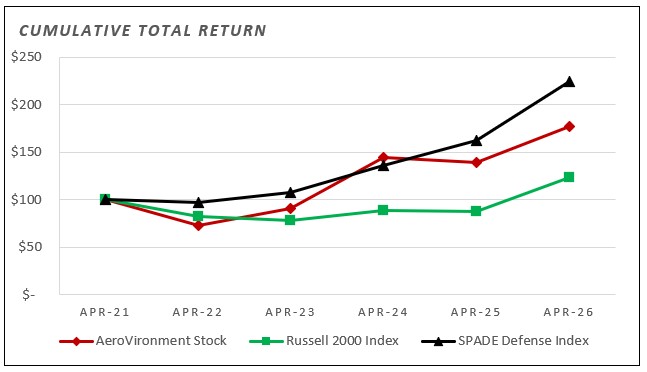
The following table shows the value of $100 invested on April 30, 2021 in AeroVironment, Inc., the Russell 2000 Index and the SPADE Defense Index.
Performance Graph Table ($) |
| ||||||||||||
| April 30, | | April 30 | | April 30, | | April 30, | | April 30 | | April 30, |
| |
2021 | 2022 | 2023 | 2024 | 2025 | 2026 |
| |||||||
AeroVironment, Inc. Stock | 100 | 73 | 91 | 144 | 139 | 177 | |||||||
Russell 2000 Index | 100 | 82 | 78 | 89 | 87 | 124 | |||||||
SPADE Defense Index | 100 | 97 | 107 | 136 | 162 | 224 | |||||||
The stock price performance shown on the graph above is not necessarily indicative of future price performance. Factual material was obtained from sources believed to be reliable, but we are not responsible for any errors or omissions contained therein. No portions of this graph shall be deemed incorporated by reference into any filing under the Securities Act or the Exchange Act through any general statement incorporating by reference in its entirety the report in which this graph appears, except to the extent that we specifically incorporate this graph or a portion of it by reference. In addition, this graph shall not be deemed filed under either the Securities Act or the Exchange Act.
Securities Authorized for Issuance Under Equity Compensation Plans
The information required by Item 5 of Form 10-K regarding equity compensation plans is incorporated herein by reference to Item 12 of Part III of this Annual Report on Form 10-K.
Issuer Purchases of Equity Securities
None.
57
Item 6.
Reserved.
Item 7. Management’s Discussion and Analysis of Financial Condition and Results of Operations.
Introduction
The following discussion of our financial condition and results of operations should be read in conjunction with our consolidated financial statements and notes thereto included herein as Item 8. This discussion contains forward-looking statements. Refer to Part I, “Forward-Looking Statements” on page 2 and Item 1A, “Risk Factors” beginning on page 14, for a discussion of the uncertainties, risks and assumptions associated with these statements.
Overview
We are a defense technology provider delivering integrated capabilities across air, land, sea, space, and cyber. We develop and deploy autonomous systems, precision strike systems, counter-UAS technologies, space-based platforms, directed energy systems, and cyber and electronic warfare capabilities. We operate an international manufacturing footprint, delivering proven systems and capabilities to markets that offer the potential for significant long-term growth. In addition, we believe that some of the innovative potential products, services and technologies in our R&D pipeline will emerge as new growth platforms in the future, creating additional market opportunities.
The success of our current product and service offerings stems from our investments in R&D to invent and deliver advanced solutions, utilizing proprietary and commercially available technologies, and in acquiring leading businesses that help our customers achieve their desired outcomes. We develop and acquire these highly innovative solutions by working closely with our key customers to solve their most important challenges related to our areas of expertise. Our core technological capabilities, developed by more than 50 years of innovation, include robotics and robotics systems autonomy; modular open systems architecture; sensor design, development, miniaturization and integration; embedded software and firmware; miniature, low power, secure wireless digital communications and networks; lightweight aerostructures; high-altitude systems design, integration and operations; machine vision, machine learning, AI and autonomy; land, maritime and air deployment of munitions and aircraft systems; design and qualification for robotics in extreme terrestrial and space environments; low SWaP (Size, Weight and Power) system design and integration; collaborative multi-robotic crewed and uncrewed mission operation; power electronics and electric propulsion systems; efficient electric power conversion, storage systems and high density energy packaging; controls and systems integration; vertical takeoff and landing for fixed wing and hybrid aircraft and rotocraft systems; image stabilization and target tracking; advanced flight control systems; fluid dynamics; human-machine interface development; modular dismounted, networked multi-domain robotic control interfaces and analytic processing architecture; and integrated mission solutions for austere environments.
The BlueHalo acquisition significantly enhanced our core technological capabilities, which now include advanced RF system design and development, software defined digital phased array antennas and radars, space qualified electronics, laser communication technologies, software defined radios, electronic warfare technology, target acquisition and tracking, directed energy-based weapons systems for counter uncrewed systems, RF-based systems for counter uncrewed, next generation counter uncrewed system missile technology, extended reality and virtual reality systems for training, modeling and simulation, hardware in the loop simulations, C2 sensing and tracking, uncrewed maritime platforms, uncrewed aerial platforms, full spectrum cyber operations, tactical mission networks, multi-int data analytics and threat intelligence, tools and analytics for GEOINT, SIGNINT, MASINT and OSINT, aerospace power and propulsion, material and processes, directed energy, photonics and electronics, biological and nanoscale technology, and health and human performance.
Our business focuses primarily on the design, development, production, marketing, support and operation of innovative autonomous systems, precision strike systems, counter-UAS technologies, space-based platforms, directed
58
energy systems and the provision of services for advanced cyber, intel, defense operations, solutions that deliver mission-critical expertise and prototype development.
Revenue
We generate our revenue primarily from the sale, support, design and operation of our UAS, PSDS, UUV, UGV, Space and Directed Energy products. Support for our products includes training, spare parts, product repair and product replacement. We refer to these support activities, in conjunction with customer-funded R&D and services provided for our Cyber and Mission Solutions customers, as our services operation. We derive most of our revenue from fixed-price and cost-plus-fee contracts with the majority from U.S. government and allied foreign governments.
Cost of Sales
Cost of sales consists of direct costs and allocated indirect costs. Direct costs include labor, materials, travel, subcontracts and other costs directly related to the execution of a specific contract. Indirect costs include overhead expenses, fringe benefits, depreciation of in-service ISR assets, inventory reserve for excess and obsolescence charges, amortization of acquired intangible assets and other costs that are not directly charged to a specific contract.
Gross Margin
Gross margin is equal to revenue minus cost of sales. We use gross margin as a financial metric to help us understand trends in our direct costs and allocated indirect costs when compared to the revenue we generate.
Selling, General and Administrative
Our selling, general and administrative expenses (“SG&A”), include salaries, fringe benefits, and other expenses related to selling, marketing and proposal activities, and other administrative costs and amortization of acquired intangible assets. Some SG&A expenses relate to marketing, commissions on certain direct commercial sales to international customers and business development activities that support both ongoing business areas as well as new and emerging market areas. These activities can be directly associated with developing requirements for and applications of capabilities created in our R&D activities. SG&A is an important financial metric that we analyze to help us evaluate the contribution of our selling, marketing and proposal activities to revenue generation.
Research and Development Expense
R&D is an integral part of our business model. We normally conduct significant internally funded R&D. Our R&D activities focus specifically on creating capabilities that support our existing product portfolio as well as new solutions.
Impairment of Goodwill
In January 2026, a stop-work order was received on an OTA for the delivery of BADGER phased array antenna systems to support Space Force’s SCAR program. Additionally, in March 2026, the customer terminated the agreement for convenience. We concluded that the stop-work order represented a trigger event that indicated the carrying value of the Space reporting unit exceeded its fair value. As a result, we updated the estimates of the long-term cash flows of the Space reporting unit to reflect the reduced revenue associated with the stop-work order and termination for convenience as well as an increase in expected research and development and capital investments to achieve product commercialization, which is expected to result in expanded opportunities and improve long term product margins. The changes in estimates resulted in the recognition of a goodwill impairment charge of approximately $241 million in the Space reporting unit.
As part of our annual goodwill impairment and identifiable asset test during the fiscal quarter ended April 30, 2025, we determined the carrying value of the UGV reporting unit exceeded its fair value due to a decrease in forecasted results of the UGV reporting unit resulting from reduced probability and delays of obtaining certain opportunities as well
59
as an increase in forecast expenditures to support operational decisions identified during the fiscal quarter ended April 30, 2025. These changes in estimates resulted in the recognition of a goodwill impairment charge of $18.4 million during the three months ended April 30, 2025 in the UGV reporting unit.
For the fiscal year ended April 30, 2026, we determined that it was more likely than not that the fair value of each of the remaining reporting units were more than their carrying values as of the annual goodwill impairment test date.
Other (Loss) Income, net
Other (loss) income, net includes unrealized gains and losses associated with changes in the fair market value for equity security investments, realized gains and losses for the disposition of available-for-sale debt securities, interest income, and interest expense.
Provision for (Benefit from) Income Taxes
Our effective tax rates for fiscal years 2026 and 2025 were lower than the U.S. federal statutory rate of 21% primarily due to tax benefits from the U.S. federal research tax credit, excess benefits from stock-based compensation, and Foreign Derived Intangible Income deduction (“FDII”).
Equity Method Investment (Loss) Income, Net of Tax
Equity method investment (loss) income, net of tax, includes equity method income or loss related to our investment in limited partnership funds for which we have concluded we have influence for holding more than a minor interest.
Critical Accounting Policies and Estimates
This Management’s Discussion and Analysis of Financial Condition and Results of Operations discusses our consolidated financial statements, which have been prepared in accordance with accounting principles generally accepted in the United States. When we prepare these consolidated financial statements, we are required to make estimates and assumptions that affect the reported amounts of assets and liabilities and the disclosure of contingent assets and liabilities at the date of the financial statements and the reported amounts of revenue and expenses during the reporting period. Some of our accounting policies require that we make subjective judgments, including estimates that involve matters that are inherently uncertain. Our most critical estimates include those related to revenue recognition, inventory reserves for excess and obsolescence, intangible assets acquired in a business combination, goodwill, and income taxes. We base our estimates and judgments on historical experience and on various other factors that we believe to be reasonable under the circumstances, the results of which form the basis for our judgments about the carrying values of assets and liabilities that are not readily apparent from other sources. Our actual results may differ from these estimates under different assumptions or conditions.
We believe the following critical accounting estimates affect our more significant judgments and estimates used in preparing our consolidated financial statements. Refer to Note 1 to our consolidated financial statements entitled “Organization and Significant Accounting Policies,” which is included in Part II, Item 8 “Financial Statements and Supplementary Data” of this Annual Report. There have been no material changes made to the critical accounting estimates during the periods presented in the consolidated financial statements.
Revenue Recognition
Significant management judgments and estimates must be made and used in connection with the recognition of revenue in any accounting period. Material differences in the amount of revenue in any given period may result if these judgments or estimates prove to be incorrect or if management’s estimates change on the basis of development of the business or market conditions. Management judgments and estimates have been applied consistently and have been reliable historically. We believe that there are two key factors which impact the reliability of management’s estimates.
60
The first of those key factors is that a significant number of our contracts are typically less than six months. The short-term nature of such contracts reduces the risk that material changes in accounting estimates will occur on the basis of market conditions or other factors. The second key factor is that we have hundreds of contracts in any given accounting period, which reduces the risk that any one change in an accounting estimate on one or several contracts would have a material impact on our consolidated financial statements.
The substantial majority of our revenue is generated pursuant to written contractual arrangements to design, develop, manufacture and/or modify complex products, and to provide related engineering, technical and other services according to customer specifications. These contracts may be fixed price, cost-reimbursable, or time and materials. We account for all revenue contracts in accordance with ASC 606. A performance obligation is a promise in a contract to transfer distinct goods or services to a customer, and it is the unit of account in ASC 606. A contract’s transaction price is allocated to each distinct performance obligation and revenue is recognized when each performance obligation under the terms of a contract is satisfied. For contracts with multiple performance obligations, we allocate the contract’s transaction price to each performance obligation using observable standalone selling prices for similar products and services. When the standalone selling price is not directly observable, we use our best estimate of the standalone selling price of each distinct good or service in the contract using the cost plus reasonable margin approach.
Our performance obligations are satisfied over time or at a point in time. Product revenue for certain Precision Strike products including LMS, Space, Directed Energy and Cyber and Mission Solution product deliveries and customization of UGV transport vehicles is recognized over time as costs are incurred. Contract services revenue is recognized over time and composed of revenue recognized on contracts for the provision of services, including repairs and maintenance, training, engineering design, development and prototyping activities, technical support services, ISR services, and customer-funded R&D contracts. For performance obligations satisfied over time, revenue is generally recognized using costs incurred to date relative to total estimated costs at completion to measure progress. Incurred costs represent work performed, which correspond with, and thereby best depict, transfer of control to the customer. Contract costs include labor, materials, subcontractors’ costs, other direct costs, and indirect costs applicable on government and commercial contracts. We elected the right to invoice practical expedient in which if an entity has a right to consideration from a customer in an amount that corresponds directly with the value to the customer of the entity’s performance completed to date, the entity may recognize revenue in the amount to which the entity has a right to invoice. Certain training services are recognized over time using an output method based on days of training completed. Warranty agreements which meet the definition of a performance obligation are recognized straight line over the warranty period. LMS product revenue is currently recognized over time as the product is considered to not have alternative use as the U.S. government is the only current customer including FMS sales. Once LMS products receive a DCS contract, which is expected during fiscal year 2027, the products are considered to have alternative use and revenue will be recognized at a point in time.
For performance obligations which are not satisfied over time per the aforementioned criteria above, revenue is recognized at the point in time in which each performance obligation is fully satisfied. Our product sales revenue is primarily composed of revenue recognized on contracts for the delivery of UAS, UGV, UUV, IAMD, and EW systems and spare parts, respectively. Revenue is recognized at the point in time when control transfers to the customer, which generally occurs when title and risk of loss have passed to the customer.
We review cost performance, estimates to complete and variable consideration at least quarterly and in many cases more frequently. Adjustments to original estimates for a contract’s revenue, estimated costs at completion and estimated profit or loss are often required as work progresses under a contract, as experience is gained and as more information is obtained, even though the scope of work required under the contract may not change, or if contract modifications, including the finalization of undefinitized contract actions, occur. The impact of revisions in estimate of completion and variable consideration for all types of contracts are recognized on a cumulative catch-up basis in the period in which the revisions are made. Changes in variable consideration associated with the finalization of undefinitized contract actions or unpriced change orders could result in cumulative catch up adjustments to revenue that could be material. During the fiscal years ended April 30, 2026, 2025 and 2024, changes in accounting estimates on contracts recognized using the over time method are presented below. Amounts representing contract change orders or claims are included in revenue if the order or claim meets the criteria of a contract or contract modification in accordance with ASC 606. Incentives or penalties and awards applicable to performance on contracts are considered in
61
estimating revenue and profit rates, and are recorded when there is sufficient information to assess anticipated contract performance.
For the years ended April 30, 2026, 2025 and 2024, favorable and unfavorable cumulative catch-up adjustments included in revenue were as follows (in thousands):
Year Ended April 30, |
| |||||||||
2026 | | 2025 | | 2024 | ||||||
|
| |||||||||
Gross favorable adjustments | $ | 14,339 | $ | 11,106 | $ | 7,359 | ||||
Gross unfavorable adjustments |
| (16,896) |
| (5,104) |
| (1,951) | ||||
Net adjustments | $ | (2,557) | $ | 6,002 | $ | 5,408 | ||||
For the year ended April 30, 2026, favorable cumulative catch up adjustments of $14.3 million were primarily due to favorable adjustments on 18 contracts, of which one contract had individually material adjustments. A Space and Directed Energy contract had a favorable adjustment due to lower expected costs and an increase in profitability which increased revenue by approximately $6.7 million. For the same period, unfavorable cumulative catch up adjustments of $16.9 million were primarily related to unfavorable adjustments on 25 contracts, of which one contract had individually material adjustments. A Cyber and Mission Solutions contract had an adjustment due to revised estimates of the total expected costs to complete the contracts, which decreased revenue by approximately $(3.1) million.
For the year ended April 30, 2025, favorable cumulative catch up adjustments of $11.1 million were primarily due to favorable adjustments on eight contracts, of which four LMS undefinitized contract actions were definitized during the year ended April 30, 2025, which resulted in cumulative catch-up revenue adjustments that increased revenue by approximately $9.9 million. The remaining adjustments individually were not material. For the same period, unfavorable cumulative catch up adjustments of $5.1 million were primarily related to unfavorable adjustments on 17 contracts for higher revised estimates of the total expected costs to complete the contract, including one LMS contract, which decreased revenue by approximately $2.9 million. The remaining adjustments individually were not material.
For the year ended April 30, 2024, favorable cumulative catch up adjustments of $7.4 million were primarily due to final cost adjustments on 17 contracts, of which we revised our estimates of the total expected costs to complete two LMS contracts during the year ended April 30, 2024. The aggregate impact of these adjustments in contract estimates on revenue related to performance obligations satisfied or partially satisfied in previous periods was an increase to revenue of approximately $2.7 million. For the same period, unfavorable cumulative catch up adjustments of $2.0 million were primarily related to higher than expected costs on 11 contracts, which individually were not material.
Inventories Reserves for Excess and Obsolescence
Our policy for valuation of inventory, including the determination of obsolete or excess inventory, requires us to perform a detailed assessment of inventory at each balance sheet date, which includes a review of, among other factors, an estimate of future demand for products within specific time horizons, valuation of existing inventory, as well as product lifecycle and product development plans. Inventory reserves are also provided to cover risks arising from slow-moving items. We write down our inventory for estimated obsolescence or unmarketable inventory equal to the difference between the cost of inventory and the estimated net realizable value based on assumptions about future demand and market conditions and record to cost of sales. We may be required to record additional inventory write-downs if actual market conditions are less favorable than those projected by our management.
Goodwill
Goodwill represents the excess of the cost of an acquired entity over the fair value of the acquired net assets. We test goodwill for impairment annually during the fourth quarter of our fiscal year or when events or circumstances change in a manner that indicates goodwill might be impaired. Events or circumstances that could trigger an impairment review include, but are not limited to, a significant adverse change in legal factors or in the business or political climate, an adverse action or assessment by a regulator, unanticipated competition, a loss of key personnel, significant changes in
62
the manner of our use of the acquired assets or the strategy for our overall business, significant negative industry or economic trends or significant underperformance relative to projected future results of operations.
Our evaluation of goodwill for impairment involves the comparison of the fair value of each reporting unit to its carrying value. For the impairment test, we first assess qualitative factors, macroeconomic conditions, industry and market considerations, triggering events, cost factors, and overall financial performance, to determine whether it is necessary to perform a quantitative goodwill impairment test. Alternatively, we may bypass the qualitative assessment for some or all of its reporting units and apply the quantitative impairment test. If determined to be necessary, the quantitative impairment test shall be used to identify goodwill impairment and measure the amount of a goodwill impairment loss to be recognized (if any). For the quantitative impairment test we estimate the fair value by weighting the results from the income approach and the market approach. These valuation approaches consider a number of factors that include, but are not limited to, prospective financial information, growth rates, terminal value, discount rates, and comparable multiples from publicly traded companies in our industry and require us to make certain assumptions and estimates regarding industry economic factors and future profitability of its business.
In January 2026, a stop-work order was received on an OTA for the delivery of BADGER phased array antenna systems to support Space Force’s SCAR program. Additionally, in March 2026, the customer terminated the agreement for convenience. We concluded that the stop-work order represented a trigger event that indicated the carrying value of the Space reporting unit exceeded its fair value. As a result, we updated our estimates of the long-term cash flows of the Space reporting unit to reflect the reduced revenue associated with the stop-work order and termination for convenience as well as an increase in expected research and development and capital investments to achieve product commercialization, which is expected to result in expanded opportunities and improve long term product margins. The changes in estimates resulted in the recognition of a goodwill impairment charge of approximately $241 million in the Space reporting unit. Due to the trigger event, we also performed a recoverability test on the long-lived assets, inclusive of the intangibles, of the Space reporting unit for impairment in accordance with ASC 360. The undiscounted cash flows exceeded the carrying value and no impairment was recorded.
As part of our annual goodwill impairment and identifiable asset test during the fiscal quarter ended April 30, 2025, we determined the carrying value of the UGV reporting unit exceeded its fair value due to a decrease in forecasted results of the UGV reporting unit resulting from reduced probability and delays of obtaining certain opportunities as well as an increase in forecast expenditures to support operational decisions identified during the fiscal quarter ended April 30, 2025. These changes in estimates resulted in the recognition of a full goodwill impairment charge of $18.4 million during the three months ended April 30, 2025 in the UGV reporting unit.
As of April 30, 2026, our Space reporting unit has a goodwill balance of approximately $291 million. During the most recent annual impairment test during the fourth quarter of fiscal year 2026, the estimated fair value of all reporting units with goodwill from acquisitions in previous years substantially exceeded their carrying value. The reporting units from the BlueHalo and ESAero acquisitions were recently recorded at estimated fair value during the fiscal year ended April 30, 2026 and, other than the Space unit, no triggering event for goodwill impairment was since identified.
The estimates and assumptions used to determine the fair value of our reporting units are highly subjective in nature. Actual results can be materially different from the estimates and assumptions. If actual market conditions are less favorable than those projected by the industry or by us, or if events occur or circumstances change that would reduce the estimated fair value of our indefinite-lived intangible assets below the carrying amounts, we could recognize future impairment charges, the amount of which could be material.
Intangible Assets – Acquired in Business Combinations
We perform valuations of assets acquired and liabilities assumed on each acquisition accounted for as a business combination and allocate the purchase price of each acquired business to our respective net tangible and intangible assets. Acquired intangible assets include technology, backlog, in-process research and development, customer relationships, licenses, trademarks and tradenames, and non-compete agreements. We use valuation techniques to value these intangibles assets, with the primary technique being a discounted cash flow analysis. A discounted cash
63
flow analysis requires us to make various assumptions and estimates including projected revenue, gross margins, operating costs, growth rates, useful lives and discount rates. Intangible assets are amortized over their estimated useful lives using the straight-line method which approximates the pattern in which the economic benefits of such assets are consumed. As part of our annual goodwill impairment and identifiable asset test, performed during the quarter ended April 30, 2025, a decrease in forecasted results for the UGV reporting unit resulting from reduced probability and delays of obtaining certain opportunities as well as an increase in forecast expenditures to support operational decisions identified during the fiscal quarter ended April 30, 2025 was concluded to be a triggering event for impairment assessment and resulted in accelerated intangible amortization expenses of $4.3 million which were recorded during the three months ended April 30, 2025. Due to the trigger event, the Company performed a recoverability test on the long-lived assets of the Space reporting unit, inclusive of the intangibles, for impairment in accordance with ASC 360. The undiscounted cash flows exceeded the carrying value and no impairment was recorded for long-lived assets. Due to the SCAR trigger event in January 2026, the Company performed a recoverability test on the long-lived assets of the Space reporting unit, inclusive of the intangibles, for impairment in accordance with ASC 360. The undiscounted cash flows exceeded the carrying value and no impairment was recorded for long-lived assets.
Income Taxes
Our income tax provision and related income tax assets and liabilities are based on actual and expected future income, U.S. and foreign statutory income tax rates, and tax regulations and planning opportunities in the various jurisdictions in which it operates. Significant judgment is required in interpreting tax regulations in the United States and in foreign jurisdictions, evaluating our worldwide uncertain tax positions, and assessing the likelihood of realizing certain tax benefits. Actual results could differ materially from those judgments, and changes in judgments could materially affect our consolidated financial statements.
We are required to estimate our income taxes, which includes estimating our current income taxes as well as measuring the temporary differences resulting from different treatment of items for tax and accounting purposes. We currently have significant deferred tax assets, which are subject to periodic recoverability assessments. Realizing our deferred tax assets principally depends on our achieving projected future taxable income. We may change our judgments regarding future profitability due to future market conditions and other factors, which may result in recording a valuation allowance against those deferred tax assets. We record a valuation allowance to reduce our deferred tax assets if, based on the weight of available evidence, we believe expected future taxable income is not likely to support the use of a deduction or credit in that jurisdiction. We evaluate the level of our valuation allowances during the interim and annually.
We record unrecognized tax benefits for U.S. federal, state, local, and foreign tax positions related primarily to tax credits claimed and tax nexus. For each reporting period, we apply a consistent methodology to measure unrecognized tax benefits and all unrecognized tax benefits are reviewed periodically and adjusted as circumstances warrant. Our measurement of our unrecognized tax benefits is based on our assessment of all relevant information, including prior audit experience, the status of audits, conclusions of tax audits, lapsing of applicable statutes of limitations, identification of new issues, and any administrative guidance or developments. We recognize unrecognized tax benefits in the first financial reporting period in which information becomes available indicating that such benefits will more likely than not (a greater than 50% likelihood) be realized.
We have various foreign subsidiaries to conduct or support our business outside the United States. We do not provide for U.S. income taxes on undistributed earnings for our foreign subsidiaries as we expect the foreign earnings will be indefinitely reinvested in such foreign jurisdictions.
Fiscal Periods
Our fiscal year ends on April 30. Due to our fixed year end date of April 30, our first and fourth quarters each consist of approximately 13 weeks. The second and third quarters each consist of exactly 13 weeks. Our first three quarters end on a Saturday.
64
Results of Operations
The following table sets forth certain historical consolidated income statement data expressed in dollars (in thousands) and as a percentage of revenue for the periods indicated. Certain amounts may not sum due to rounding.
Fiscal Year Ended April 30, |
| |||||||||||||||||
2026 |
| 2025 |
| 2024 |
| |||||||||||||
Revenue | | $ | 1,976,845 | | 100 | % | $ | 820,627 | | 100 | % | $ | 716,720 | | 100 | % | ||
Cost of sales |
| 1,476,203 | 75 | % |
| 501,991 | 61 | % |
| 432,789 | 60 | % | ||||||
Gross margin |
| 500,642 | 25 | % |
| 318,636 | 39 | % |
| 283,931 | 40 | % | ||||||
Selling, general and administrative |
| 443,251 | 22 | % |
| 158,753 | 19 | % |
| 114,420 | 16 | % | ||||||
Research and development |
| 127,678 | 6 | % |
| 100,729 | 12 | % |
| 97,687 | 14 | % | ||||||
Impairment of goodwill | 240,708 | 12 | % | 18,359 | 2 | % | — | — | % | |||||||||
(Loss) income from operations |
| (310,995) | (16) | % |
| 40,795 | 5 | % |
| 71,824 | 10 | % | ||||||
Interest expense, net |
| (5,613) | — | % |
| (2,188) | — | % |
| (4,220) | (1) | % | ||||||
Other income (expense), net | 10,986 | 1 | % |
| 1,057 | — | % |
| (4,373) | (1) | % | |||||||
(Loss) income before income taxes |
| (305,622) | (15) | % |
| 39,664 | 5 | % |
| 63,231 | 9 | % | ||||||
Provision for (benefit from) income taxes |
| (23,059) | (1) | % |
| 882 | — | % |
| 1,891 | — | % | ||||||
Equity method investment income (loss), net of tax | 17,441 | 1 | % | 4,837 | 1 | % | (1,674) | — | % | |||||||||
Net (loss) income | (265,122) | (13) | % | 43,619 | 5 | % | 59,666 | 8 | % | |||||||||
Effective May 1, 2025, we reorganized our segments in connection with our acquisition of BlueHalo. The reorganization was implemented to drive additional operational improvements, foster synergies and provide leaders with greater autonomy over their business units. Our reportable segments are AxS and SCDE. AxS includes the historical AeroVironment businesses UxS, LMS and MW as well as IAMD, EW, UUV, and Autonomous R&D from the BlueHalo acquisition. SCDE includes the Space, Cyber and Mission Solutions, and Directed Energy businesses from the BlueHalo acquisition. Effective May 1, 2026 Autonomous R&D is included in the SCDE segment.
Also effective May 1, 2025, due to the increased size and complexity of the businesses, the significant amount of debt to finance the acquisition and the related debt covenants, the Chief Operating Decision Maker’s (“CODM”) measure of profitability is Segment Adjusted EBITDA, defined as segment income (loss) from operations before depreciation and amortization and adjusted for the impact of certain other non-cash items, including goodwill impairment, amortization of implementation of cloud computing arrangements, stock-based compensation, other purchase accounting adjustments, and cash items including acquisition related expenses and certain one-time non-operating expense or income such as legal expense. The following table (in thousands) sets forth our revenue and segment adjusted EBITDA generated by each reporting segment for the periods indicated. Prior period segment information has been revised to align with the new segment measure of profitability and the new reportable segments.
Year Ended April 30, 2026 | |||||||||
AxS | | SCDE | Total | ||||||
Revenue | $ | 1,358,077 | $ | 618,768 | $ | 1,976,845 | |||
Segment adjusted EBITDA | $ | 288,652 | $ | (2,596) | $ | 286,056 | |||
Year Ended April 30, 2025 | |||||||||
AxS | | SCDE | Total | ||||||
Revenue | $ | 820,627 | $ | — | $ | 820,627 | |||
Segment adjusted EBITDA | $ | 146,424 | $ | — | $ | 146,424 | |||
65
| Year Ended April 30, 2024 | ||||||||
AxS | | SCDE | Total | ||||||
Revenue | $ | 716,720 | $ | — | $ | 716,720 | |||
Segment adjusted EBITDA | $ | 127,753 | $ | — | $ | 127,753 | |||
We recorded intangible amortization expense and other purchase accounting adjustments in the following categories on the accompanying consolidated statements of income (loss):
| | Year Ended April 30, | ||||||||
2026 | | 2025 | 2024 | |||||||
Cost of sales: | ||||||||||
Product sales | $ | 81,220 | $ | 15,018 | $ | 8,214 | ||||
Contract services | 11,489 | 4,387 | 5,334 | |||||||
Selling, general and administrative | 130,431 | 4,001 | 5,010 | |||||||
Total | $ | 223,140 | $ | 23,406 | $ | 18,558 | ||||
Fiscal Year Ended April 30, 2026 Compared to Fiscal Year Ended April 30, 2025
Revenue. Revenue for the fiscal year ended April 30, 2026 was $1,976.8 million, as compared to $820.6 million for the fiscal year ended April 30, 2025, representing an increase of $1,156.2 million, or 141%. The increase in revenue was due to an increase in product revenue of $722.6 million, and an increase in service revenue of $433.6 million. The increase in product revenue was primarily due to an increase of $526.0 million related to the acquisitions of BlueHalo and ESAero. Legacy AV product revenue included in the AxS segment increased by $196.6 million driven by an increase in LMS, MacCready Works, and MUAS products due to increase in domestic and international demand, partially offset by a decrease in SUAS due to a decrease in international sales. The increase in service revenue was primarily due to the $413.2 million service revenue resulting from our acquisition of BlueHalo. Legacy AV service revenue, included in the AxS segment, increased by $20.4 million driven by an increase in customer funded R&D and engineering services of $22.6 million, partially offset by a decrease training and repair services primarily due to the decrease in SUAS product revenue. The proportion of service revenue to product revenue is expected to remain higher following the acquisition of BlueHalo.
Cost of Sales. Cost of sales for the fiscal year ended April 30, 2026 was $1,476.2 million, as compared to $502.0 million for the fiscal year ended April 30, 2025, representing an increase of $974.2 million, or 194%. The increase in cost of sales was a result of an increase in product cost of sales of $554.9 million and an increase in service costs of sales of $419.3 million. The increase in product costs of sales was primarily due to an increase of $345.0 million related to the acquisitions of BlueHalo and ESAero and an increase of $66.2 million intangible amortization related to the BlueHalo and ESAero acquisitions. Legacy AV product cost of sales increased $143.7 million. The increase in legacy product costs of sales was primarily due to an increase of approximately $111 million due to the increase in sales volume and approximately $34 million due to mix shift to a higher proportion of lower margin products driven by the increase in Switchblade production. The increase in service cost of sales was primarily due to an increase of $398.8 million associated with the BlueHalo acquisition and an increase of $7.1 million intangible amortization related to the BlueHalo acquisition. Legacy AV service cost of sales increased $13.4 million primarily due to an increase of approximately $15 million related to service volume. Cost of sales for the fiscal year ended April 30, 2026 included $92.7 million of intangible amortization and other related non-cash purchase accounting expenses as compared to $19.4 million for the fiscal year ended April 30, 2025. As a percentage of revenue, cost of sales increased from 61% to 75% primarily due to increased amortization and other non-cash purchase accounting expenses and an increase in the proportion of service revenue resulting from the effect of the BlueHalo acquisition, resulting in gross margin decreasing from 39% to 25%.
Gross Margin. Gross margin is equal to revenue minus cost of sales.
Selling, General and Administrative. SG&A expense for the fiscal year ended April 30, 2026 was $443.0 million, or 22% of revenue, as compared to SG&A expense of $158.8 million, or 19% of revenue, for the fiscal year
66
ended April 30, 2025. The increase in SG&A expense was primarily due to an increase of $126.4 million of intangible amortization expense primarily related to the BlueHalo acquisition, an increase of approximately $48 million of employee related expenses related to the increase in headcount, and an increase of $26.4 million of acquisition related expenses related to the BlueHalo and ESAero acquisitions.
Research and Development. R&D expense for the fiscal year ended April 30, 2026 was $127.7 million, or 6% of revenue, as compared to R&D expense of $100.7 million, or 12% of revenue, for the fiscal year ended April 30, 2025. R&D expense increased by $27 million, or 27%, for the fiscal year ended April 30, 2026, primarily due to an increase in development activities regarding enhanced capabilities for our products, development of new product lines and to support our acquired businesses.
Impairment of Goodwill. During the fiscal year ended April 30, 2026, a goodwill impairment charge of $240.7 million was recorded resulting from a decrease in forecasted results of the Space reporting unit due to the Space Force’s decision to cancel the contract related to the delivery of BADGER phased array antenna systems to support the SCAR program. During the fiscal year ended April 30, 2025, a goodwill impairment charge of $18.4 million was recorded resulting from a decrease in forecasted results of the UGV reporting unit.
Interest Expense, net. Interest expense, net for the fiscal year ended April 30, 2026 was $5.6 million, as compared to interest expense net of $2.2 million for the fiscal year ended April 30, 2025. The increase was driven by the interest expense related to the Term Loan and Revolver Facility obtained on May 1, 2025 in conjunction with the BlueHalo acquisition and the unamortized debt issuance costs allocated to the Term Loan Facility of $6.7 million, which were expensed upon repayment of the Term Loan Facility in July 2025 using the proceeds from the convertible notes and common stock issuances in July 2025. The increase in interest expense was partially offset by an increase in interest income due to a combination of higher cash and investment balances and lower interest bearing debt balances.
Other Income, net. Other income, net for the fiscal year ended April 30, 2026 was $11.0 million, as compared to $1.1 million for the fiscal year ended April 30, 2025. The increase in other income, net is primarily due to realized gains associated with the sale of equity security investments of $11.7 million.
Income Taxes. Our effective income tax rate was 7.5% for the fiscal year ended April 30, 2026 as compared to 2.2% for the fiscal year ended April 30, 2025. The change in our effective income tax rate was primarily attributable to the increase in net loss before income taxes, inclusive of the goodwill impairment loss which is non-deductible, combined with a decrease in FDII deductions. The effective income tax rate for the fiscal year ended April 30, 2026, was primarily attributable to the goodwill impairment loss, which is non-deductible, partially offset by R&D tax credits.
Equity method investment income, net of tax. Equity method investment income, net of tax for the fiscal year ended April 30, 2026 was $17.4 million, as compared to $4.8 million for the fiscal year ended April 30, 2025.
Business Segment Results of Operations
AxS
Year Ended | ||||||
April 30, | April 30, | |||||
| 2026 | 2025 | ||||
Revenue: | $ | 1,358,077 | $ | 820,627 | ||
Segment adjusted EBITDA | $ | 288,652 | $ | 146,424 | ||
AxS Segment Revenue. AxS revenue for the year ended April 30, 2026 was $1,358.1 million, as compared to $820.6 million for the year ended April 30, 2025, representing an increase of $537.5 million, or 65%. The increase in revenue was due to an increase in product and service revenues of $450.1 million and $87.4 million, respectively. The increase in product revenue was primarily due to the $253.5 million of product revenue resulting from our acquisitions of BlueHalo and ESAero. Legacy AV product revenue included in the AxS segment increased by $196.6 million driven by an increase in LMS, MacCready Works, and MUAS products due to increase in domestic and international demand,
67
partially offset by a decrease in SUAS due to a decrease in international sales. The increase in service revenue was primarily due to the $67.0 million of service revenue resulting from our acquisition of BlueHalo. Legacy AV service revenue, included in the AxS segment, increased by $20.4 million driven by an increase in customer funded R&D and engineering services of $22.6 million, partially offset by a decrease training and repair services primarily due to the decrease in SUAS product revenue. Proportion of service revenue to product revenue is expected to remain higher following the acquisition of BlueHalo.
AxS Segment Adjusted EBITDA. AxS segment adjusted EBITDA for the year ended April 30, 2026 was $288.7 million, as compared to $146.4 million for the year ended April 30, 2025, representing an increase of $142.3 million, or 97%. The increase in AxS segment adjusted EBITDA was primarily due to an increase in revenue of $537.5 million. The increase in revenue was partially offset by an increase in adjusted cost of sales of $340.8 million, adjusted SG&A of $36.7 million primarily due employee related costs driven by the increased headcount, and R&D of $12.3 million. The increase in adjusted cost of sales was primarily due to an increase of approximately $197.7 million associated with the BlueHalo and ESAero acquisitions. Legacy AV adjusted cost of sales increased $157.8 million driven by approximately $127 million due to the increase in sales volume and approximately $30 million due to mix shift to a higher proportion of lower margin products driven by the increase in Switchblade production, partially offset by $14 million of stock-based compensation and depreciation not included in adjusted cost of sales.
SCDE
Year Ended | ||||||
April 30, | April 30, | |||||
| 2026 | 2025 | ||||
Revenue: | $ | 618,768 | $ | — | ||
Segment adjusted EBITDA | $ | (2,596) | $ | — | ||
Revenue. SCDE revenue for the year ended April 30, 2026 was $618.8 million, as compared to $0 for the year ended April 30, 2025. The SCDE segment consists of business units obtained in the BlueHalo acquisition on May 1, 2025, and the increase in revenue is a result of the acquisition.
SCDE Segment Adjusted EBITDA. SCDE segment adjusted EBITDA for the year ended April 30, 2026 was $(2.6) million, as compared to $0 for the year ended April 30, 2025. The SCDE segment consists of business units obtained in the BlueHalo acquisition on May 1, 2025, and the increase in segment adjusted EBITDA is a result of the acquisition.
Fiscal Year Ended April 30, 2025 Compared to Fiscal Year Ended April 30, 2024
Revenue. Revenue for the fiscal year ended April 30, 2025 was $820.6 million, as compared to $716.7 million for the fiscal year ended April 30, 2024, representing an increase of $103.9 million, or 14%. The increase in revenue was due to an increase in product revenue of $107.0 million, partially offset by a decrease in service revenue of $3.0 million. The increase in product revenue was primarily due to an increase of $164.7 million from the production of our Switchblade products, driven by increased global demand for our LMS associated with the current global conflicts as well as U.S. DoD. resupply and an increase of $4.4 million from the delivery of MW products driven by demand for new product releases, partially offset by a decrease of $62.1 million of product deliveries of our UxS products, primarily due to a decrease in international sales to Ukraine. Fiscal 2025 also included favorable cumulative catch-up revenue adjustments of $12.0 million due to changes in estimates associated with the definitization of certain LMS contracts. The decrease in service revenue was primarily due to a decrease of $2.8 million in other engineering services and customer-funded R&D activities primarily associated with the shift from development to production of certain LMS products.
Cost of Sales. Cost of sales for the fiscal year ended April 30, 2025 was $502.0 million, as compared to $432.8 million for the fiscal year ended April 30, 2024, representing an increase of $69.2 million, or 16%. The increase in cost of sales was a result of an increase in product cost of sales of $64.2 million and an increase in service costs of sales of $5.0 million. The increase in product cost of sales was primarily due to approximately $62 million associated with the increase in product sales volume, $4.6 million due to the UGV accelerated intangible amortization expenses, partially
68
offset by a decrease of approximately $3 million due to product mix shift primarily to the definitization of LMS contracts. The increase of $5.0 million in service costs of sales was primarily due to approximately $7 million increase due to mix shift associated with a higher proportion of engineering services, partially offset by approximately $2 million associated with the decreased service volume. Cost of sales for the fiscal year ended April 30, 2025 included $19.4 million of intangible amortization as compared to $13.5 million of intangible amortization and other related non-cash purchase accounting expenses for the fiscal year ended April 30, 2024. As a percentage of revenue, cost of sales increased from 60% to 61%, primarily due to the accelerated amortization of UGV intangibles of $4.6 million, partially offset by an increase in the proportion of product revenue to total revenue, resulting in a decrease in gross margin from 40% to 39%.
Gross Margin. Gross margin is equal to revenue minus cost of sales.
Selling, General and Administrative. SG&A expense for the fiscal year ended April 30, 2025 was $158.8 million, or 19% of revenue, as compared to SG&A expense of $114.4 million, or 16% of revenue, for the fiscal year ended April 30, 2024. The increase in SG&A expense was primarily due to an increase of $17.2 million in acquisition related expenses related to the BlueHalo acquisition, an increase in employee related expenses of $10.0 million driven by an increase in average headcount and expansion of our global business development team, and an increase in sales and marketing expense of $9.4 million driven by an increase in bid and proposal efforts associated with the higher sales volume.
Research and Development. R&D expense for the fiscal year ended April 30, 2025 was $100.7 million, or 12% of revenue, as compared to R&D expense of $97.7 million, or 14% of revenue, for the fiscal year ended April 30, 2024. R&D expense increased by $3.0 million, or 3%, for the fiscal year ended April 30, 2025, primarily due to an increase in development activities regarding enhanced capabilities for our products, development of new product lines and to support our acquired businesses.
Impairment of Goodwill. A goodwill impairment charge of $18.4 million resulting from a decrease in forecasted results of the UGV reporting unit identified during our annual goodwill impairment test during the three months ended April 30, 2025 in the UGV reporting unit.
Interest Expense, net. Interest expense, net for the fiscal year ended April 30, 2025 was $2.2 million, as compared to interest expense net of $4.2 million for the fiscal year ended April 30, 2024. The decrease in interest expense, net was primarily due to a decrease of $5.0 million in interest expense primarily due to lower average outstanding balances on our debt facility, partially offset by a decrease in interest income of $2.5 million primarily due to lower interest rates and a decrease in our average investment balances. On May 1, 2025, in connection with the closing of the BlueHalo acquisition, we entered into a new Term A Loan and borrowed from our revolving credit facility (the “Revolving Credit Facility,” and together with the Term A Loan, the “Credit Facilities”). As of May 1, 2025, the outstanding balance of the Credit Facilities was $955.0 million, which bears a variable interest rate.
Other Income (Expense), net. Other income, net for the fiscal year ended April 30, 2025 was $1.1 million, as compared to other expense, net of $4.4 million for the fiscal year ended April 30, 2024. The increase in other income, net is primarily due to a decrease in unrealized losses associated with increases in fair market value for equity security investments of $4.1 million.
Income Taxes. Our effective income tax rate was 2.2% for the fiscal year ended April 30, 2025 as compared to 3.0% for the fiscal year ended April 30, 2024. The decrease in our effective tax rate in fiscal 2025 compared with fiscal 2024 was primarily due to a decrease in net income, a decrease in our FDII deduction, offset by non-deductible goodwill impairment expense from our foreign subsidiary.
Equity method investment gain (loss), net of tax. Equity method investment gain, net of tax for the fiscal year ended April 30, 2025 was $4.8 million, as compared to equity method investment loss of $(1.7) million for the fiscal year ended April 30, 2024.
69
Business Segment Results of Operations
AxS
Year Ended | ||||||
April 30, | April 30, | |||||
| 2025 | 2024 | ||||
Revenue: | $ | 820,627 | $ | 716,720 | ||
Segment adjusted EBITDA | $ | 146,424 | $ | 127,753 | ||
AxS Revenue. AxS Revenue for the fiscal year ended April 30, 2025 was $820.6 million, as compared to $716.7 million for the fiscal year ended April 30, 2024, representing an increase of $103.9 million, or 14%. The increase in revenue was due to an increase in product revenue of $107.0 million, partially offset by a decrease in service revenue of $3.0 million. The increase in product revenue was primarily due to an increase of $164.7 million from the production of our Switchblade products, driven by increased global demand for our LMS associated with the current global conflicts as well as U.S. DoD. resupply and an increase of $4.4 million from the delivery of MW products driven by demand for new product releases, partially offset by a decrease of $62.1 million of product deliveries of our UxS products, primarily due to a decrease in international sales to Ukraine. Fiscal 2025 also included favorable cumulative catch-up revenue adjustments of $12.0 million due to changes in estimates associated with the definitization of certain LMS contracts. The decrease in service revenue was primarily due to a decrease of $2.8 million in other engineering services and customer-funded R&D activities primarily associated with the shift from development to production of certain LMS products.
AxS Segment Adjusted EBITDA. AxS segment adjusted EBITDA for the year ended April 30, 2025 was $146.4 million, as compared to $127.8 million for the year ended April 30, 2024, representing an increase of $18.6 million, or 15%. The increase in AxS segment adjusted EBITDA was primarily due to an increase in revenue of $103.9 million. The increase in revenue was partially offset by an increase in adjusted cost of sales of $60.1 million, adjusted SG&A of $25.5 million primarily due employee related costs driven by the increased headcount, and R&D of $3.0 million. The increase in adjusted cost of sales was primarily due to an increase of approximately $58 million due to the increase in sales volume and approximately $2 million due to mix shift to a higher proportion of lower margin products driven by the increase in Switchblade production.
SCDE. SCDE was formed as a segment May 1, 2025 with no results prior to this date.
Liquidity and Capital Resources
In May 2025, in connection with the consummation of the BlueHalo acquisition, the Company entered into a Fourth Amendment to Credit Agreement with BofA NA, the administrative agent and the swingline lender, JPM, U.S. Bank, Citibank, BMO, Citizens and RBC. The Amended Credit Agreement provides for an aggregate $700.0 million term loan and an aggregate $350.0 million revolving credit facility. Upon effectiveness of the Amended Credit Agreement, we drew $225.0 million from the amended Revolving Facility and the full $700.0 million of the Term Loan Facility. The proceeds from the Term Loan Facility and the Revolving Facility were used to repay certain outstanding indebtedness of BlueHalo and to pay for certain related transaction costs. In June 2025, we drew an additional $10.0 million under the Revolving Facility.
In July 2025, we issued 4,057,460 shares of common stock at a public offering price of $248.00 per share (the “Common Stock Offering”) and issued $747,500,000 aggregate principal amount of 0% convertible senior notes due 2030 (the “Notes Offering”). The aggregate net proceeds from the Common Stock Offering and the Notes Offering, after deducting underwriting discounts and debt and equity issuance costs, was approximately $1.70 billion. The Company used approximately $965.3 million of the net proceeds from the Common Stock Offering and the Notes Offering to repay indebtedness under the Term Loan Facility and outstanding borrowings under the Revolving Credit Facility, and the remainder is expected to be used for general corporate purposes, including to increase manufacturing capacity.
70
The $700.0 million term loan has been repaid in full and closed; although new term loans can be renegotiated and issued under the Credit Facility. Our ability to borrow under the Revolving Facility is reduced by outstanding letters of credit of $13.2 million as of April 30, 2026. As of April 30, 2026, approximately $336.8 million was available under the Revolving Facility. Refer to Note 10—Debt to our unaudited condensed consolidated financial statements in Part I, Item 1 of this Annual Report on Form 10-K for further details. In addition, Telerob has a line of credit of €9.0 million ($10.5 million) available for borrowing or issuing letters of credit of which €2.2 million ($2.6 million) was outstanding as of April 30, 2026.
We anticipate funding our normal recurring trade payables, accrued expenses, ongoing R&D costs and obligations under the Credit Facilities through our existing working capital and funds provided by operating activities. The majority of our purchase obligations are pursuant to funded contractual arrangements with our customers. We believe that our existing cash, cash equivalents, cash provided by operating activities and other financing sources will be sufficient to meet our anticipated working capital, capital expenditure requirements. There can be no assurance, however, that our business will continue to generate cash flow at current levels. If we are unable to generate sufficient cash flow from operations, then we may be required to sell assets, reduce capital expenditures or draw on our Credit Facilities. We anticipate that existing sources of liquidity, Credit Facilities, and cash flows from operations will be sufficient to satisfy our cash needs for the foreseeable future.
The Company is party to a receivables purchase agreement with Citibank, N.A., with an aggregate capacity of $100 million. As of April 30, 2026, no receivables have been sold, proceeds collected, or purchase discount fees incurred.
Our primary recurring liquidity needs are for financing working capital, investing in capital expenditures, supporting product development efforts, introducing new products and enhancing existing products, marketing acceptance and adoption of our products and services, and possible acquisitions of entities or strategic assets. Our future capital requirements, to a certain extent, are also subject to general conditions in or affecting the defense industry and are subject to general economic, political, financial, competitive, legislative and regulatory factors that are beyond our control. Moreover, to the extent that existing cash, cash equivalents, cash from operations, and cash from our Credit Facilities are insufficient to fund our future activities, we may need to raise additional funds through public or private equity or debt financing, subject to the limitations specified in the Amended Credit Agreement. In addition, we may also need to seek additional equity funding or debt financing if we become a party to any agreement or letter of intent for potential investments in, or acquisitions of, businesses, services or technologies.
Our working capital requirements vary by contract type. On Cost Plus and T&M contracts, we typically bill our incurred costs and fees monthly as work progresses, and therefore working capital investment is minimal. On FFP contracts, we typically are paid as we deliver products, and working capital is needed to fund labor and expenses incurred during the lead time from contract award until contract deliveries begin. Certain contracts have negotiated progress payments, which facilitates billing and collection as work is completed.
Due to the July 2025 reconciliation bill, commonly known as the One Big Beautiful Bill Act (“OBBA”), which allows R&D expenditures to be deducted, our cash taxes paid for U.S. federal income taxes are significantly reduced for the fiscal year ending April 30, 2026.
In May 2026, we notified the lessor of our intent to exercise the purchase option in the 100 Quality Circle, Huntsville, Alabama lease agreement and plan to purchase the building for $16.3 million.
71
Cash Flows
The following table provides our cash flow data from continuing operations for the periods ended:
Fiscal Year Ended April 30, |
| |||||||||
2026 | | 2025 | | 2024 | ||||||
|
| |||||||||
(In thousands) |
| |||||||||
Net cash (used in) provided by operating activities | $ | (78,404) | $ | (1,318) | $ | 15,292 | ||||
Net cash used in investing activities | $ | (1,232,671) | $ | (28,490) | $ | (51,714) | ||||
Net cash provided by (used in) financing activities | $ | 1,647,178 | $ | (2,856) | $ | (22,852) | ||||
Cash (Used in) Provided by Operating Activities. Net cash used in operating activities for the fiscal year ended April 30, 2026 increased by $77.1 million to $78.4 million, as compared to net used in operating activities of $1.3 million for the fiscal year ended April 30, 2025. This decrease in net cash provided by operating activities was primarily due to a decrease in changes in operating assets and liabilities of $236.6 million, largely resulting from increases in inventories due to increased demand and accounts receivable and unbilled receivables and retentions due to year over year timing differences, and a decrease in net income of $308.7 million. The decrease in cash provided by operating activities was partially offset by an increase in non-cash expenses of $468.3 million, primarily due to an increase in depreciation and amortization and goodwill impairment charges.
Net cash used in operating activities for the fiscal year ended April 30, 2025 increased by $16.6 million to $1.3 million, as compared to net cash provided by operating activities of $15.3 million for the fiscal year ended April 30, 2024. This decrease in net cash provided by operating activities was primarily due to a decrease in net income of $16.0 million and changes in operating assets and liabilities, largely resulting from increases in accounts receivable and income tax receivable and a decrease in other liabilities, partially offset by a decrease in inventories and an increase in accounts payable due to year over year timing differences. The decrease in cash provided by operating activities was partially offset by an increase in non-cash expenses of $10.9 million, primarily due to a goodwill impairment of $18.4 million in the fiscal year ended April 30, 2025, an increase in stock-based compensation and depreciation and amortization, partially offset by a decrease in stock inventory reserve charges.
Cash Used in Investing Activities. Net cash used in investing activities increased by $1,204.2 million to $1,232.7 million for the fiscal year ended April 30, 2026, compared to $28.5 million for the fiscal year ended April 30, 2025. The increase in net cash used in investing activities was primarily due to business acquisitions, net of cash acquired of $871.5 million related to the BlueHalo and ESAero acquisitions in the fiscal year ended April 30, 2026 and net purchase investments of $283.4 million. During the fiscal years ended April 30, 2026 and 2025, we used cash to purchase property and equipment totaling $62.5 million and $22.8 million, respectively.
Net cash used in investing activities decreased by $23.2 million to $28.5 million for the fiscal year ended April 30, 2025, compared to $51.7 million for the fiscal year ended April 30, 2024. The decrease in net cash used in investing activities was primarily due to a decrease in business acquisitions, net of cash acquired of $24.2 million related to the Tomahawk acquisition in the fiscal year ended April 30, 2024. During the fiscal years ended April 30, 2025 and 2024, we used cash to purchase property and equipment totaling $22.8 million and $23.0 million, respectively.
Cash Provided by (Used in) Financing Activities. Net cash provided by financing activities increased by $1,650.0 million to $1,647.2 million for the fiscal year ended April 30, 2026, compared to net cash used in financing activities of $2.9 million for the fiscal year ended April 30, 2025. The increase in net cash used in financing activities was primarily due to proceeds from shares issued, net of issuance costs of $968.5 million proceeds and proceeds from the convertible notes of $726.9 million, partially offset by net principal payments of the credit facility of $39.9 million.
Net cash used in financing activities decreased by $20.0 million to $2.9 million for the fiscal year ended April 30, 2025, compared to net cash provided by financing activities of $22.9 million for the fiscal year ended April 30, 2024. The decrease in net cash used in financing activities was primarily due to a decrease in the principal payments on the credit facility of $69.0 million and an increase in proceeds from the credit facility of $40.0 million, partially offset by
72
a decrease in the proceeds from shares issued, net of issuance costs of $88.4 million in the fiscal year ended April 30, 2024.
Contractual Obligations
The following table describes our commitments to settle contractual obligations as of April 30, 2026:
Payments Due By Period (2) |
| |||||||||||||||
| | Less Than | | | | More Than |
| |||||||||
Total | 1 Year | 1 to 3 Years | 3 to 5 Years | 5 Years |
| |||||||||||
(In thousands) |
| |||||||||||||||
Operating lease obligations | $ | 134,344 | $ | 23,263 | $ | 47,592 | $ | 29,400 | $ | 34,089 | ||||||
Purchase obligations(1) |
| 680,159 |
| 662,673 |
| 17,486 |
| — |
| — | ||||||
Long-term debt obligations | 747,500 | — | — | 747,500 | — | |||||||||||
Total | $ | 1,562,003 | $ | 685,936 | $ | 65,078 | $ | 776,900 | $ | 34,089 | ||||||
| (1) | Consists of all cancelable and non-cancelable purchase orders as of April 30, 2026. |
| (2) | Not included in the table above is additional capital contributions of $0.9 million committed under the terms of a limited partnership agreement. Additionally, subsequent to the reporting period in May 2026, the Company entered into a new limited partnership and committed to contributions totaling $20.0 million over an expected five year period. |
Recently Adopted Accounting Standards
In December 2023, the FASB issued ASU 2023-09, Income Taxes (Topic 740): Improvements to Income Tax Disclosures (“ASU 2023-09”). ASU 2023-09 requires updates to the rate reconciliation, income taxes paid and other disclosures. Effective April 30, 2026, we adopted the ASU 2023-09 retrospectively. The Company’s adoption of ASU 2023-07 did not have a material impact on the Company’s consolidated financial statements.
New Accounting Standards
In November 2024, the FASB issued ASU 2024-03, Income Statement—Reporting Comprehensive Income— Expense Disaggregation Disclosures (Subtopic 220-40): Disaggregation of Income Statement Expenses (“ASU 2024-03”). ASU 2024-03 requires disclosure, in the notes to financial statements, of specified information about certain costs and expenses included in each expense caption on the face of the income statement at interim and annual reporting periods. The new standard is effective for fiscal years beginning after December 15, 2026, interim periods within fiscal years beginning after December 15, 2027, and should be applied either prospectively to financial statements issued for reporting periods after the effective date of this ASU or retrospectively to any or all prior periods presented in the financial statements. We do not expect this guidance to have a material impact on our financial position or results of operations; however, it will result in additional disclosures in the notes to our consolidated financial statements.
In September 2025, the FASB issued ASU 2025-06, Targeted Improvements to the Accounting for Internal-Use Software (“ASU 2025-06”), which better aligns the accounting guidance to how software is developed by eliminating project stages from capitalization criteria. The new standard is effective for annual reporting periods beginning after December 15, 2027 and interim periods within those annual reporting periods. The standard allows for prospective, modified, or retrospective transition. Early adoption is permitted. We are currently evaluating the impact of adopting this new pronouncement.
In December 2025, the FASB issued ASU 2025-11, Interim Reporting (“ASU 2025-11”), which is intended to improve the navigability of required interim disclosures and clarify when that guidance is applicable, and also to provide additional guidance on what disclosures should be provided in interim reporting periods. The new standard is effective for annual reporting periods beginning after December 15, 2027 and interim periods within those annual reporting periods. The standard allows for prospective or retrospective transition. Early adoption is permitted. We do not expect this guidance to have a material impact on our financial position or results of operations.
73
Item 7A. Quantitative and Qualitative Disclosures About Market Risk.
Interest Rate Risk
In July 2025, we issued $747.5 million of convertible notes. We used the proceeds from the Notes Offering as well as the Common Stock Offering to repay indebtedness under our Term Loan Facility and outstanding borrowings under the Revolving Facility. The convertible notes have a zero percent coupon rate. The Revolving Facility has no current outstanding balance.
Foreign Currency Exchange Rate Risk
Since a significant part of our sales and expenses are denominated in U.S. dollars, we have not experienced significant foreign exchange gains or losses to date. We currently do not engage in forward contracts or other derivatives in foreign currencies to limit our exposure on non-U.S. dollar transactions. As our German subsidiary, Telerob conducts sales denominated in Euros, we are exposed to future foreign exchange gains or losses, and we will consider methods to limit our exposure on non-U.S. dollar transactions in the future.
74
Item 8. Financial Statements and Supplementary Data.
AeroVironment, Inc.
Audited Consolidated Financial Statements
Index to Consolidated Financial Statements and Supplementary Data
All other schedules are omitted because they are not applicable, not required or the information required is included in the Consolidated Financial Statements, including the notes thereto.
75
REPORT OF INDEPENDENT REGISTERED PUBLIC ACCOUNTING FIRM
To the stockholders and the Board of Directors of AeroVironment, Inc.
Opinion on the Financial Statements
We have audited the accompanying consolidated balance sheets of AeroVironment, Inc. and subsidiaries (the "Company") as of April 30, 2026 and 2025, the related consolidated statements of income (loss), comprehensive income (loss), stockholders' equity, and cash flows, for each of the three years in the period ended April 30, 2026, and the related notes and the schedule listed in the Index at Item 15(a) (collectively referred to as the "financial statements"). In our opinion, the financial statements present fairly, in all material respects, the financial position of the Company as of April 30, 2026 and 2025, and the results of its operations and its cash flows for each of the three years in the period ended April 30, 2026, in conformity with accounting principles generally accepted in the United States of America.
We have also audited, in accordance with the standards of the Public Company Accounting Oversight Board (United States) (PCAOB), the Company's internal control over financial reporting as of April 30, 2026, based on criteria established in Internal Control — Integrated Framework (2013) issued by the Committee of Sponsoring Organizations of the Treadway Commission and our report dated June 29, 2026, expressed an adverse opinion on the Company's internal control over financial reporting because of material weaknesses.
Basis for Opinion
These financial statements are the responsibility of the Company's management. Our responsibility is to express an opinion on the Company's financial statements based on our audits. We are a public accounting firm registered with the PCAOB and are required to be independent with respect to the Company in accordance with the U.S. federal securities laws and the applicable rules and regulations of the Securities and Exchange Commission and the PCAOB.
We conducted our audits in accordance with the standards of the PCAOB. Those standards require that we plan and perform the audit to obtain reasonable assurance about whether the financial statements are free of material misstatement, whether due to error or fraud. Our audits included performing procedures to assess the risks of material misstatement of the financial statements, whether due to error or fraud, and performing procedures that respond to those risks. Such procedures included examining, on a test basis, evidence regarding the amounts and disclosures in the financial statements. Our audits also included evaluating the accounting principles used and significant estimates made by management, as well as evaluating the overall presentation of the financial statements. We believe that our audits provide a reasonable basis for our opinion.
Critical Audit Matters
The critical audit matters communicated below are a matter arising from the current-period audit of the financial statements that was communicated or required to be communicated to the audit committee and that (1) relates to accounts or disclosures that are material to the financial statements and (2) involved our especially challenging, subjective, or complex judgments. The communication of critical audit matters does not alter in any way our opinion on the financial statements, taken as a whole, and we are not, by communicating the critical audit matters below, providing a separate opinion on the critical audit matters or on the accounts or disclosures to which they relate.
Revenue Recognition — Contract Estimates on Select Contracts - Refer to Note 1 to the financial statements
Critical Audit Matter Description
As further described in Note 1 to the financial statements, for performance obligations satisfied over time, revenue is generally recognized using costs incurred to date relative to total estimated costs at completion to measure progress. Contract estimates are based on various assumptions to project the outcome of future events that may span several years. Contract costs include labor, materials, subcontractors’ costs, other direct costs, and indirect costs applicable on government and commercial contracts. Additionally, the nature of the Company’s contracts gives rise to several types of variable consideration, which are within the scope of ASC 606 with final contract values to be negotiated, penalty fees and
76
incentive awards generally for late delivery and early delivery, respectively. The Company regularly reviews and updates its contract-related estimates. Changes in cumulative revenue estimates, due to changes in the estimated transaction price or cost estimates, are recorded using a cumulative catch-up adjustment in the period identified. We analyzed the Company’s contract portfolio to identify contracts that we believe had elevated financial or performance risk. For those contracts identified, the evaluation of one or more contract estimate assumptions used to recognize revenue required extensive audit effort due to the complexity of the contracts and a high degree of auditor judgments.
How the Critical Audit Matter Was Addressed in the Audit
Our audit procedures related to the contract estimates for these contracts identified included the following, among others:
| ● | We tested the design and operating effectiveness of management’s controls over the significant assumptions and judgments underlying the contract estimates associated with these contracts. |
| ● | Based on the risk characteristic identified on an individual contract, we evaluated certain contract estimates by: |
| o | Reading the underlying contract and any amendments or modifications to understand the contractual requirements and performance obligations. |
| o | Assessing the reasonableness of the contract estimates based on contract terms, relevant historical trends, and performing inquiries with the Company’s program and business management regarding their basis of estimates including work plans and supplier status, actual performance to date, and any recent correspondence between the company and the customer. |
| o | Evaluating the appropriateness of the timing and amounts of changes in select contract estimates by obtaining supporting documentation. |
| o | Assessing the completeness and accuracy of information utilized to develop contract estimates. |
| o | Testing the mathematical accuracy of management’s calculation of revenue recognized during the period for the selected contracts, and the cumulative catch-up adjustment. |
Goodwill — Refer to Note 1 and Note 6 to the financial statements
Critical Audit Matter Description
In January 2026, a stop-work order was received on the Company’s Other Transaction Agreement for the delivery of BADGER phased array antenna systems to support Space Force’s Satellite Communication Augmentation Resource (“SCAR”) program. The Company concluded that the stop-work order represented a trigger event that indicated the carrying value of the Space reporting unit exceeded its fair value. The Company estimates the fair value by weighting the results from the income approach and the market approach. These valuation approaches consider a number of factors that include prospective financial information, growth rates, terminal value, discount rates, and comparable multiples from publicly traded companies in the Company’s industry. The Company updated their estimates of the long-term cash flows of the Space reporting unit to reflect the reduced revenue associated with the stop-work order as well as an increase in expected research and development and capital investments to achieve product commercialization. The changes in estimates resulted in the recognition of a goodwill impairment charge of approximately $240,708,000 in the Space reporting unit.
We identified the significant judgments made by management related to the amount and timing of future revenue projections used to determine the fair value of the Space reporting unit as a critical audit matter. This required a high degree of auditor judgment and an increased extent of effort, including the need to involve our fair value specialists, when performing audit procedures to evaluate the reasonableness of management’s estimates and assumptions related to future revenue projections.
77
How the Critical Audit Matter Was Addressed in the Audit
Our audit procedures related to the expected amount and timing of future revenue projections used to estimate the fair value of the Space reporting unit included the following, among others:
| ● | We tested the design and effectiveness of management’s controls over their goodwill impairment evaluation, including those over the determination of the fair value of the Space reporting unit, such as controls related to management’s review of forecasts of future revenues. |
| ● | We inquired of appropriate individuals, both within and outside of finance, regarding the revenue projections. |
| ● | We assessed the reasonableness of management’s forecasts of future revenues by comparing the projections to historical results, third-party industry forecasts, contractual agreements and internal communications to management and the Company’s Board of Directors. |
| ● | With the assistance of our fair value specialists, we compared applicable industry forecasted long-term revenue growth rates to management’s projected revenues used within the valuation model. |
| ● | We evaluated management’s ability to estimate future revenues by comparing actual revenues to management’s historical forecasts. |
Business Acquisitions — Refer to Note 1 and Note 19 to the financial statements
Critical Audit Matter Description
On May 1, 2025, the Company closed its acquisition of BlueHalo for merger consideration, net of cash acquired, of $3,484,945,000. The Company accounted for the acquisition under the acquisition method of accounting for business combinations. Accordingly, the purchase price was allocated to the fair value of the assets acquired and liabilities assumed, resulting in developed technology of $480,400,000, customer relationships of $499,500,000, backlog of $49,900,000, and goodwill of $2,367,428,000.
Management used valuation techniques to value these intangibles assets, with the primary technique being a discounted cash flow analysis. A discounted cash flow analysis requires Management to make various assumptions and estimates including projected revenue, gross margins, operating costs, growth rates, useful lives and discount rates.
We identified the significant judgements made by management related to the amount and timing of future revenue projections used in the valuation of certain developed technology and customer relationship assets to be a critical audit matter. This required a high degree of auditor judgment and an increased extent of effort, including the need to involve our fair value specialists, when performing audit procedures to evaluate the reasonableness of management’s estimates and assumptions related to future revenue projections.
How the Critical Audit Matter Was Addressed in the Audit
Our audit procedures related to the expected amount and timing of future revenue used to estimate the fair value of the intangible assets acquired included the following, among others:
| ● | We tested the design and effectiveness of management’s controls over the valuation of intangibles, including management’s controls over the estimates of the amount and timing of expected future revenues. |
| ● | We assessed the reasonableness of management’s forecasts of future revenues relating to certain developed technology and customer relationship assets by performing inquiries of appropriate individuals outside of the accounting organization, comparing the projections to historical results, contractual agreements, third-party industry forecasts, and internal communications to management and the Company’s Board of Directors. |
| ● | With the assistance of our fair value specialists, we compared applicable industry forecasted long-term revenue growth rates to management’s projected revenues used within the valuation model. |
78
| ● | We evaluated management’s ability to estimate future revenues by comparing actual revenues to estimates assumed in the valuation model. |
/s/
June 29, 2026
We have served as the Company’s auditor since fiscal 2020.
79
AEROVIRONMENT, INC.
CONSOLIDATED BALANCE SHEETS
(In thousands except share data)
April 30, | |||||||
2026 | 2025 | ||||||
Assets | |||||||
Current assets: | |||||||
Cash and cash equivalents | $ | | $ | | |||
Short-term investments | | — | |||||
Accounts receivable, net of allowance for credit losses of $ | | | |||||
Unbilled receivables and retentions | | | |||||
Inventories, net | | | |||||
Income taxes receivable | | | |||||
Prepaid expenses and other current assets | | | |||||
Total current assets | | | |||||
Long-term investments | | | |||||
Property and equipment, net | | | |||||
Operating lease right-of-use assets | | | |||||
Deferred income taxes | — | | |||||
Intangibles, net | | | |||||
Goodwill | | | |||||
Other assets | | | |||||
Total assets | $ | | $ | | |||
Liabilities and stockholders’ equity | |||||||
Current liabilities: | |||||||
Accounts payable | $ | | $ | | |||
Wages and related accruals | | | |||||
Customer advances | | | |||||
Current operating lease liabilities | | | |||||
Income taxes payable | | | |||||
Other current liabilities | | | |||||
Total current liabilities | | | |||||
Long-term debt | | | |||||
Non-current operating lease liabilities | | | |||||
Other non-current liabilities | | | |||||
Liability for uncertain tax positions | | | |||||
Deferred income taxes | | — | |||||
Commitments and contingencies | |||||||
Stockholders’ equity: | |||||||
Preferred stock, $ | |||||||
Authorized shares— | |||||||
Common stock, $ | |||||||
Authorized shares— | |||||||
Issued and outstanding shares— | | | |||||
Additional paid-in capital | | | |||||
Accumulated other comprehensive loss | ( | ( | |||||
Retained earnings | | | |||||
Total stockholders’ equity | | | |||||
Total liabilities and stockholders’ equity | $ | | $ | | |||
See accompanying notes to consolidated financial statements.
80
AEROVIRONMENT, INC.
CONSOLIDATED STATEMENTS OF INCOME (LOSS)
(In thousands except share and per share data)
Year Ended April 30, |
| |||||||||
2026 | | 2025 | | 2024 | ||||||
Revenue: | ||||||||||
Product sales | $ | | $ | | $ | | ||||
Contract services |
| |
| |
| | ||||
| |
| |
| | |||||
Cost of sales: | ||||||||||
Product sales |
| |
| |
| | ||||
Contract services |
| |
| |
| | ||||
| |
| |
| | |||||
Gross margin: |
| |||||||||
Product sales | | | | |||||||
Contract services | | | | |||||||
| |
| |
| | |||||
Selling, general and administrative |
| |
| |
| | ||||
Research and development |
| |
| |
| | ||||
Impairment of goodwill | | | — | |||||||
(Loss) income from operations |
| ( |
| |
| | ||||
Other income (loss): | ||||||||||
Interest expense, net |
| ( |
| ( |
| ( | ||||
Other income (expense), net |
| |
| |
| ( | ||||
(Loss) income before income taxes |
| ( |
| |
| | ||||
(Benefit from) provision for income taxes | ( |
| |
| | |||||
Equity method investment income (loss), net of tax |
| |
| |
| ( | ||||
Net (loss) income | ( | | | |||||||
Net (loss) income per share | ||||||||||
Basic | $ | ( | $ | | $ | | ||||
Diluted | $ | ( | $ | | $ | | ||||
Weighted-average shares outstanding: | ||||||||||
Basic |
| |
| |
| | ||||
Diluted |
| |
| |
| | ||||
See accompanying notes to consolidated financial statements.
81
AEROVIRONMENT, INC.
CONSOLIDATED STATEMENTS OF COMPREHENSIVE INCOME (LOSS)
(In thousands)
Year Ended April 30, |
| |||||||||
2026 | | 2025 | | 2024 | ||||||
|
| |||||||||
Net (loss) income | $ | ( | $ | | $ | | ||||
Other comprehensive income (loss): | ||||||||||
Unrealized loss on available-for-sale investments, net of deferred tax expense of $ | ( | — | — | |||||||
Change in foreign currency translation adjustments | | ( | ( | |||||||
Total comprehensive (loss) income | $ | ( | $ | | $ | | ||||
See accompanying notes to consolidated financial statements.
82
AEROVIRONMENT, INC.
CONSOLIDATED STATEMENTS OF STOCKHOLDERS’ EQUITY
(In thousands except share data)
Accumulated | ||||||||||||||||||
Additional | Other | Total | ||||||||||||||||
Common Stock | Paid-In | Retained | Comprehensive | AeroVironment, Inc. | ||||||||||||||
| Shares | | Amount | | Capital | | Earnings | | (Loss) Income | Equity | ||||||||
Balance at April 30, 2023 |
| | $ | | $ | | $ | | $ | ( | $ | | ||||||
Net income |
| — |
| — |
| — |
| |
| — | | |||||||
Foreign currency translation | — |
| — |
| — |
| — |
| ( | ( | ||||||||
Restricted stock awards |
| |
| — |
| — |
| — | — | — | ||||||||
Restricted stock awards forfeited |
| ( |
| — |
| — |
| — | — | — | ||||||||
Tax withholding payment related to net share settlement of equity awards | ( |
| — |
| ( |
| — | — | ( | |||||||||
Shares issued, net of issuance costs | |
| — |
| |
| — | — | | |||||||||
Issuance of common stock for business acquisition | | — | | — | — | | ||||||||||||
Stock-based compensation |
| — |
| — |
| |
| — | — | | ||||||||
Balance at April 30, 2024 |
| | $ | | $ | | $ | | $ | ( | $ | | ||||||
Net income |
| — |
| — |
| — |
| |
| — | | |||||||
Foreign currency translation | — |
| — |
| — |
| — |
| ( | ( | ||||||||
Employee stock purchase plan contributions | | — | | — | — | | ||||||||||||
Stock options exercised | | — | | — | — | | ||||||||||||
Restricted stock awards |
| |
| — |
| — |
| — | — | — | ||||||||
Restricted stock awards forfeited |
| ( |
| — |
| — |
| — | — | — | ||||||||
Tax withholding payment related to net share settlement of equity awards |
| ( |
| — |
| ( |
| — | — | ( | ||||||||
Stock based compensation |
| — |
| — |
| |
| — | — | | ||||||||
Balance at April 30, 2025 |
| | $ | | $ | | $ | | $ | ( | $ | | ||||||
Net loss |
| — |
| — |
| — |
| ( |
| — | ( | |||||||
Unrealized loss on investments | — | — | — | — | ( | ( | ||||||||||||
Foreign currency translation | — |
| — |
| — |
| — |
| | | ||||||||
Employee stock purchase plan contributions | | — |
| |
| — | — | | ||||||||||
Restricted stock awards |
| |
| — |
| — |
| — | — | — | ||||||||
Restricted stock awards forfeited |
| ( |
| — |
| — |
| — | — | — | ||||||||
Tax withholding payment related to net share settlement of equity awards |
| ( |
| — |
| ( |
| — | — | ( | ||||||||
Issuance of common stock for business acquisitions |
| |
| |
| |
| — | — | | ||||||||
Shares issued, net of issuance costs | | — | | — | — | | ||||||||||||
Stock based compensation |
| — |
| — |
| |
| — | — | | ||||||||
Balance at April 30, 2026 |
| | $ | | $ | | $ | | $ | ( | $ | | ||||||
See accompanying notes to consolidated financial statements.
83
AEROVIRONMENT, INC.
CONSOLIDATED STATEMENTS OF CASH FLOWS
(In thousands)
Year Ended April 30, |
| |||||||||
| 2026 | | 2025 | | 2024 |
| ||||
Operating activities | ||||||||||
Net (loss) income | $ | ( | $ | | $ | | ||||
Adjustments to reconcile net (loss) income to cash used in operating activities: | ||||||||||
Depreciation and amortization | | | | |||||||
Impairment of goodwill | | | — | |||||||
(Gain)/Loss from equity method investments | ( | ( | | |||||||
Amortization of debt issuance costs | | | | |||||||
Provision for credit losses | | | | |||||||
Reserve for inventory excess and obsolescence | | | | |||||||
Other non-cash expense, net | | | | |||||||
Non-cash lease expense | | | | |||||||
Loss on foreign currency transactions | | | | |||||||
(Gain) loss on sale of equity securities, net | ( | ( | | |||||||
Deferred income taxes | ( | ( | ( | |||||||
Stock-based compensation | | | | |||||||
Loss on disposal of property and equipment | | | | |||||||
Amortization of debt securities | ( | — | — | |||||||
Changes in operating assets and liabilities, net of acquisitions: | ||||||||||
Accounts receivable | ( | ( | | |||||||
Unbilled receivables and retentions | ( | ( | ( | |||||||
Inventories | ( | | ( | |||||||
Income taxes receivable | ( | ( | — | |||||||
Prepaid expenses and other assets | ( | ( | ( | |||||||
Accounts payable | | | | |||||||
Other liabilities | | | ( | |||||||
Net cash (used in) provided by operating activities | ( | ( | | |||||||
Investing activities | ||||||||||
Acquisition of property and equipment | ( | ( | ( | |||||||
Acquisition of capitalized software to be sold | ( | ( | — | |||||||
Contributions in equity method investments | ( | ( | ( | |||||||
Purchase of available-for-sale investments | ( | — | — | |||||||
Redemption of available-for-sale investments | | — | — | |||||||
Purchase of equity and debt investments | ( | — | — | |||||||
Proceeds from sale of equity securities | | — | — | |||||||
Exercise of warrants | ( | — | — | |||||||
Acquisition of intangibles | — | — | ( | |||||||
Business acquisitions, net of cash acquired | ( | — | ( | |||||||
Net cash used in investing activities | ( | ( | ( | |||||||
Financing activities | ||||||||||
Proceeds from revolving credit facility | | | — | |||||||
Principal payments of term loan | ( | ( | ( | |||||||
Principal payments of revolver | ( | ( | — | |||||||
Proceeds from long-term debt | | — | — | |||||||
Proceeds from shares issued, net of underwriter costs | | — | | |||||||
Payment of contingent consideration | — | — | ( | |||||||
Proceeds from convertible debt, net of underwriter costs | | — | — | |||||||
Payment of debt issuance costs | ( | ( | ( | |||||||
Payment of equity issuance costs | ( | ( | — | |||||||
Holdback and retention payments for business acquisition | — | ( | ( | |||||||
Tax withholding payment related to net settlement of equity awards | ( | ( | ( | |||||||
Employee stock purchase plan contributions | | | — | |||||||
Exercise of stock options | — | | — | |||||||
Other | ( | ( | ( | |||||||
Net cash provided by (used in) financing activities | | ( | ( | |||||||
Effects of currency translation on cash and cash equivalents | | | ( | |||||||
Net increase (decrease) in cash and cash equivalents |
| |
| ( |
| ( | ||||
Cash and cash equivalents at beginning of period | | | | |||||||
Cash and cash equivalents at end of period | $ | | $ | | $ | | ||||
Supplemental disclosures of cash flow information | ||||||||||
Cash paid, net during the period for: | ||||||||||
Income taxes | $ | | $ | | $ | | ||||
Interest | $ | | $ | | $ | | ||||
Non-cash activities | ||||||||||
Issuance of common stock for business acquisition | | — | | |||||||
Unrealized loss on available-for-sale investments | ( | — | — | |||||||
Change in foreign currency translation adjustments | $ | | $ | ( | $ | ( | ||||
Acquisitions of property and equipment included in accounts payable | $ | | $ | | $ | | ||||
See accompanying notes to consolidated financial statements.
84
AEROVIRONMENT, INC.
NOTES TO THE CONSOLIDATED FINANCIAL STATEMENTS
1. Organization and Significant Accounting Policies
Organization
AeroVironment, Inc., a Delaware corporation and its fully owned subsidiaries (collectively referred to herein as the “Company”), is engaged in the design, development, production, delivery and support of autonomous systems, precision strike systems, Counter-Uncrewed Aircraft Systems (“C-UAS”) technologies, space-based platforms, directed energy systems, and cyber and electronic warfare capabilities. The Company provides these products and services primarily to organizations within or supplying the U.S. Department of Defense (“DoD”), other federal agencies and to international allied governments.
Effective May 1, 2025, the Company reorganized its segments. In connection with the Company’s acquisition of BlueHalo Financing Topco, LLC (“BlueHalo”), the reorganization was implemented to drive additional operational improvements, foster synergies and provide leaders with greater autonomy over their product lines. The Company’s reportable segments are as follows:
Autonomous Systems (“AxS”)— The AxS segment focuses on the design, development, production, delivery, and support of intelligent, multi-domain robotic systems, including UAS, uncrewed underwater vehicles and ground robot systems. The segment includes the Company’s former Uncrewed Systems (“UxS”), Loitering Munitions Systems (“LMS”), and MacCready Works (“MW”) segments as well as Integrated Air and Missile Defense (“IAMD”), Electronic Warfare Systems (“EW”) and Uncrewed Maritime (“UUV”) products and services from the BlueHalo acquisition. It primarily serves organizations within or supplying the DoD, other federal agencies, and international allied governments. This segment encompasses the Company’s core autonomous platforms, such as drones and robotic systems, tailored for mission-critical applications across air, land and sea domains.
Space, Cyber, and Directed Energy (“SCDE”)— The SCDE segment focuses on advanced technologies in the space domain providing space-based and ground-based platforms, cyber capabilities, and directed energy systems. This segment positions the Company in high-growth areas of next-generation defense technology, addressing emerging threats and mission requirements in space, cyber warfare, and directed energy applications (e.g., high-energy lasers). It also primarily serves organizations within or supplying the U.S. DoD, other federal agencies, and international allied governments.
Significant Accounting Policies
Principles of Consolidation
The accompanying consolidated financial statements include the accounts of AeroVironment, Inc. and its wholly-owned subsidiaries. Consolidated results include that of the Company and subsidiaries. The assets, liabilities and operating results of acquired companies have been included in the Company’s consolidated financial statements. Refer to Note 19—Business Acquisitions for further details. The Company eliminates intercompany balances and transactions in consolidation.
Investments in Companies Accounted for Using the Equity or Cost Method
Investments in other non-consolidated entities are accounted for using the equity method or cost basis depending upon the level of ownership and/or the Company’s ability to exercise significant influence over the operating and financial policies of the investee. When the equity method is used, investments are recorded at original cost and adjusted periodically to recognize the Company’s proportionate share of the investees’ net income or losses after the date of investment. When net losses from an investment accounted for under the equity method exceed its carrying amount, the investment balance is reduced to zero and additional losses are not provided for as the Company is not obligated to provide additional capital. The Company resumes accounting for the investment under the equity method if the entity
85
subsequently reports net income and the Company’s share of that net income exceeds the share of net losses not recognized during the period the equity method was suspended.
When an investment accounted for using the equity method issues its own shares, the subsequent reduction in the Company’s proportionate interest in the investee is reflected in equity as an adjustment to paid-in-capital. The Company evaluates its investments in companies accounted for by the equity or cost method for impairment when there is evidence or indicators that a decrease in value may be other than temporary. Refer to Note 8—Investments in Companies Accounted for Using the Equity Method for further details. For investments accounted for using the cost basis, refer to Note 2—Investments for further details.
Segments
Operating segments are defined as components of an enterprise about which separate financial information is available that is evaluated regularly by the Chief Operating Decision Maker (“CODM”) in deciding how to allocate resources and in assessing performance. The Company’s CODM, who is the Chief Executive Officer, makes operating decisions, assesses performance and makes resource allocation decisions, including the focus of research and development (“R&D”) and other significant expenses, leading to decisions related to resource allocations in relation to profit and loss.
Use of Estimates
The preparation of consolidated financial statements in conformity with generally accepted accounting principles (“GAAP”) in the United States requires management to make estimates and assumptions. These estimates and assumptions affect the reported amounts of assets and liabilities and disclosure of contingent assets and liabilities at the date of the financial statements and the reported amounts of revenue and expenses during the reporting period. Significant estimates made by management include, but are not limited to, valuation of inventory, acquired intangibles, goodwill, deferred tax assets and liabilities, useful lives of property, plant and equipment, medical and dental liabilities, warranty liabilities, long-term incentive plan liabilities and estimates of anticipated contract costs and transaction price utilized in the revenue recognition process. Actual results could differ from those estimates.
Reclassifications
Certain prior year amounts have been reclassified to conform to the current year presentation. Specifically, the Company’s disaggregated revenue disclosure has been recast to conform to the new disaggregation by operating groups and presentation of capitalized software to be sold in the statement of cash flows has been recast to conform to current year presentation.
Cash Equivalents
The Company considers all highly liquid investments with an original maturity of three months or less at the time of purchase to be cash equivalents. The Company’s cash equivalents are comprised of money market funds, certificates of deposit of major financial institutions and U.S. Treasury bills.
Investments
The Company’s investments are accounted for as available-for-sale and are reported at fair value. Unrealized gains and losses for debt securities are excluded from earnings and reported as a separate component of stockholders’ equity, net of deferred income taxes for available-for-sale investments. Investments in equity securities and warrants are measured at fair value with net unrealized gains and losses from changes in the fair value recognized in other (expense) income, net. Gains and losses realized on the disposition of investment securities are determined on the specific identification basis and credited or charged to income. Management determines the appropriate classification of securities at the time of purchase and reevaluates such designation as of each balance sheet date.
86
Fair Values of Financial Instruments Approximating Cost
Fair values of cash and cash equivalents, accounts receivable, unbilled receivables, retentions and accounts payable approximate cost due to the short period of time to maturity.
Concentration of Credit Risk
Financial instruments that potentially subject the Company to concentration of credit risk consist primarily of cash, cash equivalents, municipal bonds, U.S. government securities, U.S. government-guaranteed agency securities, U.S. government sponsored agency debt securities, highly rated corporate bonds, and accounts receivable. The Company currently invests in equity securities and limited partnership funds. The Company’s revenue and accounts receivable are with a limited number of corporations and governmental entities. In the aggregate,
Accounts Receivable, Unbilled Receivables and Retentions
Accounts receivable represents primarily U.S. government and allied foreign governments, and to a lesser extent commercial receivables, net of allowances for doubtful accounts. Unbilled receivables represent costs in excess of billings on incomplete contracts and, where applicable, accrued profit related to government long-term contracts on which revenue has been recognized, but for which the customer has not yet been billed. Unbilled receivables are considered contract assets.
Retentions represent amounts withheld by customers until contract completion. At April 30, 2026 and 2025, the retention balances were $
Inventories
Inventories are stated at the lower of cost (using the weighted average costing method and the first in first out or FIFO method) or net realizable value. Inventory write-offs and write-down provisions are provided to cover risks arising from slow-moving items or technological obsolescence and for market prices lower than cost. The Company periodically evaluates the quantities on hand relative to current and historical selling prices and historical and projected sales volume. Based on this evaluation, provisions are made to write inventory down to its net realizable value.
87
Long-Lived Assets
Property, plant and equipment are carried at cost. Depreciation of property and equipment, including amortization of leasehold improvements, are provided using the straight-line method over the following estimated useful lives:
Machinery and equipment | |
| |
Computer equipment and software |
| ||
Buildings | |||
In-service ISR assets | |||
Furniture and fixtures |
| ||
Leasehold improvements |
| Lesser of useful life or term of lease |
Maintenance, repairs and minor renewals are charged directly to expense as incurred. Additions and betterments to property and equipment are capitalized at cost. When the Company disposes of assets, the applicable costs and accumulated depreciation and amortization thereon are removed from the accounts and any resulting gain or loss is included in other income (expense), net in the period incurred with the exception of in-service intelligence, surveillance and reconnaissance (“ISR”) assets which is included in cost of sales in the period incurred.
The Company reviews the recoverability of its long-lived assets whenever events or changes in circumstances indicate that the carrying amount of such assets may not be recoverable. The estimated future cash flows are based upon, among other things, assumptions about expected future operating performance, and may differ from actual cash flows. If the sum of the projected undiscounted cash flows (excluding interest) is less than the carrying value of the assets, the assets will be written down to the estimated fair value in the period in which the determination is made.
Cloud Computing Arrangements
Implementation costs incurred in a cloud computing arrangement that is a service contract are capitalized and recorded on the consolidated balance sheets in prepaid expenses and other current assets and other assets. The amounts capitalized are amortized on a straight-line basis over the estimated useful life of the service arrangement, which generally range from to
Costs of Software to Be Sold
Costs incurred for internally developed and produced or purchased software to be sold, leased or marketed once the software has established technological feasibility are capitalized and recorded on the consolidated balance sheets in other assets. The amounts capitalized are amortized according to the greater of a straight-line basis over the estimated useful life of the service arrangement, which generally range from to
Intangibles Assets — Acquired in Business Combinations
The Company performs valuations of assets acquired and liabilities assumed on each acquisition accounted for as a business combination and allocates the purchase price of the acquired business to the respective net tangible and intangible assets. Acquired intangible assets include technology, backlog, licenses, customer relationships, in-process research and development, trademarks and tradenames, and non-compete agreements. The Company determines the appropriate useful life by performing an analysis of expected cash flows based on historical experience of the acquired businesses. Intangible assets are amortized over their estimated useful lives using the straight-line method which
88
approximates the pattern in which the economic benefits are consumed. The estimated useful life for the Company’s intangible assets are as follows:
Technology | |
| |
Backlog | |||
Licenses |
| ||
Customer relationships |
| ||
In-process research and development | |||
Trademarks and tradenames |
| ||
Non-compete agreements | Contractual term |
The Company monitors conditions related to these assets to determine whether events and circumstances warrant a revision to the remaining amortization period. The Company tests its intangible assets with finite lives for potential impairment whenever management concludes events or changes in circumstances indicate that the carrying amount may not be recoverable. The original estimate of an asset’s useful life and the impact of an event or circumstance on either an asset’s useful life or carrying value involve significant judgment. As part of the Company’s annual goodwill impairment and identifiable asset test during the fiscal quarter ended April 30, 2025, a decrease in forecasted results of the Uncrewed Ground Vehicles (“UGV”) reporting unit resulted in accelerated intangible amortization expenses of $
Goodwill
Goodwill represents the excess of the cost of an acquired entity over the fair value of the acquired net assets. The Company tests goodwill for impairment annually during the fourth quarter of the fiscal year or when events or circumstances change in a manner that indicates goodwill might be impaired. Events or circumstances that could trigger an impairment review include, but are not limited to, a significant adverse change in legal factors or in the business or political climate, an adverse action or assessment by a regulator, unanticipated competition, a loss of key personnel, significant changes in the manner of our use of the acquired assets or the strategy for the Company’s overall business, significant negative industry or economic trends or significant underperformance relative to projected future results of operations.
The Company’s evaluation of goodwill for impairment involves the comparison of the fair value of each reporting unit to its carrying value. For the impairment test, the Company first assesses qualitative factors, macroeconomic conditions, industry and market considerations, triggering events, cost factors, and overall financial performance, to determine whether it is necessary to perform a quantitative goodwill impairment test. Alternatively, the Company may bypass the qualitative assessment for some or all of its reporting units and apply the quantitative impairment test. If determined to be necessary, the quantitative impairment test shall be used to identify goodwill impairment and measure the amount of a goodwill impairment loss to be recognized (if any). For the quantitative impairment test we estimate the fair value by weighting the results from the income approach and the market approach. These valuation approaches consider a number of factors that include, but are not limited to, prospective financial information, growth rates, terminal value, discount rates, and comparable multiples from publicly traded companies in the Company’s industry and require the Company to make certain assumptions and estimates regarding industry economic factors and future profitability of its business.
89
In January 2026, a stop-work order was received on the Company’s Other Transaction Agreement (“OTA”) for the delivery of BADGER phased array antenna systems to support Space Force’s SCAR program. Additionally, in March 2026, the customer terminated the agreement for convenience. The Company concluded that the stop-work order represented a trigger event that indicated the carrying value of the Space reporting unit exceeded its fair value. As a result, the Company updated the estimates of the long-term cash flows of the Space reporting unit to reflect the reduced revenue associated with the stop-work order and termination for convenience as well as an increase in expected research and development and capital investments to achieve product commercialization, which is expected to result in expanded opportunities and improve long term product margins. The changes in estimates resulted in the recognition of a goodwill impairment charge of approximately $
During the Company’s annual impairment test during the fiscal quarter ended April 30, 2025, the Company determined the carrying value of the UGV reporting unit exceeded its fair value due to a decrease in forecasted results of the UGV reporting unit resulting from reduced probability and delays of obtaining certain opportunities as well as an increase in forecast expenditures to support operational decisions identified during the fiscal quarter ended April 30, 2025. These changes in estimates resulted in a full impairment and the recognition of a goodwill impairment charge of $
During the most recent annual impairment test during the fourth quarter of fiscal year 2026, the estimated fair value of all reporting units with goodwill from acquisitions in previous years substantially exceeded their carrying value. The reporting units from the BlueHalo acquisition and the acquisition of Empirical Systems Aerospace, Inc. (“ESAero”) were recently recorded at estimated fair value during the fiscal year ended April 30, 2026 and, other than the Space unit, no triggering event for goodwill impairment was since identified.
The estimates and assumptions used to determine the fair value of our reporting units are highly subjective in nature. Actual results can be materially different from the estimates and assumptions. If actual market conditions are less favorable than those projected by the industry or by us, or if events occur or circumstances change that would reduce the estimated fair value of our indefinite-lived intangible assets below the carrying amounts, the Company could recognize future impairment charges, the amount of which could be material.
Product Warranty
The Company accrues an estimate of its exposure to warranty claims based upon both current and historical product sales data and warranty costs incurred. Product warranty reserves are recorded in other current liabilities. The majority of warranties provided do not provide for services beyond standard assurances. However, certain warranties are considered to be separate performance obligations.
Accrued Sales Commissions
As of April 30, 2026 and 2025, the Company accrued sales commissions in other current liabilities of $
Self-Insurance Liability
The Company is self-insured for employee medical claims, subject to individual and aggregate stop loss policies. The Company estimates a liability for claims filed and incurred but not reported based upon recent claims experience and an analysis of the average period of time between the occurrence of a claim and the time it is reported to and paid by the Company. As of April 30, 2026 and 2025, the Company estimated and recorded a self-insurance liability in wages and related accruals of approximately $
90
Employee Savings Plan
The Company has an employee 401(k) savings plan covering all eligible employees. The Company expensed approximately $
Interest Expense, net
Interest expense, net includes interest expense and interest income. Interest expense for the fiscal year ended April 30, 2026 was $
Interest income for the fiscal year ended April 30, 2026 was $
Income Taxes
Deferred income tax assets and liabilities are computed annually for differences between the financial statement and income tax bases of assets and liabilities that will result in taxable or deductible amounts in the future. The provision for income taxes reflects the taxes to be paid for the period and the change during the period in the deferred income tax assets and liabilities. The Company records a valuation allowance to reduce the deferred tax assets to the amount of future tax benefit that is more likely than not to be realized. For uncertain tax positions, the Company determines whether it is “more likely than not” that a tax position will be sustained upon examination by the appropriate taxing authorities before any part of the benefit can be recorded in the financial statements. For those tax positions where it is “not more likely than not” that a tax benefit will be sustained, no tax benefit is recognized. Where applicable, associated interest and penalties are also recorded. The Company records a deferred tax asset for acquisition-related costs incurred for an acquisition that closes in a subsequent reporting period. The Company reevaluates the deferred tax asset in the period the acquisition closes and reverses the deferred tax asset to tax expense for deductible expenses.
Customer Advances
The Company receives advances, performance-based payments and progress payments from customers that may exceed costs incurred on certain contracts, including contracts with agencies of the U.S. government resulting in contract liabilities. These advances are classified as customer advances and will be offset against billings.
Revenue Recognition
The Company’s revenue is generated pursuant to written contractual arrangements to design, develop, manufacture and/or modify complex products, and to provide related engineering, technical and other services according to the specifications of the customers. These contracts may be firm fixed price (“FFP”), cost-plus-fixed fee, cost-plus-award fee, and cost-plus-incentive fee (“Cost Plus”), or time and materials (“T&M”). The Company considers all such contracts to be within the scope of ASC Topic 606, Revenue from Contracts with Customers (“ASC 606”).
Performance Obligations
A performance obligation is a promise in a contract to transfer distinct goods or services to a customer, and it is the unit of account in ASC 606. A contract’s transaction price is allocated to each distinct performance obligation and revenue is recognized when each performance obligation under the terms of a contract is satisfied. Revenue is measured at the amount of consideration the Company expects to receive in exchange for transferring goods or providing services. For contracts with multiple performance obligations, the Company allocates the contract’s transaction price to each performance obligation using its observable standalone selling price for products and services. When the standalone selling price is not directly observable, the Company uses its best estimate of the standalone selling price of each distinct
91
good or service in the contract using the cost plus reasonable margin approach. This approach estimates the Company’s expected costs of satisfying the performance obligation and then adds an appropriate margin for that distinct good or service.
Contract modifications are routine in the performance of the Company’s contracts. In most instances, contract modifications are for additional goods and/or services that are distinct and, therefore, accounted for as new contracts.
Performance obligations are satisfied over time if the customer receives the benefits as the Company performs, if the customer controls the asset as it is being developed or produced, or if the product being produced for the customer has no alternative use and the Company has a contractual right to payment for the Company’s costs incurred to date plus a reasonable margin. The contractual right to payment is generally supported by termination for convenience clauses that allow the customer to unilaterally terminate the contract for convenience, pay the Company for costs incurred plus a reasonable profit, and take control of any work in process. Product revenue for certain Precision Strike products including LMS, Space, Directed Energy and Cyber and Mission Solutions product deliveries and customization of UGV transport vehicles is recognized over time as costs are incurred. Contract services revenue is recognized over time and composed of revenue recognized on contracts for the provision of services, including repairs and maintenance, training, engineering design, development and prototyping activities, technical support services, ISR services, and customer-funded R&D contracts. Contract services revenue is recognized over time as services are rendered. Typically, revenue is recognized over time using an input measure (e.g., costs incurred to date relative to total estimated costs at completion) to measure progress. Certain contract services revenue is recognized over time as services are rendered. The Company elected the right to invoice practical expedient in which if an entity has a right to consideration from a customer in an amount that corresponds directly with the value to the customer of the entity’s performance completed to date, the entity may recognize revenue in the amount to which the entity has a right to invoice. Certain training services are recognized over time using an output method based on days of training completed. LMS product revenue is currently recognized over time as the product is considered to not have alternative use as the U.S. government is the only current customer including FMS sales. Once LMS products receive a DCS contract, which is expected during fiscal year 2027, the products are considered to have alternative use and revenue will be recognized at a point in time.
For performance obligations satisfied over time, revenue is generally recognized using costs incurred to date relative to total estimated costs at completion to measure progress. Incurred costs represent work performed, which correspond with, and thereby best depict, transfer of control to the customer. Contract costs include labor, materials, subcontractors’ costs, other direct costs, and indirect costs applicable on government and commercial contracts.
For performance obligations which are not satisfied over time per the aforementioned criteria above, revenue is recognized at the point in time in which each performance obligation is fully satisfied. The Company’s product sales revenue is primarily composed of revenue recognized on contracts for the delivery of UAS, UGV, UUV, IAMD, and EW systems and spare parts, respectively. Revenue is recognized at the point in time when control transfers to the customer, which generally occurs when title and risk of loss have passed to the customer.
On April 30, 2026, the Company had approximately $
The Company collects sales, value add, and other taxes concurrent with revenue producing activities, which are excluded from revenue when they are both imposed on a specific transaction and collected from a customer.
Contract Estimates
Accounting for contracts and programs involves the use of various techniques to estimate total contract revenue and costs. For long-term contracts, the Company estimates the total expected costs to complete the contract and recognizes revenue based on the percentage of costs incurred at period end.
92
Contract estimates are based on various assumptions to project the outcome of future events that may span several years. These assumptions include labor productivity and availability, the complexity of the work to be performed, the cost and availability of materials, the performance of subcontractors, and the availability and timing of funding from the customer.
The nature of the Company’s contracts gives rise to several types of variable consideration, including undefinitized contract actions and unpriced change orders, which are within the scope of ASC 606 with final contract values to be negotiated, penalty fees and incentive awards generally for late delivery and early delivery, respectively. The Company generally estimates such variable consideration as the most likely amount. In addition, the Company includes the estimated variable consideration to the extent that it is probable that a significant reversal in the amount of cumulative revenue recognized will not occur when the related uncertainty is resolved. These estimates are based on historical award experience, anticipated performance and the Company’s best judgment at the time. Based on experience in estimating these amounts, they are included in the transaction price of the Company’s contracts and the associated remaining performance obligations.
As a significant change in one or more of these estimates could affect the profitability of the Company’s contracts, the Company regularly reviews and updates its contract-related estimates. Changes in cumulative revenue estimates, due to changes in the estimated transaction price or cost estimates including definitization of contracts, are recorded using a cumulative catch-up adjustment in the period identified. In the period undefinitized contract actions or unpriced change orders become definitized, a cumulative catch-up adjustment is recorded to reflect the final consideration, which could have a material positive or negative impact.
If at any time the estimate of contract profitability indicates an anticipated loss on the contract and the contract falls under the scope of onerous contract guidance, contracts for which specifications are provided by the customer for the construction of facilities or the production of goods or the provision of related services, the Company recognizes the total loss in the quarter it is identified, and it is recorded in other current liabilities. The balance of forward loss reserves as of April 30, 2026 and April 30, 2025 was $
The impact of adjustments in contract estimates on the Company’s operating earnings can be reflected in either operating costs and expenses or revenue. The aggregate impact of adjustments in contract estimates on revenue related to performance obligations satisfied or partially satisfied in previous periods was a decrease to revenue of $(
93
Revenue by Category
The following tables present the Company’s revenue disaggregated by operating group, contract type, customer category and geographic location (in thousands):
Year Ended April 30, | |||||||||
Revenue by operating group | 2026 | | 2025 | 2024 | |||||
Uncrewed Aircraft Systems | $ | | $ | | $ | | |||
Precision Strike and Defense Systems | | | | ||||||
Other | | | | ||||||
Space and Directed Energy | | — | — | ||||||
Cyber and Mission Solutions | | — | — | ||||||
Total revenue | $ | | $ | | $ | | |||
Year Ended April 30, | |||||||||
April 30, | April 30, | April 30, | |||||||
Revenue by contract type | 2026 | | 2025 | 2024 | |||||
FFP | $ | | $ | | $ | | |||
Cost Plus | | | | ||||||
T&M |
| |
| |
| | |||
Total revenue | $ | | $ | | $ | | |||
Each of these contract types presents advantages and disadvantages. Typically, the Company assumes more risk with FFP contracts. However, these types of contracts generally offer additional profits when the Company completes the work for less than originally estimated. CPFF contracts generally subject the Company to lower risk. Accordingly, the associated base fees are usually lower than fees on FFP contracts. Under T&M contracts, the Company’s profit may vary if actual labor hour rates vary significantly from the negotiated rates.
Year Ended April 30, | |||||||||
April 30, | April 30, | April 30, | |||||||
Revenue by customer category | 2026 | | 2025 | 2024 | |||||
U.S. government | $ | | $ | | $ | | |||
Non-U.S. government | | | | ||||||
Total revenue | $ | | $ | | $ | | |||
Year Ended April 30, | |||||||||
April 30, | April 30, | April 30, | |||||||
Revenue by geographic location | 2026 | | 2025 | 2024 | |||||
Domestic | $ | | $ | | $ | | |||
International | | | | ||||||
Total revenue | $ | | $ | | $ | | |||
Year Ended April 30, | |||||||||
April 30, | April 30, | April 30, | |||||||
Revenue percentage by recognition method | 2026 | | 2025 | 2024 | |||||
Over time | |||||||||
Point in time | |||||||||
Total revenue | |||||||||
Contract Balances
The timing of revenue recognition, billings and cash collections results in billed accounts receivable, unbilled receivables, and customer advances and deposits on the consolidated balance sheets. In the Company’s services
94
contracts, amounts are billed as work progresses in accordance with agreed-upon contractual terms, either at periodic intervals, which is generally monthly, or upon the achievement of contractual milestones. Generally, billing occurs subsequent to revenue recognition, resulting in contract assets recorded in unbilled receivables and retentions on the consolidated balance sheets. However, the Company sometimes receives advances or deposits from its customers before revenue is recognized, resulting in contract liabilities recorded in customer advances on the consolidated balance sheets. Contract liabilities are not a significant financing component as they are generally utilized to pay for contract costs within a one-year period or are used to ensure the customer meets contractual requirements. These assets and liabilities are reported on the consolidated balance sheets on a contract-by-contract basis at the end of each reporting period. For the Company’s product revenue, the Company generally receives cash payments subsequent to satisfying the performance obligation via delivery of the product, resulting in billed accounts receivable. Changes in the contract asset and liability balances during the years ended April 30, 2026 or 2025 were not materially impacted by any other factors. For the Company’s contracts, there are no significant gaps between the receipt of payment and the transfer of the associated goods and services to the customer for material amounts of consideration.
Revenue recognized for the years ended April 30, 2026, 2025, and 2024 that was included in contract liability balances at the beginning of each year were $
Cost to Fulfill a Contract with a Customer
The Company recognizes assets for the costs to fulfill a contract with a customer if the costs are specifically identifiable, generate or enhance resources used to satisfy future performance obligations, and are expected to be recovered in accordance with ASC 340-40 Other Assets and Deferred Costs: Contracts with Customers. The assets related to costs to fulfill contracts with customers are capitalized and amortized over the period the related performance obligations are satisfied. As of April 30, 2026 and 2025, the Company’s costs to fulfill were $
Stock-Based Compensation
Stock-based compensation is measured at the grant date based on the fair value of the award and is recognized as expense over the requisite service period, which is generally the vesting period of the respective award. No compensation cost is ultimately recognized for awards for which employees do not render the requisite service and are forfeited.
Long-Term Incentive Awards
For long-term incentive awards outstanding as of April 30, 2026, the awards include time-based awards which vest equally over
At each reporting period, the Company reassesses the probability of achieving the performance targets. The estimation of whether the performance targets will be achieved requires judgment, and, to the extent actual results or updated estimates differ from the Company’s current estimates, the cumulative effect on current and prior periods of those changes will be recorded in the period estimates are revised.
Research and Development
Internally funded R&D costs sponsored by the Company relate to both U.S. government products and services and those for commercial and foreign customers. Internally funded R&D costs for the Company are recoverable and allocable under government contracts in accordance with U.S. government procurement regulations.
Customer-funded R&D costs are incurred pursuant to contracts (revenue arrangements) to perform research and development activities according to customer specifications. These costs are direct contract costs and are expensed to cost of sales when the corresponding revenue is recognized, which is generally as the research and development services
95
are performed. Revenue from customer-funded R&D was $
Lease Accounting
The Company leases certain buildings, land and equipment. At contract inception the Company determines whether the contract is, or contains, a lease and whether the lease should be classified as an operating or a financing lease. Operating leases are recorded in operating lease right-of-use assets, current operating lease liabilities and non-current operating lease liabilities.
The Company recognizes operating lease right-of-use assets and operating lease liabilities based on the present value of the future minimum lease payments over the lease term at commencement date. The Company uses its incremental borrowing rate based on the information available at commencement date to determine the present value of future payments and the appropriate lease classification. The Company defines the initial lease term to include renewal options determined to be reasonably certain. The Company’s leases have remaining lease terms of less than
Many of the Company’s real estate lease agreements contain incentives for tenant improvements, rent holidays, or rent escalation clauses. For tenant improvement incentives, if the incentive is determined to be a leasehold improvement owned by the lessee, the Company generally records the incentive as a reduction to fixed lease payments thereby reducing rent expense. For rent holidays and rent escalation clauses during the lease term, the Company records rental expense on a straight-line basis over the term of the lease. For these lease incentives, the Company uses the date of initial possession as the commencement date, which is generally when the Company is given the right of access to the space and begins to make improvements in preparation for intended use.
The Company does not have any material restrictions or covenants in its lease agreements, sale-leaseback transactions, land easements or residual value guarantees.
In determining the inputs to the incremental borrowing rate calculation, the Company makes judgments about the value of the leased asset, its credit rating and the lease term including the probability of its exercising options to extend or terminate the underlying lease or purchase the underlying asset. Additionally, the Company makes judgments around contractual asset substitution rights in determining whether a contract contains a lease.
Advertising Costs
Advertising costs are expensed as incurred. Advertising expenses included in SG&A expenses were $
Foreign Currency Transactions
Foreign currency transaction gains and losses are charged or credited to earnings as incurred. For the fiscal years ended April 30, 2026, 2025 and 2024, foreign currency transaction losses that are included in other income (expense), net in the accompanying consolidated statements of (loss) income were $
(Loss) Earnings Per Share
Basic (loss) earnings per share are computed using the weighted-average number of common shares outstanding and excludes any anti-dilutive effects of options, restricted stock and restricted stock units. The dilutive effect of potential common shares outstanding is included in diluted (loss) earnings per share.
96
The reconciliation of diluted to basic shares is as follows:
Year Ended April 30, |
| |||||||||
| 2026 | | 2025 | | 2024 |
| ||||
Net (loss) income attributable to AeroVironment, Inc. | $ | ( | $ | | $ | | ||||
Denominator for basic earnings per share: | ||||||||||
Weighted average common shares |
| |
| |
| | ||||
Dilutive effect of employee stock options, restricted stock and restricted stock units |
| — |
| |
| | ||||
Denominator for diluted earnings per share | | | | |||||||
During the years ended April 30, 2026, 2025 and 2024, certain options, shares of restricted stock and restricted stock units were not included in the computation of diluted earnings per share because their inclusion would have been anti-dilutive. Due to the net loss for the fiscal year ended April 30, 2026,
Recently Adopted Accounting Standards
In December 2023, the FASB issued ASU 2023-09, Income Taxes (Topic 740): Improvements to Income Tax Disclosures (“ASU 2023-09”). ASU 2023-09 requires updates to the rate reconciliation, income taxes paid and other disclosures. Effective April 30, 2026, the Company adopted the ASU 2023-09. The Company is evaluating the potential impact of this adoption on its consolidated financial statements. The Company’s adoption of ASU 2023-07 did not have a material impact on the Company’s consolidated financial statements but did result in additional disclosures in the notes to the Company’s consolidated financial statements.
Recently Issued Accounting Standards
In November 2024, the FASB issued ASU 2024-03, Income Statement—Reporting Comprehensive Income— Expense Disaggregation Disclosures (Subtopic 220-40): Disaggregation of Income Statement Expenses (“ASU 2024-03”). ASU 2024-03 requires disclosure, in the notes to financial statements, of specified information about certain costs and expenses included in each expense caption on the face of the income statement at interim and annual reporting periods. The new standard is effective for fiscal years beginning after December 15, 2026, and interim periods within fiscal years beginning after December 15, 2027, and should be applied either prospectively to financial statements issued for reporting periods after the effective date of this ASU or retrospectively to any or all prior periods presented in the financial statements. The Company does not expect the adoption of ASU 2024-03 to have a material impact on its consolidated financial statements; however, the ASU will result in additional disclosures in the notes to our consolidated financial statements.
In September 2025, the FASB issued ASU 2025-06, Targeted Improvements to the Accounting for Internal-Use Software (“ASU 2025-06”), which better aligns the accounting guidance to how software is developed by eliminating project stages from capitalization criteria. The new standard is effective for annual reporting periods beginning after December 15, 2027 and interim periods within those annual reporting periods. The standard allows for prospective, modified, or retrospective transition. Early adoption is permitted. The Company is currently evaluating the impact of adopting this new pronouncement.
97
In December 2025, the FASB issued ASU 2025-11, Interim Reporting (“ASU 2025-11”), which is intended to improve the navigability of required interim disclosures and clarify when that guidance is applicable, and also to provide additional guidance on what disclosures should be provided in interim reporting periods. The new standard is effective for annual reporting periods beginning after December 15, 2027 and interim periods within those annual reporting periods. The standard allows for prospective or retrospective transition. Early adoption is permitted. The Company does not expect the adoption of ASU 2024-03 to have a material impact on its consolidated financial statements.
2. Investments
Investments consist of the following:
April 30, | ||||||
| 2026 | | 2025 | |||
Short-term investments: | (In thousands) | |||||
Available-for-sale securities: | ||||||
U.S. government securities | | — | ||||
Corporate securities | | — | ||||
Total short-term investments | $ | | $ | — | ||
Long-term investments: | ||||||
Available-for-sale securities: | ||||||
U.S. government securities | | — | ||||
Corporate securities | | — | ||||
Investments at cost | | — | ||||
Equity securities and warrants | — | | ||||
Total long-term available-for-sale securities investments | $ | | $ | | ||
Equity method investments | ||||||
Investments in limited partnership funds |
| |
| | ||
Total equity method investments |
| |
| | ||
$ | | $ | | |||
Available-For-Sale Securities
As of April 30, 2026, the balance of available-for-sale securities consisted of U.S. government securities and high-grade corporate bonds. Interest earned from these investments is recorded in interest expense, net. Realized gains on sales of these investments on the basis of specific identification are recorded in interest expense, net. As of April 30, 2025, the company held
The following table is a summary of the activity related to the available-for-sale investments recorded in short-term and long-term investments as of April 30, 2026 (in thousands):
| April 30, 2026 | |||||||||||
Gross | Gross | |||||||||||
Amortized | Unrealized | Unrealized | Fair | |||||||||
Cost | | Gains | Losses | Value | ||||||||
Corporate securities | $ | | | ( | $ | | ||||||
U.S. government securities | | $ | | $ | ( | | ||||||
Total available-for-sale securities | $ | | $ | | $ | ( | $ | | ||||
Equity Securities
On September 12, 2022, the Company invested $
98
Equity securities and warrants are measured at fair value with net unrealized gains (losses) from changes in the fair value recognized in other income (expense), net.
Year Ended April 30, | |||||||||
2026 | | 2025 | 2024 | ||||||
Net gain (loss) recognized during the period on equity securities | $ | | $ | | $ | ( | |||
Less: Net gain recognized during the period on equity securities sold during the period | | — | — | ||||||
Unrealized gain (loss) recognized during the period on equity securities still held at the reporting date | $ | — | $ | | $ | ( | |||
Investments Measured at Cost
On December 22, 2025, the Company invested $
On April 13, 2026, the Company invested $
3. Fair Value Measurements
Fair value is the price that would be received to sell an asset or paid to transfer a liability (an exit price) in the principal or most advantageous market for the asset or liability in an orderly transaction between market participants on the measurement date. The fair value hierarchy contains three levels as follows:
| ● | Level 1—Inputs to the valuation based upon quoted prices (unadjusted) for identical assets or liabilities in active markets that are accessible as of the measurement date. |
| ● | Level 2—Inputs to the valuation include quoted prices in either markets that are not active, or in active markets for similar assets or liabilities, inputs other than quoted prices that are observable, and inputs that are derived principally from or corroborated by observable market data. |
| ● | Level 3—Inputs to the valuation that are unobservable inputs for the asset or liability. |
The Company’s financial assets measured at fair value on a recurring basis at April 30, 2026, were as follows (in thousands):
Fair Value Measurement Using | |||||||||||||
| | Significant | | | |||||||||
Quoted prices in | other | Significant | |||||||||||
active markets for | observable | unobservable | |||||||||||
identical assets | inputs | inputs | |||||||||||
Description | (Level 1) | (Level 2) | (Level 3) | Total | |||||||||
Available-for-sale securities | $ | — | $ | | $ | — | $ | | |||||
Total | $ | — | $ | | $ | — | $ | | |||||
99
The Company had
The Company’s financial assets measured at fair value on a recurring basis at April 30, 2025, were as follows (in thousands):
Fair Value Measurement Using | ||||||||||||
| | Significant | | | ||||||||
Quoted prices in | other | Significant | ||||||||||
active markets for | observable | unobservable | ||||||||||
identical assets | inputs | inputs | ||||||||||
Description | (Level 1) | (Level 2) | (Level 3) | Total | ||||||||
Equity securities | $ | | $ | — | $ | — | $ | | ||||
Warrants | — | | — | | ||||||||
Total | $ | | $ | | $ | — | $ | | ||||
The Company had
4. Inventories, net
Inventories consist of the following (in thousands):
April 30, | |||||||
| 2026 | | 2025 |
| |||
(In thousands) |
| ||||||
Raw materials | $ | | $ | | |||
Work in process |
| |
| | |||
Finished goods |
| |
| | |||
Inventories, gross |
| |
| | |||
Reserve for inventory excess and obsolescence |
| ( |
| ( | |||
Inventories, net | $ | | $ | | |||
For the fiscal years ended April 30, 2026, 2025 and 2024, the Company recorded inventory reserve charges of $
5. Intangibles, net
The components of intangibles are as follows (in thousands):
April 30, | April 30, | ||||||
| 2026 | | 2025 | ||||
Technology | $ | | $ | | |||
Licenses | | | |||||
Customer relationships | | | |||||
Backlog | | | |||||
In-process research and development | | | |||||
Non-compete agreements | | | |||||
Trademarks and tradenames | | | |||||
Other | | | |||||
Intangibles, gross | | | |||||
Less accumulated amortization |
| ( |
| ( | |||
Intangibles, net | $ | | $ | | |||
The weighted average amortization period at April 30, 2026 and 2025 was
100
In January 2026, a stop-work order was received on the Company’s OTA for the delivery of BADGER phased array antenna systems to support Space Force’s Satellite Communication Augmentation Resource (“SCAR”) program. Additionally, in March 2026, the customer terminated the agreement for convenience. The Company concluded that the stop-work order represented a trigger event that indicated the carrying value of the Space reporting unit exceeded its fair value. Due to the trigger event, the Company performed a recoverability test on the long-lived assets of the Space reporting unit, inclusive of the intangibles, for impairment in accordance with ASC 360. The undiscounted cash flows exceeded the carrying value and no impairment was recorded for long-lived assets.
As part of the Company’s annual goodwill impairment and identifiable assets test during the fiscal quarter ended April 30, 2025, a decrease in forecasted results of the UGV reporting unit resulted in accelerated intangible amortization expenses of $
Customer relationships, backlog, technology, non-compete agreements, and tradename intangibles were recognized in conjunction with the Company’s acquisition of ESAero on March 16, 2026. Technology, backlog and customer relationships intangibles were recognized in conjunction with the Company’s acquisition of Blue Halo on May 1, 2025. Refer to Note 19—Business Acquisitions for further details.
Estimated amortization expense for the next five years is as follows (in thousands):
| Year ending |
| ||
April 30, |
| |||
2027 | $ | | ||
2028 |
| | ||
2029 |
| | ||
2030 |
| | ||
2031 |
| | ||
$ | | |||
6. Goodwill
The following table presents the changes in the Company’s goodwill balance (in thousands):
AxS | SCDE | Total | |||||||
Goodwill | $ | | $ | — | $ | | |||
Accumulated impairment losses | ( | — | ( | ||||||
Balance at April 30, 2025 | | — | | ||||||
Additions to goodwill | | | | ||||||
Impairment to goodwill | — | ( | ( | ||||||
Goodwill | | | | ||||||
Accumulated impairment losses | ( | ( | ( | ||||||
Balance at April 30, 2026 | $ | | $ | | $ | | |||
101
AxS | SCDE | Total | |||||||
Goodwill | $ | | $ | — | $ | | |||
Accumulated impairment losses | ( | — | ( | ||||||
Balance at April 30, 2024 | | — | | ||||||
Change to goodwill | ( | — | ( | ||||||
Impairment of goodwill | ( | — | ( | ||||||
Goodwill | | — | | ||||||
Accumulated impairment losses | ( | — | ( | ||||||
Balance at April 30, 2025 | $ | | $ | — | $ | | |||
The AxS segment includes goodwill from the acquisitions of ESAero, Pulse Aerospace, LLC, Arcturus UAV, Inc., Telerob Gesellschaft für Fernhantierungstechnik mbH (“Telerob”), which has since been fully impaired, Planck Aerosystems, Inc., Tomahawk Robotics, Inc. (“Tomahawk”), certain reporting units from BlueHalo and includes goodwill from the purchase of certain assets of Intelligent Systems Group business segment of Progeny Systems Corporation. The SCDE segment includes goodwill from certain reporting units from BlueHalo.
During the fiscal year ended April 30, 2026, the additions relate to the BlueHalo and ESAero acquisitions. Refer to Note 19—Business Acquisitions for further details.
The impairment during the fiscal year ended April 30, 2026 relates to the impairment of the Space reporting unit. In January 2026, a stop-work order was received on the Company’s Other Transaction Agreement for the delivery of BADGER phased array antenna systems to support Space Force’s SCAR program. Additionally, in March 2026, the customer terminated the agreement for convenience. The Company concluded that the stop-work order represented a trigger event that indicated the carrying value of the Space reporting unit exceeded its fair value. As a result, the Company updated the estimates of the long-term cash flows of the Space reporting unit to reflect the reduced revenue associated with the stop-work order and termination for convenience as well as an increase in expected research and development and capital investments to achieve product commercialization, which is expected to result in expanded opportunities and improve long term product margins. The changes in estimates resulted in the recognition of a goodwill impairment charge of approximately $
During the fiscal year ended April 30, 2025, the change to goodwill in AxS is attributable to the translation of the goodwill related to the Telerob Acquisition, which was recorded in Euros and translated to dollars at each reporting date and was fully impaired during the fiscal year ended April 30, 2025. The impairment relates to the impairment of the UGV reporting unit. During the Company’s annual impairment test during the fiscal quarter ended April 30, 2025, the Company determined the carrying value of the UGV reporting unit exceeded its fair value due to a decrease in forecasted results of the UGV reporting unit resulting from reduced probability and delays of obtaining certain opportunities as well as an increase in forecast expenditures to support operational decisions identified during the fiscal quarter ended April 30, 2025. The changes in estimates resulted in the recognition of a goodwill impairment charge of $
During the most recent annual impairment test during the fourth quarter of fiscal year 2026, the estimated fair value of all reporting units with goodwill from acquisitions in previous years substantially exceeded their carrying value. The reporting units from the BlueHalo and ESAero acquisitions were recently recorded at estimated fair value during the fiscal year ended April 30, 2026 and, other than the Space unit, no triggering event for goodwill impairment was since identified.
102
7. Property and Equipment, net
Property and equipment, net consist of the following:
April 30, | |||||||
| 2026 | | 2025 | ||||
(In thousands) | |||||||
In-service ISR assets | | | |||||
Land, building, and leasehold improvements | | | |||||
Machinery and equipment |
| |
| | |||
Furniture and fixtures |
| |
| | |||
Computer equipment and software |
| |
| | |||
Construction in process |
| |
| | |||
Property and equipment, gross |
| |
| | |||
Less accumulated depreciation and amortization |
| ( |
| ( | |||
Property and equipment, net | $ | | $ | | |||
Depreciation expense for the years ended April 30, 2026, 2025 and 2024 was $
8.Investments in Companies Accounted for Using the Equity Method
Investment in Limited Partnership Fund
In July 2019, the Company made its initial capital contribution to a limited partnership fund focusing on highly relevant technologies and start-up companies serving defense and industrial markets. Under the terms of the limited partnership agreement, the Company contributed a total of $
9. Warranty Reserves
Warranty reserve activity is summarized as follows:
April 30, | |||||||
2026 | | 2025 |
| ||||
(In thousands) |
| ||||||
Beginning balance | $ | | $ | | |||
Balance acquired from acquisition | | — | |||||
Warranty expense |
| |
| | |||
Change in estimate | ( | — | |||||
Warranty costs settled |
| ( |
| ( | |||
Ending balance | $ | | $ | | |||
103
10.Debt
In connection with the consummation of the Arcturus Acquisition on February 19, 2021, the Company, as borrower, and Arcturus, as guarantor, entered into a Credit Agreement with certain lenders, letter of credit issuers, Bank of America, N.A., as the administrative agent and the swingline lender, and BofA Securities, Inc., JPMorgan Chase Bank, N.A., and U.S. Bank National Association, as joint lead arrangers and joint bookrunners (the “Credit Agreement”).
The Credit Agreement and its associated Security and Pledge Agreement set forth the terms and conditions for (i) a
On February 4, 2022, the Company entered into a First Amendment to Credit Agreement and Waiver relating to its existing Credit Agreement. On June 6, 2023, the Company entered into a Second Amendment to Credit Agreement relating to its existing credit Agreement which increased the sublimit from $
On May 1, 2025, in connection with the consummation of the BlueHalo Acquisition, the Company entered into a Fourth Amendment to Credit Agreement with the lenders, BofA NA, the administrative agent and the swingline lender, JPM, and U.S. Bank, and Citibank (the “Fourth Amendment to Credit Agreement” and the existing Credit Agreement as amended thereby, the “Amended Credit Agreement”). The Amended Credit Agreement now provides for an aggregate $
In July 2025, the Company used approximately $
The Company’s ability to borrow under the Revolving Facility is reduced by outstanding letters of credit, which as of April 30, 2026 and 2025 was $
104
Long-term debt and the current period interest rates were as follows:
April 30, | April 30, | |||||
2026 | | 2025 | ||||
(In thousands) | (In thousands) | |||||
Revolving credit facility | $ | — | $ | | ||
Convertible notes | | — | ||||
Total long-term debt | | | ||||
Less unamortized debt issuance costs–convertible notes | | — | ||||
Total long-term debt, net of unamortized debt issuance costs–convertible notes | $ | | $ | | ||
Unamortized debt issuance costs–revolving credit facility | $ | | $ | | ||
Current period interest rate | — | |||||
Future contractual long-term debt principal payments at April 30, 2026 were as follows:
Fiscal Year | (In thousands) | ||
2027 | $ | — | |
2028 | — | ||
2029 | — | ||
2030 | — | ||
2031 | | ||
$ | | ||
11. Convertible Notes
In July 2025, the Company entered into an underwriting agreement (the “Note Underwriting Agreement”) with certain underwriters (the “Note Underwriters”) agreeing, subject to customary conditions, to issue and sell $
The Notes are the Company’s senior, unsecured obligations and are (i) equal in right of payment with the Company’s existing and future senior, unsecured indebtedness; (ii) senior in right of payment to the Company’s existing and future indebtedness that is expressly subordinated to the Notes; (iii) effectively subordinated to the Company’s existing and future secured indebtedness, to the extent of the value of the collateral securing that indebtedness, including any borrowings under the Company's revolving credit facility; and (iv) structurally subordinated to all existing and future indebtedness and other liabilities, including trade payables, and (to the extent the Company is not a holder thereof) preferred equity, if any, of the Company’s subsidiaries.
The Notes do not bear regular interest, and the principal amount of the Notes will not accrete. Special interest will accrue on the Notes upon the occurrence of certain events relating to the Company's failure to file certain SEC reports as provided in the Indenture. The Notes will mature on July 15, 2030, unless earlier repurchased, redeemed or converted. Before April 15, 2030, noteholders have the right to convert their Notes only upon the occurrence of certain events. From and after April 15, 2030, noteholders may convert their Notes at any time at their election until the close of business on the second scheduled trading day immediately before the maturity date. The Company will have the right to elect to settle conversions either entirely in cash or in a combination of cash and shares of its common stock. Upon conversion of any Note, the consideration due upon conversion, which will be determined over an “Observation Period” (as defined in the Indenture) consisting of
105
election, in respect of the remainder, if any, of the Company’s conversion obligation in excess of the principal amount of the Notes being converted. The initial conversion rate is
The Notes will be redeemable, in whole or in part (subject to certain limitations described below), at the Company’s option at any time, and from time to time, on or after July 21, 2028 and on or before the 61st scheduled trading day immediately before the maturity date, at a cash redemption price equal to the principal amount of the Notes to be redeemed, plus accrued and unpaid special interest, if any, to, but excluding, the redemption date, but only if the last reported sale price per share of the Company’s common stock exceeds
If certain events that constitute a “Fundamental Change” (as defined in the Indenture) occur, then, subject to a limited exception for certain cash mergers as provided in the Indenture, noteholders may require the Company to repurchase their Notes at a cash repurchase price equal to the principal amount of the Notes to be repurchased, plus accrued and unpaid special interest, if any, to, but excluding, the fundamental change repurchase date. The definition in the Indenture of Fundamental Change includes certain business combination transactions involving the Company and certain de-listing events with respect to the Company’s common stock.
The Notes have customary provisions relating to the occurrence of “Events of Default” (as defined in the Indenture), which include the following: (i) certain payment defaults on the Notes (which, in the case of a default in the payment of special interest on the Notes, will be subject to a cure period); (ii) the Company’s failure to send certain notices under the Indenture within specified periods of time; (iii) the Company's failure to convert a Note in accordance with the Indenture within a specified period of time; (iv) the Company’s failure to comply with certain covenants in the Indenture relating to the Company’s ability to consolidate with or merge with or into, or sell, lease or otherwise transfer, in one transaction or a series of transactions, all or substantially all of the assets of the Company and its subsidiaries, taken as a whole, to another person; (v) a default by the Company in its other obligations or agreements under the Indenture or the Notes if such default is not cured or waived within
If an Event of Default involving bankruptcy, insolvency or reorganization events with respect to the Company (and not solely with respect to a significant subsidiary of the Company) occurs, then the principal amount of, and all accrued and unpaid interest, if any, on all of the Notes then outstanding will immediately become due and payable without any further action or notice by any person. If any other Event of Default occurs and is continuing, then, the Trustee, by notice to the Company, or noteholders of at least
106
12. Leases
The components of lease costs recorded in cost of sales and SG&A expense were as follows (in thousands):
Year Ended | Year Ended | |||||
April 30, | April 30, | |||||
| 2026 | 2025 | ||||
Operating lease cost | $ | | $ | | ||
Short term lease cost | | | ||||
Variable lease cost | | | ||||
Sublease income | — | — | ||||
Total lease costs, net | $ | | $ | | ||
Supplemental lease information was as follows:
Year Ended | Year Ended | |||||
April 30, | April 30, | |||||
| 2026 | 2025 | ||||
(In thousands) | (In thousands) | |||||
Cash paid for amounts included in the measurement of operating lease liabilities | $ | | $ | | ||
Right-of-use assets obtained in exchange for new lease liabilities | $ | | $ | | ||
Weighted average remaining lease term | ||||||
Weighted average discount rate | ||||||
Maturities of operating lease liabilities as of April 30, 2026 were as follows (in thousands):
Fiscal Year | |||
2027 | $ | | |
2028 |
| | |
2029 |
| | |
2030 |
| | |
2031 |
| | |
Thereafter | | ||
Total lease payments | $ | | |
Less: imputed interest | ( | ||
Total present value of operating lease liabilities | $ | |
13. Stock-Based Compensation
For the years ended April 30, 2026, 2025 and 2024, the Company recorded stock-based compensation expense of approximately $
On September 24, 2021, the stockholders of the Company approved the 2021 Equity Incentive Plan (“2021 Plan”) effective September 24, 2021, for officers, directors, key employees and consultants. Under the 2021 Plan, incentive stock options, nonqualified stock options, restricted stock awards, stock appreciation right awards, performance share awards, performance stock unit awards, dividend equivalents awards, stock payment awards, deferred stock awards, restricted stock unit awards, other stock-based awards, performance bonus awards or performance-based awards may be granted at the discretion of the compensation committee, which consists of outside directors. The sum of any cash compensation, or other compensation, and the value of awards granted to a non-employee director as compensation for services as a non-employee director during any fiscal year may not exceed $
107
The prior plan, the 2006 Equity Incentive Plan (“2006 Plan”), was approved by the stockholders of the Company on January 14, 2007 and effective January 21, 2007 for officers, directors, key employees and consultants. On September 29, 2011, the stockholders of the Company approved an amendment and restatement of the 2006 Plan (“Restated 2006 Plan”). The Restated 2006 Plan expired in July 2021.
On September 19, 2023, the stockholders of the Company approved the Company’s 2023 Employee Stock Purchase Plan (the “2023 ESPP”). The 2023 ESPP allows for eligible employees to purchase common stock through payroll deductions of up to $
The fair value of the grants under the 2023 ESPP was estimated at the grant date using an option pricing model. Assumptions included in the option pricing model included the expected term of grants, the expected volatility, the risk-free interest rate, and the expected dividend yield. The expected term of stock options represents the weighted average period the Company expects the grants to remain outstanding, based on the offering period of the grant. The expected volatility is based on historical volatility for the Company’s stock. The risk-free interest rate is based on the implied yield on a U.S. Treasury zero coupon bond with a remaining term that approximates the expected term of the option. The expected dividend yield of zero reflects that the Company has not paid any cash dividends since inception and does not anticipate paying cash dividends in the foreseeable future.
The fair value of stock options granted previously was estimated at the grant date using the Black-Scholes option pricing model. Assumptions included in the Black-Scholes option pricing model included the expected term of stock options, the expected volatility, the risk-free interest rate, and the expected dividend yield. The expected term of stock options represents the weighted average period the Company expects the stock options to remain outstanding, based on the Company’s historical exercise and post-vesting cancellation experience and the remaining contractual life of its outstanding options. The expected volatility is based on historical volatility for the Company’s stock. The risk-free interest rate is based on the implied yield on a U.S. Treasury zero-coupon bond with a remaining term that approximates the expected term of the option. The expected dividend yield of zero reflects that the Company has not paid any cash dividends since inception and does not anticipate paying cash dividends in the foreseeable future.
As of April 30, 2025,
Restated 2006 Plan | |||||
| | Weighted | |||
Average | |||||
Exercise | |||||
Shares | Price | ||||
Outstanding at April 30, 2023 |
| |
| | |
Options granted |
| — |
| — | |
Options exercised |
| — |
| — | |
Options canceled |
| — |
| — | |
Outstanding at April 30, 2024 |
| |
| | |
Options granted |
| — |
| — | |
Options exercised |
| ( |
| | |
Options canceled |
| — |
| — | |
Outstanding at April 30, 2025 |
| — |
| — | |
108
were approximately $
As of April 30, 2026, there was approximately $
Information related to the Company’s restricted stock awards at April 30, 2026 and for the year then ended is as follows:
2021 Plan | |||||
| | Weighted | |||
Average | |||||
Grant Date | |||||
Shares | Fair Value | ||||
Unvested stock at April 30, 2025 |
| | $ | | |
Stock granted |
| |
| | |
Stock vested |
| ( |
| | |
Stock canceled |
| ( |
| | |
Unvested stock at April 30, 2026 |
| | $ | | |
Information related to the Company’s restricted stock units at April 30, 2026 and for the year then ended is as follows:
2021 Plan | |||||
| | Weighted | |||
Average | |||||
Grant Date | |||||
Shares | Fair Value | ||||
Unvested stock at April 30, 2025 |
| | $ | | |
Stock granted |
| | | ||
Stock vested |
| ( |
| | |
Stock canceled |
| ( |
| | |
Unvested stock at April 30, 2026 |
| | $ | | |
14. Long-Term Incentive Awards
The Company grants awards as a long-term incentive plan (“LTIP”) under its 2021 Plan to key employees. These awards consist of: (i) time-based restricted stock awards and time-based restricted stock units, which vest in
During the three months ended August 2, 2025, the Company granted LTIP awards (the “Fiscal 2026 LTIP”). The time-based restricted stock awards and time-based restricted stock units vest in equal tranches in July 2026, July 2027 and July 2028. The PRSUs vest based on the Company’s achievement of the financial performance metrics targets for the
109
$
During the three months ended July 27, 2024, the Company granted LTIP awards (the “Fiscal 2025 LTIP”). The time-based restricted stock awards and time-based restricted stock units vest in equal tranches in July 2025, July 2026 and July 2027. The PRSUs vest based on the Company’s achievement of the financial performance metrics targets for the
During the three months ended July 29, 2023, the Company granted LTIP awards (the “Fiscal 2024 LTIP”). The time-based restricted stock awards and time-based restricted stock units vest in equal tranches in July 2024, July 2025 and July 2026. The PRSUs vest based on the Company’s achievement of the financial performance metrics targets for the
During the three months ended July 30, 2022, the Company granted LTIP awards (the “Fiscal 2023 LTIP”). The time-based restricted stock awards and time-based restricted stock units vested in equal tranches in July 2023, July 2024 and July 2025. The PRSUs vested based on the Company’s achievement of the financial performance metrics targets for the
At each reporting period, the Company reassesses the probability of achieving the performance targets. The estimation of whether the performance targets will be achieved requires judgment, and, to the extent actual results or updated estimates differ from the Company’s current estimates, the cumulative effect on current and prior periods of those changes will be recorded in the period estimates are revised.
15. Income Taxes
The components of income/(loss) before income taxes are as follows (in thousands):
| Year Ended April 30, |
| ||||||||
2026 | 2025 | 2024 |
| |||||||
Domestic | $ | ( | $ | | $ | | ||||
Foreign | ( |
| ( |
| ( | |||||
(Loss) income before income taxes | ( | | | |||||||
Equity method investment income (loss) | | | ( | |||||||
Total (loss) income before income taxes | $ | ( | $ | | $ | | ||||
The Company expects any foreign earnings to be reinvested in such foreign jurisdictions and, therefore,
110
A reconciliation of income tax expense/(benefit) computed using the U.S. federal statutory rates to actual income tax expense is as follows (dollars in thousands):
Year Ended April 30, | ||||||||||||||||||
2026 | 2025 | 2024 | ||||||||||||||||
Dollars | Percentages | Dollars | Percentages | Dollars | Percentages | |||||||||||||
U.S. federal statutory income tax rate | $ | ( | | % | $ | | | % | $ | | | % | ||||||
State income taxes, net of federal benefit | ( | | ( | ( | | | ||||||||||||
Effect of cross-border tax laws: | ||||||||||||||||||
Foreign-derived intangible income | — | — | ( | ( | ( | ( | ||||||||||||
Tax Credits: | ||||||||||||||||||
Research and development credits | ( | | ( | ( | ( | ( | ||||||||||||
Changes in valuation allowance | ( | | | | | | ||||||||||||
Nontaxable or nondeductible items: | ||||||||||||||||||
Limit on executive compensation | | ( | | | | | ||||||||||||
Excess benefit relating to stock-based compensation | ( | | ( | ( | ( | ( | ||||||||||||
Goodwill impairment | | ( | — | — | — | — | ||||||||||||
Acquisition related costs | | ( | — | — | — | — | ||||||||||||
Other Perms | | ( | | | | | ||||||||||||
Changes in unrecognized tax benefit | | ( | | | ( | ( | ||||||||||||
Foreign Tax Effects: | ||||||||||||||||||
Statutory tax rate different from US | ( | | ( | ( | ( | ( | ||||||||||||
Goodwill impairment | — | — | | | — | — | ||||||||||||
Change in valuation allowance | | ( | | | — | — | ||||||||||||
Other Adjustments | | ( | ( | ( | | | ||||||||||||
Effective income tax rate | $ | ( | | % | $ | | | % | $ | | | % | ||||||
The components of the (benefit from) provision for income taxes are as follows (in thousands):
Year Ended April 30, |
| |||||||||
| 2026 | | 2025 | | 2024 |
| ||||
Current: | ||||||||||
Federal | $ | ( | $ | | $ | | ||||
State |
| |
| ( |
| | ||||
Foreign | | — | ( | |||||||
| |
| |
| | |||||
Deferred: | ||||||||||
Federal |
| ( |
| ( |
| ( | ||||
State |
| ( |
| ( |
| ( | ||||
Foreign | — | ( | ( | |||||||
| ( |
| ( |
| ( | |||||
Total income tax expense (benefit) | $ | ( | $ | | $ | | ||||
111
Significant components of the Company’s deferred income tax assets and liabilities are as follows (in thousands):
April 30, |
| ||||||
| 2026 | | 2025 |
| |||
Deferred income tax assets: | |||||||
Accrued expenses | $ | | $ | | |||
Stock based compensation | | | |||||
Allowances, reserves, and other |
| |
| — | |||
Unrealized loss on securities |
| |
| | |||
Net operating loss and credit carry-forwards |
| |
| | |||
163(J) disallowed interest expense carry-forward | | — | |||||
Acquisition related costs | | | |||||
Capitalized research and development costs | | | |||||
Reserve for inventory excess and obsolescence |
| |
| | |||
Lease liability | | | |||||
Total deferred income tax assets |
| |
| | |||
Deferred income tax liabilities: | |||||||
Fixed asset basis |
| ( |
| ( | |||
Allowances, reserves, and other | ( | ( | |||||
Outside basis difference | ( | ( | |||||
Right-of-use asset | ( | ( | |||||
Intangibles basis | ( | ( | |||||
Total deferred income tax liabilities |
| ( |
| ( | |||
Valuation allowance |
| ( |
| ( | |||
Net deferred tax assets | $ | ( | $ | | |||
The One Big Beautiful Bill Act was enacted in the U.S. on July 4, 2025. OBBBA introduced significant changes to the U.S. federal corporate tax system, including reinstating the immediate deductibility of domestic research and experimental (“R&E”) expenditures for tax years beginning after December 31, 2024. While foreign R&E expenditures continue to be capitalized and amortized over the applicable recovery period. Accordingly, the provisions impacting the Company have been reflected in the financial statements for the year ended April 30, 2026.
At April 30, 2026 and 2025 the Company recorded a valuation allowance of $
At April 30, 2026, the Company had federal R&D Credit carryforwards of
At April 30, 2026, the Company had federal, state and foreign net operating loss carryforwards of approximately $
At April 30, 2026 and 2025, the Company had approximately $
112
The following table summarizes the activity related to the Company’s gross unrecognized tax benefits for the years ended April 30, 2026 and 2025 (in thousands):
April 30, |
| ||||||
| 2026 | | 2025 |
| |||
Balance as of May 1 | $ | | $ | | |||
Increases related to prior year tax positions |
| |
| | |||
Decreases related to prior year tax positions |
| ( |
| ( | |||
Increases related to current year tax positions |
| |
| | |||
Decreases related to lapsing of statute of limitations |
| ( |
| ( | |||
Balance as of April 30 | $ | | $ | | |||
The Company records interest and penalties on uncertain tax positions to income tax expense. As of April 30, 2026 and 2025, the Company had accrued approximately $
The following table summarized income taxes paid for the year ended April 30, 2026, 2025 and 2024 (in thousands):
Year Ended April 30, | Year Ended April 30, | Year Ended April 30, |
| |||||||
2026 | | 2025 | | 2024 |
| |||||
Federal | $ | | $ | | $ | | ||||
State: | ||||||||||
Alabama |
| ( |
|
| ||||||
California | | |||||||||
Florida |
| |
|
| ||||||
Maryland | | |||||||||
Other |
| |
| |
| | ||||
Foreign: |
|
|
| |||||||
Germany | | ( | | |||||||
$ | | $ | | $ | | |||||
113
16.Share Issuances
In July 2025, the Company entered into an underwriting agreement (the “Common Stock Underwriting Agreement”) with certain underwriters (the “Common Stock Underwriters”) agreeing, subject to customary conditions, to issue and sell
17. Accumulated Other Comprehensive Loss
The components of accumulated other comprehensive loss are as follows (in thousands):
Foreign | Total Accumulated | |||||||||
Available-for- | Currency Translation | Other | ||||||||
| Sale Securities | Adjustments | Comprehensive Loss | |||||||
Total accumulated other comprehensive loss balance as of April 30, 2025 | $ | — | $ | ( | $ | ( | ||||
Unrealized loss, net of $ | ( | — | ( | |||||||
Changes in foreign currency translation adjustments | — | | | |||||||
Total accumulated other comprehensive loss balance as of April 30, 2026 | $ | ( | $ | ( | $ | ( | ||||
18. Commitments and Contingencies
Commitments
The Company’s operations are primarily conducted in leased facilities. Refer to Note 12—Leases for additional information.
Contingencies
The Company is subject to legal proceedings and claims which arise out of the ordinary course of its business. Although adverse decisions or settlements may occur, the Company, in consultation with legal counsel, believes that the final disposition of such matters will not have a material adverse effect on the consolidated financial position, results of operations or cash flows of the Company.
The Company’s ability to borrow under the Revolving Facility is reduced by outstanding letters of credit. Refer to Note 10—Debt for additional information.
Contract Cost Audits
Payments to the Company on government Cost Plus contracts are based on provisional, or estimated indirect rates, which are subject to an annual audit by the Defense Contract Audit Agency (“DCAA”). The cost audits result in the negotiation and determination of the final indirect cost rates that the Company may use for the period(s) audited. The final rates, if different from the provisional rates, may create an additional receivable or liability for the Company.
For example, during the course of its audits, the DCAA may question the Company’s incurred costs, and if the DCAA believes the Company has accounted for such costs in a manner inconsistent with the requirements under Federal Acquisition Regulations, the DCAA auditor may recommend to the Company’s administrative contracting officer to disallow such costs. Historically, the Company has not experienced material disallowed costs as a result of government
114
audits. However, the Company can provide no assurance that the DCAA or other government audits will not result in material disallowances for incurred costs in the future.
The Company’s revenue recognition policy calls for revenue recognized on all Cost Plus government contracts to be recorded at actual rates unless collectability is not reasonably assured. At April 30, 2026 and 2025, the Company had
19. Business Acquisitions
ESAero Acquisition
On March 16, 2026, the Company closed its acquisition of ESAero, a leading producer of UAS and advanced air mobility platforms. Pursuant to the merger agreement, the Company acquired
March 16, | ||||
2026 | ||||
Fair value of assets acquired: | ||||
Accounts receivable | $ | | ||
Unbilled receivables and retentions | | |||
Inventories, net | | |||
Prepaid expenses and other current assets | | |||
Property and equipment | | |||
Operating lease right-of-use assets | | |||
Intangibles | | |||
Goodwill | | |||
Total identifiable assets | $ | | ||
Fair value of liabilities assumed: | ||||
Accounts payable | $ | | ||
Wages and related accruals | | |||
Customer advances | | |||
Current operating lease liabilities | | |||
Other current liabilities | | |||
Non-current operating lease liabilities | | |||
Income taxes payable (non-current) | | |||
Deferred income taxes | | |||
Total liabilities assumed | | |||
Total identifiable net assets | $ | | ||
115
Determining the fair value of the intangible assets acquired requires significant judgment, including the amount and timing of expected future cash flows, long-term growth rates and discount rates. The fair value of the intangible assets was determined using a discounted cash flow analysis, which were based on the Company’s preliminary estimates of future sales, earnings and cash flows after considering such factors as general market conditions, anticipated customer demand, changes in working capital, long term business plans and recent operating performance. Use of different estimates and judgments could yield materially different results.
The goodwill is attributable to the synergies the Company expects to achieve through leveraging the acquired technology to its existing customers, the workforce of ESAero and expected future customers in the AxS market. For income tax purposes the acquisition is treated as a stock acquisition, as such the goodwill associated with this purchase is not deductible.
ESAero Supplemental Pro Forma Information (unaudited)
ESAero revenue and income from operations for the period ended April 30, 2026 since acquisition on March 16, 2026 was $
Year Ended | ||||||
April 30, | April 30, | |||||
2026 | 2025 | |||||
Revenue | $ | | $ | | ||
Net (loss) income | $ | ( | $ | | ||
These pro forma amounts have been calculated by applying the Company’s accounting policies, assuming transaction costs had been incurred during the year ended April 30, 2025, reflecting the additional amortization that would have been charged and including the results of ESAero prior to acquisition.
The Company incurred approximately $
The unaudited pro forma supplemental information is based on estimates and assumptions, which the Company believes are reasonable and are not necessarily indicative of the results that have been realized had the acquisition been consolidated in the tables above as of May 1, 2024, nor are they indicative of results of operations that may occur in the future.
BlueHalo Acquisition
On November 13, 2024, the Company formed Archangel Merger Sub LLC, a Delaware limited liability company and a direct wholly owned subsidiary of the Company (“Merger Sub”), for the purpose of the announced acquisition of BlueHalo. On May 1, 2025, the Company closed its acquisition of BlueHalo for merger consideration, net of cash acquired, of $
(in thousands) | Amount | |
Equity consideration transferred | $ | |
Settlement of BlueHalo’s transaction expenses | | |
Settlement of BlueHalo’s debt | | |
Merger consideration | $ | |
Less cash acquired | ( | |
Fair value of consideration transferred | $ | |
116
The fair value of the Company’s common stock issued is based on
May 1, | |||
2025 | |||
Fair value of assets acquired: | |||
Accounts receivable, net of allowance for credit losses of $ | | $ | |
Unbilled receivables and retentions | | ||
Inventories, net | | ||
Income taxes receivable | | ||
Prepaid expenses and other current assets | | ||
Long-term investments | | ||
Property and equipment | | ||
Operating lease right-of-use assets | | ||
Intangibles | | ||
Goodwill | | ||
Other assets | | ||
Total identifiable assets | $ | | |
Fair value of liabilities assumed: | |||
Accounts payable | | ||
Wages and related accruals | | ||
Customer advances | | ||
Current operating lease liabilities | | ||
Other current liabilities | | ||
Non-current operating lease liabilities | | ||
Liability for uncertain tax positions | | ||
Deferred income taxes | | ||
Total liabilities assumed | | ||
Total identifiable net assets | $ | | |
Determining the fair value of the intangible assets acquired requires significant judgment, including the amount and timing of expected future cash flows, long-term growth rates and discount rates. The fair value assigned to intangible assets has been estimated based on third-party preliminary valuation studies utilizing income-based methodologies and corroborated with benchmarks of similar transactions in the industry. Use of different estimates and judgments could yield materially different results. All intangible assets acquired in the BlueHalo acquisition are subject to amortization.
The goodwill is attributable to the differences between the estimated fair value of the consideration transferred and the estimated fair value of the assets acquired, and liabilities assumed. For income tax purposes the goodwill and intangibles are not deductible for tax purposes.
117
Fair Value | Estimated Useful Life | ||
Years | |||
Fair value of intangible assets acquired: | |||
Backlog | $ | | |
Customer relationships | | ||
Developed technology | | ||
Intangible assets acquired | $ | |
BlueHalo Supplemental Pro Forma Information (unaudited)
BlueHalo revenue and loss from operations for the fiscal year ended April 30, 2026 since its acquisition on May 1, 2025 was $
Year Ended | ||||||
April 30, | April 30, | |||||
2026 | 2025 | |||||
Revenue | $ | | $ | | ||
Net loss | $ | ( | $ | ( | ||
The Company recognized a nonrecurring pro forma adjustment to pro forma earnings to amortize an increase in the fair value of inventory acquired during the year ended April 30, 2025. In addition, for the year ended April 30, 2026, the amortization expense associated with the Company's
These pro forma amounts have been calculated by applying the Company’s accounting policies, assuming transaction costs had been incurred during the year ended April 30, 2025, reflecting the additional amortization and depreciation that would have been charged, incremental interest expense associated with the initial financing for the acquisition under the term loan and revolver, and including the results of BlueHalo prior to acquisition.
The Company incurred approximately $
The unaudited pro forma combined financial information presented above does not give effect to the July 2025 common stock issuance and Notes issuance, as such proceeds were not used to fund the BlueHalo acquisition. As the Company’s repayment of indebtedness using the proceeds of the common stock issuance and Convertible Notes issuance was not directly attributable to the acquisition, the related reduction in interest expense is not reflected in this unaudited pro forma combined financial information.
Tomahawk Acquisition
On September 15, 2023, the Company closed its acquisition of Tomahawk, a leader in AI-enabled robotic control systems. Pursuant to the merger agreement, the Company acquired
118
three months ended January 27, 2024, the holdback was decreased $
The following table summarizes the final allocation of the purchase price over the estimated fair value of the assets and liabilities assumed in the acquisition of Tomahawk (in thousands):
September 15, | |||
2023 | |||
Fair value of assets acquired: | |||
Accounts receivable | | $ | |
Unbilled receivable | | ||
Inventories, net | | ||
Prepaid and other current assets | | ||
Property and equipment, net | | ||
Operating lease assets | | ||
Other assets | | ||
Technology | | ||
Customer relationship | | ||
Trademarks | | ||
Deferred tax asset | | ||
Goodwill | | ||
Total identifiable net assets | $ | | |
Fair value of liabilities assumed: | |||
Accounts payable | | ||
Wages and related accruals | | ||
Customer advances | | ||
Current operating lease liabilities | | ||
Other current liabilities | | ||
Non-current operating lease liabilities | | ||
Other non-current liabilities | | ||
Deferred income taxes | | ||
Total liabilities assumed | | ||
Total identifiable net assets | $ | | |
Fair value of consideration transferred: | |||
Equity consideration | $ | | |
Cash consideration, net of cash acquired | | ||
Holdback | | ||
Total consideration | $ | | |
Determining the fair value of the intangible assets acquired requires significant judgment, including the amount and timing of expected future cash flows, long-term growth rates and discount rates. The fair value of the intangible assets was determined using a discounted cash flow analysis, which were based on the Company’s preliminary estimates of future sales, earnings and cash flows after considering such factors as general market conditions, anticipated customer demand, changes in working capital, long term business plans and recent operating performance. Use of different estimates and judgments could yield materially different results.
119
The goodwill is attributable to the synergies the Company expects to achieve through leveraging the acquired technology to its existing customers, the workforce of Tomahawk and expected future customers in the UxS market. For income tax purposes the acquisition is treated as a stock acquisition, as such the goodwill associated with this purchase is not deductible.
Tomahawk Supplemental Pro Forma Information (unaudited)
Tomahawk revenue since acquisition on September 15, 2023 was $
Year Ended | |||
April 30, | |||
2024 | |||
Revenue | $ | | |
Net income | $ | |
The Company did not have any material, nonrecurring pro forma adjustments directly attributable to the business acquisition included in the reported pro forma revenue and earnings.
These pro forma amounts have been calculated by applying the Company’s accounting policies, assuming transaction costs had been incurred during the three months ended July 30, 2022, reflecting the additional amortization that would have been charged and including the results of Tomahawk prior to acquisition.
The Company incurred approximately $
The unaudited pro forma supplemental information is based on estimates and assumptions, which the Company believes are reasonable and are not necessarily indicative of the results that have been realized had the acquisition been consolidated in the tables above as of May 1, 2022, nor are they indicative of results of operations that may occur in the future.
20.Pension
As part of the acquisition of Telerob on May 3, 2021, the Company acquired a small foreign-based defined benefit pension plan. The Rheinmetall-Zusatzversorgung (“RZV”) service plan covers
The table below includes the projected benefit obligation and fair value of plan assets. The net fair value of plan assets is recorded in other assets on the consolidated balance sheets.
April 30, | |||
2026 | |||
(In thousands) | |||
$ | ( | ||
Fair value of plan assets |
| | |
Funded status of the plan | $ | | |
120
2026 | 2025 | |||||
Pension benefit obligation balance as of April 30, 2025 and 2024, respectively | $ | ( | $ | ( | ||
Interest cost |
| ( |
| ( | ||
Actuarial loss | | | ||||
Benefits paid | | | ||||
Foreign currency exchange rate changes | ( | ( | ||||
Pension benefit obligation balance as of April 30, 2026 and 2025, respectively | $ | ( | $ | ( | ||
2026 | 2025 | |||||
Fair value of plan assets as of April 30, 2025 and 2024, respectively | $ | | $ | | ||
Expected return on plan assets | | | ||||
Benefits paid | ( | ( | ||||
Foreign currency exchange rate changes | | | ||||
Fair value of plan assets as of April 30, 2026 and 2025, respectively | $ | | $ | | ||
The accumulated benefit obligation is approximately equal to the projected benefit obligation. The plan assets consist of reinsurance policies for each of the
Year Ended | Year Ended | |||||
April 30, | April 30, | |||||
2026 | 2025 | |||||
Discount rate | ||||||
In-payment benefits |
|
| ||||
Expected return on plan assets |
2026 | $ | | |
2027 | | ||
2028 |
| | |
2029 |
| | |
2030 | | ||
2031-2035 |
| | |
Total expected benefit payments | $ | |
Net periodic benefit cost is recorded in interest (expense) income, net (in thousands).
Year Ended April 30, | |||||||||
2026 | 2025 | 2024 | |||||||
(In thousands) | (In thousands) | (In thousands) | |||||||
Actual return on plan assets | $ | | $ | | $ | | |||
Interest cost |
| ( |
| ( |
| ( | |||
Actuarial gain (loss) | | | ( | ||||||
Net periodic benefit cost | $ | | $ | | $ | ( | |||
121
21. Segments
The Company identifies
The accounting policies of the segments are the same as those described in Note 1—Organization and Significant Accounting Policies. The operating segments sales to each other are eliminated. Effective May 1, 2025, segment adjusted EBITDA is the measure of profitability used by the CODM for purposes of making decisions about allocating resources to the segments and assessing performance. Segment adjusted EBITDA is defined as segment income (loss) from operations before depreciation and amortization and adjusted for the impact of certain other non-cash items, including goodwill impairment, amortization of implementation of cloud computing arrangements, stock-based compensation, other purchase accounting adjustments, and cash items including acquisition related expenses and certain one-time non-operating expense or income such as legal expense.
Year Ended April 30, 2026 | |||||||||
| AxS | | SCDE | | Total | ||||
Revenue: | |||||||||
Product sales | $ | | $ | | $ | | |||
Contract services | | | | ||||||
| | | |||||||
Less: | |||||||||
Cost of sales less intangible amortization and other purchase accounting adjustments | | | | ||||||
Intangible amortization included in cost of sales | | | | ||||||
SG&A less intangible amortization | | | | ||||||
Intangible amortization included in SG&A | | | | ||||||
Research and development | | | | ||||||
Impairment of goodwill | — | | | ||||||
Other expense (income) | ( | ( | ( | ||||||
Add: | |||||||||
Depreciation | | | | ||||||
Amortization | | | | ||||||
Impairment of goodwill | — | | | ||||||
Acquisition-related expenses | | | | ||||||
Amortization of cloud computing arrangement implementation | | | | ||||||
Equity securities investments activity, net | ( | ( | ( | ||||||
Stock-based compensation | | | | ||||||
Segment adjusted EBITDA | $ | | $ | ( | $ | | |||
122
Year Ended April 30, 2025 | |||||||||
| AxS | | SCDE | | Total | ||||
Revenue: | |||||||||
Product sales | $ | | $ | — | $ | | |||
Contract services | | — | | ||||||
| — | | |||||||
Less: | |||||||||
Cost of sales less intangible amortization and other purchase accounting adjustments | | — | | ||||||
Intangible amortization included in cost of sales | | — | | ||||||
SG&A less intangible amortization | | — | | ||||||
Intangible amortization included in SG&A | | — | | ||||||
Research and development | | — | | ||||||
Impairment of goodwill | | — | | ||||||
Other expense (income) | ( | — | ( | ||||||
Add: | |||||||||
Depreciation | | — | | ||||||
Amortization | | — | | ||||||
Impairment of goodwill | | — | | ||||||
Acquisition-related expenses | | — | | ||||||
Amortization of cloud computing arrangement implementation | | — | | ||||||
Equity securities investments activity, net | ( | — | ( | ||||||
Legal expense | | — | | ||||||
Stock-based compensation | | — | | ||||||
Segment adjusted EBITDA | $ | | $ | — | $ | | |||
123
Year Ended April 30, 2024 | |||||||||
| AxS | | SCDE | | Total | ||||
Revenue: | |||||||||
Product sales | $ | | $ | — | $ | | |||
Contract services | | — | | ||||||
| — | | |||||||
Less: | |||||||||
Cost of sales less intangible amortization and other purchase accounting adjustments | | — | | ||||||
Intangible amortization included in cost of sales | | — | | ||||||
SG&A less intangible amortization | | — | | ||||||
Intangible amortization included in SG&A | | — | | ||||||
Research and development | | — | | ||||||
Other expense (income) | | — | | ||||||
Add: | |||||||||
Depreciation | | — | | ||||||
Amortization | | — | | ||||||
Acquisition-related expenses | | — | | ||||||
Amortization of cloud computing arrangement implementation | | — | | ||||||
Equity securities investments activity, net | | — | | ||||||
Stock-based compensation | | — | | ||||||
Segment adjusted EBITDA | $ | | $ | — | $ | | |||
The following table (in thousands) provides a reconciliation from segment adjusted EBITDA to income before income taxes:
Year Ended | |||||||||
April 30, | | April 30, | April 30, | ||||||
2026 | 2025 | 2024 | |||||||
Segment adjusted EBITDA | $ | | $ | | $ | | |||
Depreciation and amortization | ( | ( | ( | ||||||
Impairment of goodwill | ( | ( | — | ||||||
Acquisition-related expenses | ( | ( | ( | ||||||
Amortization of cloud computing arrangement implementation | ( | ( | ( | ||||||
Legal expense | — | ( | — | ||||||
Stock-based compensation | ( | ( | ( | ||||||
Equity securities investments activity, net | | | ( | ||||||
Interest expense, net | ( | ( | ( | ||||||
(Loss) income before income taxes | $ | ( | $ | | $ | | |||
Segment assets are summarized in the table below. Corporate assets primarily consist of cash and cash equivalents, prepaid expenses and other current assets, long-term investments, property and equipment, net, operating lease right-of-use assets, deferred income taxes and other assets managed centrally on behalf of the business segments.
| AxS | | SCDE | | Corporate | Total | ||||||
As of April 30, 2026 | $ | | $ | | $ | | $ | | ||||
As of April 30, 2025 | $ | | $ | — | $ | | $ | | ||||
124
Capital expenditures are summarized in the table below (in thousands):
| AxS | | SCDE | | Corporate | Total | ||||||
Year Ended April 30, 2026 | $ | | $ | | $ | | $ | | ||||
Year Ended April 30, 2025 | $ | | $ | — | $ | | $ | | ||||
Year Ended April 30, 2024 | $ | | $ | — | $ | | $ | | ||||
22. Geographic Information
Sales to non-U.S. customers, including U.S. government foreign military sales in which an end user is a foreign government, accounted for
125
SUPPLEMENTARY DATA
SCHEDULE II—VALUATION AND QUALIFYING ACCOUNTS
Additions |
| ||||||||||||||||||
| Balance at | | Balance | Charged to | | Charged to | | | Balance at |
| |||||||||
Beginning | Acquired from | Costs and | Other | End of |
| ||||||||||||||
Description | of Period | Acquisition | Expenses | Accounts | Deductions | Period |
| ||||||||||||
(In thousands) |
| ||||||||||||||||||
Allowance for credit losses for the year ended April 30: | |||||||||||||||||||
2024 | $ | | $ | — | $ | | $ | — | $ | ( | $ | | |||||||
2025 | $ | | $ | — | $ | | $ | — | $ | ( | $ | | |||||||
2026 | $ | | $ | | $ | | $ | — | $ | ( | $ | | |||||||
Warranty reserve for the year ended April 30: | |||||||||||||||||||
2024 | $ | | $ | | $ | | $ | — | $ | ( | $ | | |||||||
2025 | $ | | $ | — | $ | | $ | — | $ | ( | $ | | |||||||
2026 | $ | | $ | | $ | | $ | — | $ | ( | $ | | |||||||
Reserve for inventory excess and obsolescence for the year ended April 30: | |||||||||||||||||||
2024 | $ | | $ | — | $ | | $ | — | $ | ( | $ | | |||||||
2025 | $ | | $ | — | $ | | $ | — | $ | ( | $ | | |||||||
2026 | $ | | $ | | $ | | $ | — | $ | ( | $ | | |||||||
Reserve for self-insured medical claims for the year ended April 30: | |||||||||||||||||||
2024 | $ | | $ | — | $ | | $ | — | $ | ( | $ | | |||||||
2025 | $ | | $ | — | $ | | $ | — | $ | ( | $ | | |||||||
2026 | $ | | $ | — | $ | | $ | — | $ | ( | $ | | |||||||
126
Item 9. Changes in and Disagreements with Accountants on Accounting and Financial Disclosure.
Not applicable.
Item 9A. Controls and Procedures.
Evaluation of Disclosure Controls and Procedures
We maintain disclosure controls and procedures that are designed to ensure that information required to be disclosed in our Exchange Act reports is recorded, processed, summarized and reported within the time periods specified in the SEC’s rules and forms, and that such information is accumulated and communicated to our management, including our Chief Executive Officer and Chief Financial Officer, as appropriate, to allow for timely decisions regarding required disclosure. In designing and evaluating the disclosure controls and procedures, management recognizes that any controls and procedures, no matter how well designed and operated, can only provide reasonable assurance of achieving the desired control objectives, and management is required to apply its judgment in evaluating the cost benefit relationship of possible controls and procedures. As required by Rules 13a-15(e) and 15d-15(e) under the Exchange Act, we have carried out an evaluation, under the supervision and with the participation of our management, including our Chief Executive Officer and our Chief Financial Officer, of the effectiveness of the design and operation of our disclosure controls and procedures. Based on this assessment, our Chief Executive Officer and Chief Financial Officer concluded that our disclosure controls and procedures were not effective as of April 30, 2026, due to the material weaknesses in internal control over financial reporting described below.
Notwithstanding the material weaknesses described below, management has concluded that the financial statements included in this Annual Report present fairly, in all material respects, our financial position, results of operations and cash flows in conformity with U.S. GAAP.
Management’s Report on Internal Control Over Financial Reporting
Our management is responsible for establishing and maintaining adequate internal control over financial reporting, as such term is defined in Rules 13a-15(f) and 15d-15(f) of the Exchange Act.
Because of its inherent limitations, internal control over financial reporting may not prevent or detect misstatements. In addition, projections of any evaluation of effectiveness to future periods are subject to the risk that controls may become inadequate because of changes in conditions, or that the degree of compliance with the policies or procedures may deteriorate.
Under the supervision and with the participation of our management, including our Chief Executive Officer and Chief Financial Officer, we have evaluated the effectiveness of our internal control over financial reporting as of April 30, 2026, based on the criteria established in Internal Control—Integrated Framework (2013), issued by the Committee of Sponsoring Organizations of the Treadway Commission (“COSO”). Based on this assessment, our Chief Executive Officer and Chief Financial Officer concluded that our disclosure controls and procedures were not effective as of April 30, 2026, due to the material weaknesses in internal control over financial reporting described below.
Our assessment of the effectiveness of the Company’s internal control over financial reporting as of April 30, 2026 excludes the acquisition of BlueHalo which was acquired on May 1, 2025 and ESAero which was acquired on March 16, 2026, and whose combined financial statements constitute approximately 46% of total assets and 48% of total revenue of the consolidated financial statement amounts of the Company as of and for the year ended April 30, 2026.
A material weakness is a deficiency, or a combination of deficiencies, in internal control over financial reporting, such that there is a reasonable possibility that a material misstatement of the company’s annual or interim financial statements will not be prevented or detected on a timely basis.
Despite the exclusion of BlueHalo from our assessment of the effectiveness of the Company’s internal control over financial reporting as of April 30, 2026, we identified a material weakness in controls over the financial close and reporting process as a result of the BlueHalo acquisition. BlueHalo did not design and maintain effective information
127
technology (“IT”) general controls for certain information systems that are relevant to information used the preparation of BlueHalo’s financial reporting that is included in the consolidated financial statements of Aerovironment. Specifically, BlueHalo did not design and maintain user access controls to ensure appropriate segregation of duties and to adequately restrict user and privileged access to appropriate personnel. As a result, the automated controls and IT dependent manual business process controls that rely upon BlueHalo’s financial reporting information from the affected applications were deemed not effective.
In addition, we determined that the error resulting in the restatement of our unaudited condensed consolidated financial statements for the quarter ended January 31, 2026 in the Amendment No. 1 on Form 10-Q/A, filed with the SEC on June 22, 2026, originated from a material weakness. The material weakness relates to the design of controls over the preparation and review of our goodwill impairment analysis. Specifically, we did not have a properly designed control requiring preparation and review of a reconciliation of goodwill by reporting unit.
The effectiveness of our internal control over financial reporting as of April 30, 2026 has been audited by Deloitte & Touche LLP, our independent registered public accounting firm, as stated in their report which is included herein.
Remediation Plan
As of the date of this report, management’s remediation efforts are ongoing, and management has committed to a remediation plan to address the material weaknesses noted above. The remediation plan includes, but is not limited to, the following activities which have been performed or are in process:
| ● | With respect to the material weakness related to information technology general controls over BlueHalo’s financial reporting, we have designed and are implementing enhancements to user access and program change management controls, including restricting administrator-level access, performing periodic user access reviews, and formalizing change management and data modification processes through documented and approved workflows. |
| ● | With respect to the material weakness related to design of controls over the preparation and review of our goodwill impairment analysis, •Implemented a control over the preparation and review of a quarterly reconciliation of goodwill by reporting unit |
Remedial controls must operate for a sufficient period of time for a definitive conclusion, through testing, that the deficiencies have been remediated and, as such, management can give no assurance that the measures it has undertaken have remediated the material weaknesses that it has identified or that additional material weakness will not arise in the future. Management will continue to monitor the effectiveness of these and other processes, procedures, and controls and will make any further changes that management determines to be appropriate.
Changes in Internal Control over Financial Reporting
Except for the identification of the material weaknesses described above, there were no changes in our internal control over financial reporting as defined in Rules 13a-15(f) or 15d-15(f) that occurred during the quarter ended April 30, 2026 that have materially affected, or are reasonably likely to materially affect, our internal control over financial reporting.
Item 9B. Other Information.
Item 9C. Disclosure Regarding Foreign Jurisdictions That Prevent Inspections
Not applicable.
128
REPORT OF INDEPENDENT REGISTERED PUBLIC ACCOUNTING FIRM
To the stockholders and the Board of Directors of AeroVironment, Inc.
Opinion on Internal Control over Financial Reporting
We have audited the internal control over financial reporting of AeroVironment, Inc. and subsidiaries (the “Company”) as of April 30, 2026, based on criteria established in Internal Control — Integrated Framework (2013) issued by the Committee of Sponsoring Organizations of the Treadway Commission (COSO). In our opinion, because of the effect of the material weakness identified below on the achievement of the objectives of the control criteria, the Company has not maintained effective internal control over financial reporting as of April 30, 2026, based on criteria established in Internal Control — Integrated Framework (2013) issued by COSO.
We have also audited, in accordance with the standards of the Public Company Accounting Oversight Board (United States) (PCAOB), the consolidated financial statements as of and for the year ended April 30, 2026, of the Company and our report dated June 29, 2026, expressed an unqualified opinion on those financial statements.
As described in Management’s Report on Internal Control over Financial Reporting, management excluded from its assessment the internal control over financial reporting at BlueHalo, LLC and subsidiaries (collectively, “BlueHalo”), which was acquired on May 1, 2025, and Empirical Systems Aerospace, Inc. (“ESAero”), which was acquired on March 16, 2026, and whose financial statements constitute 46% of total assets and 48% of total revenue of the consolidated financial statement amounts as of and for the year ended April 30, 2026. Accordingly, our audit did not include the internal control over financial reporting at BlueHalo and ESAero.
Basis for Opinion
The Company’s management is responsible for maintaining effective internal control over financial reporting and for its assessment of the effectiveness of internal control over financial reporting, included in the accompanying Management’s Report on Internal Control over Financial Reporting. Our responsibility is to express an opinion on the Company’s internal control over financial reporting based on our audit. We are a public accounting firm registered with the PCAOB and are required to be independent with respect to the Company in accordance with the U.S. federal securities laws and the applicable rules and regulations of the Securities and Exchange Commission and the PCAOB.
We conducted our audit in accordance with the standards of the PCAOB. Those standards require that we plan and perform the audit to obtain reasonable assurance about whether effective internal control over financial reporting was maintained in all material respects. Our audit included obtaining an understanding of internal control over financial reporting, assessing the risk that a material weakness exists, testing and evaluating the design and operating effectiveness of internal control based on the assessed risk, and performing such other procedures as we considered necessary in the circumstances. We believe that our audit provides a reasonable basis for our opinion.
Definition and Limitations of Internal Control over Financial Reporting
A company’s internal control over financial reporting is a process designed to provide reasonable assurance regarding the reliability of financial reporting and the preparation of financial statements for external purposes in accordance with generally accepted accounting principles. A company’s internal control over financial reporting includes those policies and procedures that (1) pertain to the maintenance of records that, in reasonable detail, accurately and fairly reflect the transactions and dispositions of the assets of the company; (2) provide reasonable assurance that transactions are recorded as necessary to permit preparation of financial statements in accordance with generally accepted accounting principles, and that receipts and expenditures of the company are being made only in accordance with authorizations of management and directors of the company; and (3) provide reasonable assurance regarding prevention or timely detection of unauthorized acquisition, use, or disposition of the company’s assets that could have a material effect on the financial statements.
129
Because of its inherent limitations, internal control over financial reporting may not prevent or detect misstatements. Also, projections of any evaluation of effectiveness to future periods are subject to the risk that controls may become inadequate because of changes in conditions, or that the degree of compliance with the policies or procedures may deteriorate.
Material Weaknesses
A material weakness is a deficiency, or a combination of deficiencies, in internal control over financial reporting, such that there is a reasonable possibility that a material misstatement of the company’s annual or interim financial statements will not be prevented or detected on a timely basis. The following material weaknesses have been identified and included in management's assessment.
| ● | Ineffective design of controls over the preparation and review of the Company’s goodwill impairment analysis. Specifically, the Company did not have a properly designed control requiring preparation and review of a reconciliation of goodwill by reporting unit. |
| ● | Ineffective general information technology controls (“GITCs”) for certain information technology (“IT”) systems that are relevant to the preparation of BlueHalo’s financial reporting that is included in the consolidated financial statements of AeroVironment. Specifically, BlueHalo did not design and maintain user access controls to ensure appropriate segregation of duties and to adequately restrict user and privileged access to appropriate personnel. As a result, the automated controls and IT dependent manual business process controls that rely upon BlueHalo’s financial reporting information from the affected applications were deemed not effective. |
These material weaknesses were considered in determining the nature, timing, and extent of audit tests applied in our audit of the consolidated financial statements as of and for the year ended April 30, 2026, of the Company, and this report does not affect our report on such financial statements.
/s/ Deloitte & Touche LLP
Los Angeles, California
June 29, 2026
PART III
Item 10. Directors, Executive Officers, and Corporate Governance.
Certain information required by Item 401, Item 405, Item 407(c)(3) and Items 407(d)(4) and (d)(5) of Regulation S-K will be included in the definitive proxy statement for our 2026 Annual Meeting of Stockholders, which will be filed no later than 120 days after April 30, 2026, and that information is incorporated by reference herein.
Codes of Ethics
We have adopted a Code of Business Conduct and Ethics (“Code of Conduct”). The Code of Conduct is posted on our website, http://investor.avinc.com/corporate-governance. We intend to disclose on our website any amendments to, or waivers of, the Code of Conduct covering our Chief Executive Officer, Chief Financial Officer and/or Controller promptly following the date of such amendments or waivers. A copy of the Code of Conduct may be obtained upon request, without charge, by contacting our Secretary at (805) 520-8350 or by writing to us at AeroVironment, Inc., Attn: Secretary, 900 Innovators Way, Simi Valley, California 93065. The information contained on or connected to our website is not incorporated by reference into this Annual Report and should not be considered part of this or any reported filed with the SEC.
No family relationships exist among any of our executive officers or directors.
There have been no material changes to the procedures by which security holders may recommend nominees to our board of directors.
130
Insider Trading Policy
We have
Item 11. Executive Compensation.
The information required by Item 402 and Items 407(e)(4) and (5) of Regulation S-K will be included in the definitive proxy statement for our 2026 Annual Meeting of Stockholders, and that information is incorporated by reference herein.
Item 12. Security Ownership of Certain Beneficial Owners and Management and Related Stockholder Matters.
The information required by Item 201(d) and Item 403 of Regulation S-K will be included in the definitive proxy statement for our 2026 Annual Meeting of Stockholders, and that information is incorporated by reference herein.
Item 13. Certain Relationships and Related Transactions, and Director Independence.
The information required by Item 404 and Item 407(a) of Regulation S-K will be included in the definitive proxy statement for our 2026 Annual Meeting of Stockholders, and that information is incorporated by reference herein.
Item 14. Principal Accounting Fees and Services.
Our independent public accounting firm is Deloitte & Touche LLP, Los Angeles, California, PCAOB Auditor ID 34. The information required by this Item 14 of Form 10-K will be included in the definitive proxy statement for our 2026 Annual Meeting of Stockholders, and that information is incorporated by reference herein.
PART IV
Item 15. Exhibits, Financial Statement Schedules.
| (a) | The following are filed as part of this Annual Report: |
1. Financial Statements
The following consolidated financial statements are included in Item 8:
| ● | Report of Independent Registered Public Accounting Firm |
| ● | Consolidated Balance Sheets at April 30, 2026 and 2025 |
| ● | Consolidated Statements of Income (Loss) for the Years Ended April 30, 2026, 2025 and 2024 |
| ● | Consolidated Statements of Comprehensive Income (Loss) for the Years Ended April 30, 2026, 2025 and 2024 |
| ● | Consolidated Statements of Stockholders’ Equity for the Years Ended April 30, 2026, 2025 and 2024 |
| ● | Consolidated Statements of Cash Flows for the Years Ended April 30, 2026, 2025 and 2024 |
| ● | Notes to Consolidated Financial Statements |
131
2. Financial Statement Schedules
The following Schedule is included in Item 8:
| ● | Schedule II—Valuation and Qualifying Accounts |
All other schedules have been omitted since the required information is not present, or not present in amounts sufficient to require submission of the schedule, or because the information required is included in the consolidated financial statements or the Notes thereto.
3. Exhibits
See Item 15(b) of this report below.
| (b) | Exhibits |
Exhibit | | Exhibit |
2.1*(22) | ||
2.2*(26) | ||
3.1(26) | Amended and Restated Certificate of Incorporation of AeroVironment, Inc. dated October 1, 2024 | |
3.2 (31) | Sixth Amended and Restated Bylaws of AeroVironment, Inc., amended as of November 20, 2025 | |
4.1(1) | ||
4.2(2) | ||
4.3(29) | ||
4.4(29) | ||
4.5(29) | ||
10.1#(3) | Form of Director and Executive Officer Indemnification Agreement | |
10.2#(1) | ||
10.3#(4) | AeroVironment, Inc. 2006 Equity Incentive Plan, as amended and restated effective September 29, 2011 | |
10.4#(5) | AeroVironment, Inc. 2006 Equity Incentive Plan, as amended and restated effective September 30, 2016 | |
10.5#(1) | Form of Stock Option Agreement pursuant to the AeroVironment, Inc. 2006 Equity Incentive Plan | |
10.6#(1) | Form of Performance Based Bonus Award pursuant to the AeroVironment, Inc. 2006 Equity Incentive Plan | |
10.7#(6) | ||
10.8#(7) | ||
10.9#(7) | ||
10.10#(7) | ||
10.11#(7) | ||
10.12#(30) | Amended and Restated AeroVironment, Inc. 2021 Equity Incentive Plan | |
10.13#(8) | ||
10.14#(8) | ||
132
Exhibit | | Exhibit |
10.15#(8) | ||
10.16#(8) | ||
10.17#(8) | ||
10.18(18) | ||
10.19(23) | ||
10.20(9) | ||
10.21(10) | ||
10.22(2) | ||
10.23(26) | ||
10.24(27) | ||
10.25(9) | ||
10.26(10) | ||
10.27(11) | ||
10.29(10) | ||
10.30(11) | ||
10.31(12) | ||
10.32(13) | ||
10.33(19) | ||
10.34 | ||
10.35#(1) | ||
10.36(14) | ||
10.37#(15) | AeroVironment, Inc. Executive Severance Plan and Summary Description, effective January 1, 2019 | |
10.38#(26) | Amended and Restated Executive Severance Plan of AeroVironment, Inc. | |
10.39#(26) | ||
10.40*(11) | ||
10.41(11) |
133
134
Exhibit | | Exhibit |
101.PRE | Inline XBRL Taxonomy Presentation Linkbase Document | |
104 | Cover Page Interactive Data File formatted as Inline XBRL and contained in Exhibit 101 |
| (1) | Incorporated by reference herein to the exhibits to the Company’s Registration Statement on Form S-1 (File No. 333-137658). |
| (2) | Incorporated by reference herein to the exhibits to the Company's Annual Report on Form 10-K filed June 24, 2020 (File No. 001-33261). |
| (3) | Incorporated by reference herein to the exhibits to the Company’s Annual Report on Form 10 K filed on June 29, 2016 (File No. 001 33261). |
| (4) | Incorporated by reference to the exhibits to the Company’s Current Report on Form 8-K filed on October 5, 2011 (File No. 001-33261). |
| (5) | Incorporated by reference herein to the exhibits to the Company’s Annual Report on Form 10-K filed June 28, 2017 (File No. 001-33261). |
| (6) | Incorporated by reference herein to the exhibits to the Company’s Current Report on Form 8-K filed July 28, 2010 (File No. 001-33261). |
| (7) | Incorporated by reference herein to the exhibits to the Company’s Annual Report on Form 10-K filed June 26, 2019 (File No. 001-33261). |
| (8) | Incorporated by reference herein to the exhibits to the Company’s Registration Statement on Form S-8 filed October 13, 2021 (File No. 333-260227). |
| (9) | Incorporated by reference herein to the exhibits to the Company’s Annual Report on Form 10-K filed June 26, 2008 (File No. 001-33261). |
| (10) | Incorporated by reference herein to the exhibits to the Company’s Quarterly Report on Form 10-Q filed March 5, 2014 (File No. 001-33261). |
| (11) | Incorporated by reference herein to the exhibits to the Company’s Annual Report on Form 10-K filed June 29, 2021 (File No. 001-33261). |
| (12) | Incorporated by reference herein to the exhibits to the Company’s Quarterly Report on Form 10-Q filed September 6, 2018 (File No. 001-33261). |
| (13) | Incorporated by reference herein to the exhibits to the Company’s Quarterly Report on Form 10-Q filed November 30, 2018 (File No. 001 33261). |
| (14) | Incorporated by reference herein to the exhibits to the Company’s Quarterly Report on Form 10-Q filed March 9, 2016 (File No. 001-33261). |
| (15) | Incorporated by reference herein to the exhibits to the Company’s Quarterly Report on Form 10-Q filed March 7, 2018 (File No. 001-33261). |
| (16) | Incorporated by reference herein to the exhibits to the Company's Quarterly Report on Form 10-Q filed March 4, 2022 (File No. 001-33261). |
| (17) | Incorporated by reference herein to the exhibits to the Company's Annual Report on Form 10-K filed June 28, 2022 (File No. 001-33261). |
| (18) | Incorporated by reference herein to the exhibits to the Company's Quarterly Report on Form 10-Q filed December 7, 2022 (File No. 001-33261). |
| (19) | Incorporated by reference herein to the exhibits to the Company's Annual Report on Form 10-K filed June 27, 2023 (File No. 001-33261). |
| (20) | Incorporated by reference herein to Appendix A to the Company’s Definitive Proxy Statement on Schedule 14A filed August 17, 2023 (File No. 001-33261). |
| (21) | Incorporated by reference herein to the exhibits to the Company's Current Report on Form 8-K filed August 22, 2023 (File No. 001-33261). |
| (22) | Incorporated by reference herein to the exhibits to the Company's Quarterly Report on Form 10-Q filed December 5, 2023 (File No. 001-33261). |
| (23) | Incorporated by reference herein to the exhibits to the Company's Annual Report on Form 10-K filed June 26, 2024 (File No. 001-33261). |
| (24) | Incorporated by reference herein to the exhibits to the Company's Current Report on Form 8-K filed October 3, 2024 (File No. 001‑33261). |
135
| (25) | Incorporated by reference herein to the exhibits to the Company's Current Report on Form 8-K filed November 19, 2024 (File No. 001‑33261). |
| (26) | Incorporated by reference herein to the exhibits to the Company's Quarterly Report on Form 10-Q filed December 4, 2024 (File No. 001-33261). |
| (27) | Incorporated by reference herein to the exhibits to the Company's Current Report on Form 8-K filed April 7, 2025 (File No. 001-33261). |
| (28) | Incorporated by reference herein to the exhibits to the Company's Current Report on Form 8-K filed May 1, 2025 (File No. 001-33261). |
| (29) | Incorporated by reference herein to the exhibits to the Company's Current Report on Form 8-K filed July 3, 2025 (File No. 001-33261). |
| (30) | Incorporated by reference herein to the exhibits to the Company's Current Report on Form 8-K filed October 1, 2025 (File No. 001-33261). |
| (31) | Incorporated by reference herein to the exhibits to the Company's Current Report on Form 8-K filed November 25, 2025 (File No. 001-33261). |
| (32) | Incorporated by reference herein to the exhibits to the Company's Current Report on Form 8-K filed February 23, 2026 (File No. 001-33261). |
| (33) | Incorporated by reference herein to the exhibits to the Company's Current Report on Form 8-K filed March 5, 2026 (File No. 001-33261). |
| (34) | Incorporated by reference herein to the exhibits to the Company's Quarterly Report on Form 10-Q filed March 10, 2026 (File No. 001-33261). |
| (35) | Incorporated by reference herein to the exhibits to the Company's Current Report on Form 8-K filed April 9, 2026 (File No. 001-33261). |
ǂ | Pursuant to Items 601(b)(2) and/or 601(b)(10) of Regulation S-K, certain immaterial provisions of the agreement that would likely cause competitive harm to the Company if publicly disclosed have been redacted or omitted. |
# | Indicates management contract or compensatory plan. |
* | Schedules (or similar attachments) to this Exhibit have been omitted in accordance with Items 601(a)(5) and/or 601(b)(2) of Regulation S-K. The Registrant agrees to furnish supplementary a copy of all omitted schedules to the Securities and Exchange Commission on a confidential basis upon request. |
(c) | Financial Statement Schedules and Separate Financial Statements of Subsidiaries Not Consolidated and Fifty Percent or Less Owned Persons |
Item 16. | Form 10-K Summary |
Not applicable.
136
SIGNATURES
Pursuant to the requirements of Section 13 or 15(d) of the Securities Exchange Act of 1934, the Registrant has duly caused this report to be signed on its behalf by the undersigned, thereunto duly authorized.
AEROVIRONMENT, INC. | ||
Date: June 29, 2026 | /s/ Wahid Nawabi | |
By: | Wahid Nawabi | |
Its: | Chief Executive Officer and President | |
(Principal Executive Officer) | ||
POWER OF ATTORNEY
KNOW ALL PERSONS BY THESE PRESENTS, that each of the persons whose signature appears below hereby constitutes and appoints Wahid Nawabi and Sean T. Woodward, each of them acting individually, as his attorney-in-fact, each with full power of substitution, for him in any and all capacities, to sign any and all amendments to this Annual Report on Form 10-K, and to file the same, with all exhibits thereto and other documents in connection therewith, with the Securities and Exchange Commission, granting unto said attorneys- in-fact, and each of them, full power and authority to do and perform each and every act and thing requisite and necessary to be done in and about the premises as fully to all intents and purposes as he might or could do in person, hereby ratifying and confirming our signatures as they may be signed by our said attorney-in-fact and any and all amendments to this Annual Report on Form 10-K.
Pursuant to the requirements of the Securities Exchange Act of 1934, this report has been signed below by the following persons on behalf of the Registrant and in the capacities and on the dates indicated.
Name | Title | Date | ||
/s/ Wahid Nawabi | President, Chief | June 29, 2026 | ||
Wahid Nawabi | Executive Officer and Chairman | |||
(Principal Executive Officer) | ||||
/s/ Sean T. Woodward | Executive Vice President and | June 29, 2026 | ||
Sean T. Woodward | Chief Financial Officer (Principal | |||
Financial Officer) | ||||
/s/ Brian C. Shackley | Vice President and | June 29, 2026 | ||
Brian C. Shackley | Chief Accounting Officer (Principal | |||
Accounting Officer) | ||||
/s/ Edward R. Muller | Director | June 29, 2026 | ||
Edward R. Muller | ||||
/s/ Cindy Lewis | Director | June 29, 2026 | ||
Cindy Lewis | ||||
/s/ Stephen F. Page | Director | June 29, 2026 | ||
Stephen F. Page | ||||
/s/ Mary Beth Long | Director | June 29, 2026 | ||
Mary Beth Long | ||||
/s/ Joseph L. Votel | Director | June 29, 2026 | ||
Joseph L. Votel | ||||
/s/ Charles Thomas Burbage | Director | June 29, 2026 | ||
Charles Thomas Burbage | ||||
/s/ Philip S. Davidson | Director | June 29, 2026 | ||
Philip S. Davidson | ||||
/s/ William J. Lynn III | Director | June 29, 2026 | ||
William J. Lynn III | ||||
137
Exhibit 10.34
THIRD AMENDMENT TO LEASE
THIS THIRD AMENDMENT TO LEASE (this “Third Amendment”), dated as of June 23, 2026 (the “Effective Date”), is entered into by and between PRINCETON AVENUE HOLDINGS, LLC, a California limited liability company (the “Original Landlord”), and PRINCETON AVENUE HOLDINGS II, LLC, a California limited liability company (“Princeton II”, collectively with Original Landlord, as tenants in common, “Landlord”), and AEROVIRONMENT, INC., a Delaware corporation (“Tenant”). Landlord and Tenant may hereinafter be referred to collectively as “the parties”.
RECITALS
A. Original Landlord and Tenant entered into that certain Lease dated March 28, 2018 (the “Original Lease”) whereby Landlord leased to Tenant and Tenant leased from Original Landlord premises designated as Suite 200 at 14501 Princeton Avenue, Moorpark, California, consisting of approximately ninety-four thousand two hundred eighty (94,280) square feet of floor area (the “Original Premises”).
B.Original Landlord and Tenant subsequently entered into that certain First Amendment to Lease dated October 26, 2018 (the “First Amendment”).
C.As a result of restructuring in the ownership of the Premises, the Premises are owned by both Original Landlord and Princeton II, as tenants in common, and are collectively “Landlord.”
D.Landlord and Tenant entered into that certain Second Amendment to Lease dated November 2, 2022 (the “Second Amendment”, and together with the Original Lease and First Amendment, referred to as the “Existing Lease”),
E.Landlord and Tenant now desire to enter into this Third Amendment in order extend the Term of the Lease.
AGREEMENT
NOW THEREFORE, for good and valuable consideration, the receipt and adequacy of which are hereby acknowledged, the parties hereto agree as follows:
1.Incorporation of Recitals and Definitions. Capitalized terms used in this Third Amendment not otherwise defined shall have the meanings given such terms in the Existing Lease. The Recitals are hereby incorporated herein by this reference. In the event of any conflicts between the Existing Lease and this Third Amendment, the terms of this Third Amendment shall control. The Existing Lease as modified by this Third Amendment shall be hereinafter referred to as “Lease.”
2.Extension of Term. Landlord and Tenant agree and acknowledge that the Existing Lease is set to expire on March 31, 2027. Provided that the Extension Requirements (as defined
1
below) have been satisfied, notwithstanding anything to the contrary in the Existing Lease, the Term of the Existing Lease shall be extended for an additional thirty-six (36) month period (the “Extended Term”). The Extended Term shall commence on April 1, 2027 (the “Extended Term Commencement Date”) and end on March 31, 2030 (the “Expiration Date”). For purposes of this Section 2, the term “Extension Requirements” means that from the Effective Date until the Extended Term Commencement Date, (i) Tenant shall not have been in default beyond any applicable notice and cure periods and shall not then be in default beyond any applicable notice and cure periods under the Existing Lease, and (ii) Tenant shall not have assigned the Existing Lease and shall be in possession of the Premises. From and after the Extended Term Commencement Date, references in the Existing Lease to the “Term” shall mean and refer to the Term of the Existing Lease as extended by the Extended Term.
3.As-Is/CASp Disclosure.
(a)As a prior occupant of the Premises, Tenant hereby accepts the Premises in “AS-IS” condition with all faults, and without any representation or warranty, including, without limitation, any warranty that may be implied in this Third Amendment or the Existing Lease, any warranty as to the condition of the Premises or compliance with law, or any warranty that the Premises are suitable for Tenant’s use, and Landlord shall not be required to perform any improvements to the Premises and does not owe any allowance, free rent or similar concession to Tenant other than those obligations for which Landlord is already for under the Existing Lease (in connection with the extension of the Term contemplated herein or otherwise).
(b)As required by Section 1938(a) of the California Civil Code, Landlord discloses to Tenant that the Premises has not undergone inspection by a Certified Access Specialist ("CASp"). As required by Section 1938(e) of the California Civil Code, Landlord also states that: "A Certified Access Specialist (CASp) can inspect the subject premises and determine whether the subject premises comply with all of the applicable construction-related accessibility standards under state law. Although state law does not require a CASp inspection of the subject premises, the commercial property owner or lessor may not prohibit the lessee or tenant from obtaining a CASp inspection of the subject premises for the occupancy or potential occupancy of the lessee or tenant, if requested by the lessee or tenant. The parties shall mutually agree on the arrangements for the time and manner of the CASp inspection, the payment of the fee for the CASp inspection, and the cost of making any repairs necessary to correct violations of construction-related accessibility standards within the premises." As permitted by the quoted language above, it is agreed that: (i) any CASp inspection requested by Tenant shall be requested by Tenant within ten (10) days after the date on which this Third Amendment has been executed by Landlord and Tenant, (ii) Landlord shall be an intended third party beneficiary of the contract under which the inspection is to be performed and the contract shall otherwise comply with the provisions of the Lease applicable to Tenant contracts for construction; (iii) the CASp inspection shall be conducted (A) at Tenant's sole cost and expense, (B) by a CASp approved in advance by Landlord and only after ten (10) days' prior written notice to Landlord of the date of such CASp inspection, (C) in a manner reasonably satisfactory to Landlord, and (D) shall be addressed to, and, upon completion, promptly delivered to, Landlord and Tenant; (iv) the information in the inspection shall not be disclosed by Tenant to anyone other than contractors, subcontractors, and consultants of Tenant who have a need to know the information therein and who agree in writing not to further disclose such information; (v) Tenant, at its sole cost and expense, shall be responsible for making any improvements, alterations,
2
modifications and/or repairs to or within the Premises to correct violations of construction-related accessibility standards including, without limitation, any violations disclosed by such CASp inspection; and (vi) if such CASp inspection identifies any improvements, alterations, modifications and/or repairs necessary to correct violations of construction-related accessibility standards relating to those items of the building located outside the Premises that are Landlord's obligation to repair under this Lease, then Landlord shall perform such improvements, alterations, modifications and/or repairs as and to the extent required by applicable laws to correct such violations, and Tenant shall reimburse Landlord for the cost of such improvements, alterations, modifications and/or repairs within ten (10) business days after Tenant's receipt of an invoice therefor from Landlord.
4.Base Rent.
Commencing on the Extended Term Commencement Date, Base Rent for the Premises during the Extended Term shall be as follows:
(i)For the period commencing on the Extended Term Commencement Date through the day immediately preceding the first day of the calendar month in which the first (1st) annual anniversary of the Extended Term Commencement Date occurs (the “1-Year Anniversary”); | $148,292.19 (per month); |
(ii)For the period commencing on the 1-Year Anniversary through the day immediately preceding the first day of the calendar month in which the second (2nd) annual anniversary of the Extended Term Commencement Date occurs (the “2-Year Anniversary”); (iii)For the period commencing on the 2-Year Anniversary through the Expiration Date. | $152,740.96 (per month); $157,323.18 (per month); |
5.Extension Option. Tenant shall have the right to extend the Term of the Lease (the “Extension Option”) solely with respect to the entire Premises, and in no event with respect to only a portion of the Premises, for one (1) period of eighty-four (84) months, (the “Option Term”), if Tenant (i) gives Landlord written notice of such election (the “Option Notice”) not earlier than thirty (30) months, and not later than twenty-four (24) months, prior to the Expiration Date, (ii) is not in default of any provision of the Lease beyond any applicable notice and cure periods on or prior to the Expiration Date, and (iii) is not in default of any provision of the Lease on the date of giving the applicable Option Notice. The Base Rent attributable to the Premises during the Option Terms shall be equal to one hundred percent (100%) of the “Fair Market Rental Rate”, as defined below, provided that in no event shall Base Rent during the Option Terms be less than one hundred
3
three percent (103%). of the Base Rent attributable to the Premises immediately preceding the Expiration Date.
As used in this Section 5, the term “Fair Market Rental Rate” shall mean the fair market rental rate that would be agreed upon between a landlord and tenant entering into a renewal lease or new lease for comparable space with respect to build-out, location, configuration and size, in a comparable building for a comparable term, (A) assuming that the landlord and tenant are informed and well-advised and each is acting in what it considers its own best interests; and (B) taking into consideration all relevant factors, including such factors as the duration of the renewal term, and/or whether a broker’s commission or finder’s fee will be paid.
The Fair Market Rental Rate shall be determined as follows: Landlord and Tenant shall negotiate in good faith to determine the Base Rent for the applicable Option Term for a period of thirty (30) days after the date on which Landlord receives the Option Notice. If Landlord and Tenant are unable to agree upon the Base Rent for the applicable Option Term within said 30-day period, then the Fair Market Rental Rate for the Premises shall be determined as follows: Within ten (10) business days of the expiration of such thirty (30) day period, Landlord and Tenant shall each hire and appoint a real estate broker licensed in California specializing in the field of office leasing in buildings similar to the Premises, having no fewer than ten (10) years’ experience in such field, and recognized as ethical and reputable within the field (each, an “Appraiser”). Each party shall designate its Appraiser by written notice to the other party. If either party shall fail to appoint its Appraiser within the period specified above (such party referred to hereinafter as the “failing party”), the other party may serve notice on the failing party requiring the failing party to appoint its Appraiser within ten (10) days of the giving of such notice and if the failing party shall not respond by appointment of its Appraiser within said ten (10) day period, then the Appraiser appointed by the other party shall be the sole Appraiser whose determination of the Fair Market Rental Rate shall be binding and conclusive upon Tenant and Landlord. Following appointment of the Appraisers, the Appraisers will each submit their estimated Fair Market Rental Rate (a “Fair Market Determination”) to the other. If Appraisers are unable to agree within thirty (30) days of the exchange of Fair Market Rental Rate estimates, then the Appraisers will elect a third Appraiser (the “Neutral Appraiser”) meeting the qualifications stated above and each of Landlord’s and Tenant’s Appraiser will present the Neutral Appraiser with his or her Fair Market Determination. The Neutral Appraiser shall then select which of the two Fair Market Determinations previously submitted by the initial two Appraisers is closest to the Fair Market Rental Rate and shall not have the right to propose a different Fair Market Rental Rate. The Neutral Appraiser must be a person who has not acted in any capacity for either Landlord or Tenant in the immediately prior ten (10) years, or their affiliates. The cost and expenses of the Neutral Appraiser shall be shared equally by Tenant and Landlord. The Fair Market Rental Rate of the Premises determined in accordance with the provisions of this Section shall be binding and conclusive on Tenant and Landlord.
All of the other terms and conditions of the Lease shall apply during the Option Terms (other than the further right to extend the Term beyond the Extension Options provided above, and any obligation to construct Landlord’s Work provided in the Lease, which shall be inapplicable).
The foregoing Extension Option(s) are personal to the named Tenant under this Lease, and shall not inure to the benefit of any assignee or subtenant unless otherwise agreed to in writing between the parties. The Extension Option(s) shall be void and of no further effect if at any time
4
the named Tenant under this Lease assigns this Lease or subleases any portion of the rentable square footage of the Premises unless otherwise agreed to in writing between the parties.
6.Confidentiality. As a material condition to the effectiveness of this Third Amendment, Tenant hereby agrees, on behalf of itself and its directors, officers, employees, agents, representatives, advisors, successors and assigns (collectively, “Tenant Parties”), that the contents and terms of this Third Amendment shall remain strictly confidential and any of the Tenant Parties shall not directly or indirectly disclose, publish or otherwise reveal any of the contents or terms of this Third Amendment to any other person, party or entity without the specific prior written authorization of Landlord. The foregoing obligations of the Tenant Parties shall be effective as of the date of this Third Amendment and shall remain in effect throughout the remainder of the Lease Term (including any extensions thereof). Notwithstanding the foregoing, Tenant shall be permitted to disclose the contents and terms of this Third Amendment to: (i) affiliated companies, lenders, prospective lenders and prospective purchasers (including prospective purchases of the Tenant’s equity), provided that the recipient is advised of the confidential nature thereof and is bound to maintain the confidentiality of the same (subject to exclusions herein); and (ii) to the extent legally required by (a) any subpoena, court order, or other applicable administrative, regulatory or legal process or proceeding including, but not limited to, any applicable SEC filing requirements, or (b) any law or regulation, however only to the extent required by process, proceeding law or regulation, provided that the recipient, to the extent practicable, is advised of the confidential nature thereof.
7.Brokers. Tenant warrants that no real estate brokerage firm or agent or other person can claim a right through its dealings with Tenant to a commission or finder's fee in connection with the negotiation of this Third Amendment and that no real estate commissions or finder's fees are payable in connection herewith.
8.Miscellaneous.
5
[REMAINDER OF PAGE INTENTIONALLY LEFT BLANK]
6
IN WITNESS WHEREOF, the parties have executed this Third Amendment as of the date first written above.
TENANT: a Delaware corporation By: /s/Deane Edelman Name: Deane Edelman Its: Vice President, Real Estate & Facility Operations | LANDLORD: PRINCETON AVENUE HOLDINGS, LLC, a California limited liability company By: Nearon Enterprises, a California corporation Its: Designated Manager By: /s/Min Kim PRINCETON AVENUE HOLDINGS II, LLC, a California limited liability company By: Nearon Enterprises, a California corporation Its: Designated Manager By: /s/Min Kim |

AEROVIRONMENT, Inc.
Insider Trading POLICY
| I. | INTRODUCTION |
Insider trading violates securities laws and threatens the reputation and integrity of AeroVironment, Inc., its subsidiaries and all persons affiliated with them. Collectively, AeroVironment, Inc. and its subsidiaries are referred to herein as the “Company.” This Insider Trading Policy (this “Policy”) describes requirements with respect to transactions in the securities of the Company and the handling of material non-public information about the Company and the companies with which the Company conducts business. AeroVironment’s board of directors has adopted this policy to promote compliance with laws that prohibit insider trading. Insider trading laws prohibit buying or selling a company’s securities while in possession of material non-public information (also sometimes referred to as “inside information”) relating to that company. Insider trading is a crime and the penalties for violating insider trading laws include imprisonment, disgorgement of profits, civil fines of up to three times the profit gained or loss avoided, and criminal fines of up to $5,000,000 for individuals and $25,000,000 for entities. This Policy also prohibits insider trading and any violations could result in serious Company-imposed sanctions and disciplinary action, including dismissal.
| II. | SCOPE |
| A. | Transactions Subject to this Policy. |
All transactions in the Company’s securities, including common stock, options for common stock and any other securities the Company may issue from time to time, including preferred stock, warrants and any convertible debentures, as well as to derivative securities relating to the Company’s stock, whether or not issued by the Company, such as exchange-traded options are subject to this policy. This Policy also applies to transactions in securities of other companies as indicated herein.
| B. | Persons Subject to this Policy. |
This Policy covers all officers, employees, members of the board of directors of AeroVironment, Inc. and each of its subsidiaries (collectively, members of the boards of directors of such entities are referred to herein as “Directors”), and Designated Consultants (as defined below) of the Company, as well as family members and other persons residing with such persons, any family members subject to such persons’ control or whose transactions are directed by such persons, and entities controlled by such persons (collectively, “Covered Persons”). The Compliance Officer may determine that certain consultants to the Company should be covered under this Policy if they possess or could reasonably be expected to possess material non-public information (such consultants, the “Designated Consultants”). Each officer, employee, Director, and Designated Consultant of the Company shall comply with this Policy, and that any applicable family member, household member or entity that is controlled by them complies with this Policy. You should make all applicable family members, household members or entities controlled by you aware of the need to confer with you before they trade in securities of the Company. This Policy will be made available to and/or delivered to all new officers, employees, and Directors of the Company, upon the
AeroVironment, Inc. – 241 18th Street South, #650 Arlington, VA 22202 PH: +1.703.418.2828 – www.avinc.com
AeroVironment, Inc. Proprietary Information. No further distribution or copying of this document or any part thereof is permitted absent the prior written consent of AeroVironment, Inc. Furthermore, this material contains trade secrets and/or commercial or financial information that is proprietary and is exempt from disclosure under the Freedom of Information Act and protected from disclosure by the Trade Secrets Act. See 5 USC 552(b)(4); 18 USC 1905.
Page 1 | ||
CONFIDENTIAL | | |
|
|
Doc ID BMSD-41 (legacy ID: LDP-0020) Rev. C | |
commencement of their relationships with the Company, and to Designated Consultants upon their designation as a Designated Consultant by the Compliance Officer.
The policies and prohibitions contained in this Policy will continue to apply to the officer, Director, employee or Designated Consultant after the termination or cessation of their employment or service with the Company as long as they are in possession of material non-public information about the Company. If an individual is in possession of material non-public information about the Company or any company with which the Company conducts business when their service terminates, that individual may not trade in any securities of the entity to which such information relates until such information becomes public or is no longer material. See Section IV below for more information on what constitutes “material non-public information.”
Persons subject to this Policy have ethical and legal obligations to maintain the confidentiality of material non-public information about the Company and not to engage in transactions in the Company’s securities while in possession of material non-public information. Further, persons subject to this Policy shall not engage in any transactions in another company’s securities while in possession of material nonpublic information concerning that company when that information was obtained in the course of employment with, other performance of services on behalf of, the Company. In all cases, the responsibility for determining whether a person is in possession of material non-public information rests with that individual; any action or inaction on the part of the Company, the Compliance Officer or any other employee or Director does not in any way constitute legal advice or insulate an individual from liability under applicable securities laws.
| III. | COMPLIANCE OFFICER |
AeroVironment’s Chief Legal Officer (or an employee designated by the General Counsel) shall serve as the Compliance Officer under this Policy (the “Compliance Officer”). The Compliance Officer shall administer this Policy and monitor and enforce compliance with this Policy. The Compliance Officer shall make all determinations and interpretations of the Policy, which shall be final. Questions regarding this Policy or the application of the Policy to any proposed transaction should be directed to the Compliance Officer.
| IV. | DEFINITIONS |
Securities. “Securities” means stocks, bonds, notes and debentures, as well as options, warrants and similar instruments.
Purchase and sale. “Purchase” and “sale” are defined broadly under the federal securities laws. “Purchase” includes not only the actual purchase of a security, but any contract to purchase or otherwise acquire a security. “Sale” includes not only the actual sale of a security, but any contract to sell or otherwise dispose of a security. These definitions extend to a broad range of transactions including conventional cash-for-stock transactions, conversions, the grant and exercise of stock options and acquisitions and exercises of warrants or puts, calls or other options related to a security.
Insiders. “Insiders” means officers, directors, and employees of a company and anyone else who has material non-public information about a company. Consultants who possess or could reasonably be expected to possess material non-public information can also be considered insiders. Insiders have independent fiduciary duties to their company and its stockholders not to trade on material non-public information relating to the company’s securities. All officers, Directors, employees, and Designated Consultants of the Company
©2026 AeroVironment, Inc. Proprietary Information. Data contained herein is subject to the restrictive markings on the title page of this document.
Page 2 of 13 | ||
BMSD-41 rev. C | Every user is responsible for verifying this document is current prior to use. | |
|
|
Doc ID BMSD-41 (legacy ID: LDP-0020) Rev. C | |
should consider themselves insiders with respect to material non-public information about the Company’s business, activities and securities. A person can be considered an insider for a limited period time with respect to certain material non-public information even though they are not an officer or Director. For example, an assistant who knows that an acquisition is about to occur may be regarded as an insider with respect to that information until news of such acquisition becomes public.
Insider trading. “Insider trading” means the purchase or sale of a security while in possession of “material non-public information” relating to the issuer of that security.
It is generally understood that insider trading includes the following:
Tipping
Insiders may be liable for communicating or providing (i.e., tipping) material non-public information to a third party (“tippee”). Persons other than insiders also can be liable for insider trading, including tippees who trade on material non-public information tipped to them or individuals who trade on material non-public information which has been misappropriated.
Once in receipt of such information, tippees inherit an insider’s duties and are liable for trading on material non-public information illegally tipped to them by an insider. Similarly, just as insiders are liable for the insider trading of their tippees, so are tippees who pass the information along to others who trade. In other words, a tippee’s liability for insider trading is no different from that of an insider. Tippees can obtain material non-public information by receiving overt tips from others or through, among other things, conversations at social, business or other gatherings.
Material Non-Public Information.
Material Information. Information is considered “material” if there is a substantial likelihood that a reasonable investor would consider it important in making a decision to buy, sell or hold a security or where the information is likely to have a significant effect on the market price of the security. Material information can be positive or negative and can relate to virtually any aspect of a company’s business or to any type of security, debt or equity. There is no bright-line standard for assessing materiality of information; rather, materiality is determined based on an assessment of all facts and circumstances, and is often evaluated by enforcement authorities with the benefit of hindsight. Moreover, material information does not have to relate to a company’s business. For example, the contents of a forthcoming newspaper column that is expected to affect the market price of a security can be considered material.
©2026 AeroVironment, Inc. Proprietary Information. Data contained herein is subject to the restrictive markings on the title page of this document.
Page 3 of 13 | ||
BMSD-41 rev. C | Every user is responsible for verifying this document is current prior to use. | |
|
|
Doc ID BMSD-41 (legacy ID: LDP-0020) Rev. C | |
Examples of material information include (but are not limited to) information concerning:
| ● | Corporate earnings; |
| ● | Earnings forecasts or other earnings guidance, changes to previously announced earnings forecasts or guidance, or the decision to suspend earnings guidance; |
| ● | A pending or proposed merger, acquisition or tender offer; |
| ● | A pending or proposed acquisition or disposition of a significant asset; |
| ● | Bank borrowings or other significant financing transactions; |
| ● | Development of a new product, process or service; |
| ● | A pending or proposed joint venture or other strategic arrangement; |
| ● | A restructuring of the Company; |
| ● | Significant related party transactions; |
| ● | A change in dividend policy, the declaration of a stock split or an offering of additional securities; |
| ● | The establishment of a repurchase program for Company securities; |
| ● | A change in the Company’s pricing or cost structure; |
| ● | A change in management; |
| ● | A change in auditors or notification that the auditor’s reports may no longer be relied upon; |
| ● | Pending or threatened litigation, or the resolution of such litigation; |
| ● | Impending bankruptcy or the existence of severe liquidity problems; |
| ● | The gain or loss of a significant customer or supplier; |
| ● | A significant cybersecurity incident, such as one that leads to a material disruption in the Company’s operations or loss, potential loss, breach or unauthorized access of its property or assets, including its facilities and information technology infrastructure; and |
| ● | The imposition of a ban on trading in Company securities or the securities of another company. |
Non-Public Information. Information is “non-public” if it is not available to the general public. In order for information to be considered public, it must be widely disseminated in a manner making it generally available to investors. Information generally would be considered widely disseminated if it has been disclosed through Dow Jones, newswire services, a broadcast on a widely-available radio or television program, publication in a widely-available newspaper, magazine or news website, or public disclosure of documents filed with the Securities and Exchange Commission (the “SEC”) that are available on the SEC’s website. The circulation of rumors, even if accurate and reported in the media, does not constitute effective public dissemination.
In addition, even after information is widely disseminated, information is only considered to be public once a reasonable period has passed such that the market can react to the information. Generally, one should allow two (2) full business days following publication as a reasonable waiting period before such information is deemed to be public. For example, if the Company were to make an announcement on Tuesday, you should not trade in the Company’s securities until Friday. Depending on the particular circumstances, the Company may determine that a longer or shorter period should apply to the release of certain material non-public information.
A good general rule of thumb: when in doubt as to whether information is material or non-public, do not trade.
©2026 AeroVironment, Inc. Proprietary Information. Data contained herein is subject to the restrictive markings on the title page of this document.
Page 4 of 13 | ||
BMSD-41 rev. C | Every user is responsible for verifying this document is current prior to use. | |
|
|
Doc ID BMSD-41 (legacy ID: LDP-0020) Rev. C | |
| V. | STATEMENT OF POLICIES PROHIBITING INSIDER TRADING |
| ● | purchase or sell, directly or indirectly through family members or other persons or entities, any securities while in possession of material non-public information relating to the issuer of the security, whether the issuer of such security is the Company or any other company; |
| ● | disclose (“tip”), directly or indirectly, material non-public information about any company to anyone who may trade while in possession of such information, or make recommendations or express opinions about any security while in possession of material non-public information regarding the issuer of such security; |
| ● | disclose material non-public information, whether relating to the Company or any company with which the Company conducts business, to anyone outside the Company under any circumstances (absent prior approval by the Compliance Officer and execution of an appropriate confidentiality agreement), or to anyone within the Company other than on a need-to-know basis; or |
| ● | assist anyone engaged in any of the above activities. |
| ● | Exercises of Stock Options for Cash. This Policy does not apply to the exercise of a stock option for cash, or to the exercise of a tax withholding right pursuant to which a person has elected to have the Company withhold shares subject to an option to satisfy minimum statutory tax withholding requirements. However, the sale of any shares issued upon the exercise of options or any cashless exercises of options are transactions covered by this Policy and subject to the restrictions and prohibitions contained herein. |
| ● | Vesting of Restricted Stock or Restricted Stock Unit Awards. This Policy does not apply to the vesting of restricted stock or restricted stock unit awards, or the exercise of a tax withholding right pursuant to which a person elects (or the Company elects on such person’s behalf) to have the Company withhold shares of stock to satisfy minimum statutory tax withholding requirements upon the vesting of any restricted stock or unit award. The Policy does apply, however, to any sale of restricted stock to a third party. |
| ● | Bona Fide Gifts. Bona fide gifts of securities of the Company are exempt from the restrictions contained in this Policy, unless the person making the gift has reason to believe that the recipient intends to sell the securities when the donor is aware of material non-public information or during a Blackout Period or Special Blackout Period applicable to the donor. Any sale of any such gifted securities is subject to this Policy and the restrictions herein. |
©2026 AeroVironment, Inc. Proprietary Information. Data contained herein is subject to the restrictive markings on the title page of this document.
Page 5 of 13 | ||
BMSD-41 rev. C | Every user is responsible for verifying this document is current prior to use. | |
|
|
Doc ID BMSD-41 (legacy ID: LDP-0020) Rev. C | |
| ● | Investments in Publicly Traded Mutual Funds. This Policy does not apply to investments in publicly traded mutual funds. |
| ● | Trades Under Approved Rule 10b5-1 Plans. Rule 10b5-1 under the Securities Exchange Act of 1934, as amended (the “1934 Act”) provides a defense from insider trading liability under Rule 10b-5. In order to rely on this defense, a person must enter into a Rule 10b5-1 plan for transactions in the Company’s securities that meets certain conditions specified in Rule 10b5-1 (a “Rule 10b5-1 Plan”) before making such transactions. If the plan meets the requirements of Rule 10b5-1, Company securities may be purchased or sold without regard to certain insider trading restrictions, so long as the person making the trade complies with the terms of the plan. Once the Rule 10b5-1 Plan is adopted, the person must not exercise any influence over the amount of securities to be traded, the price at which they are to be traded or the date of the trade. The Rule 10b5-1 Plan must either specify the amount, pricing and timing of transactions in advance or delegate discretion on these matters to an independent third party. |
Prior to entering into or amending any Rule 10b5-1 Plan, a person covered by this Policy must obtain approval of the Compliance Officer (an “approved Rule 10b5-1 Plan”), who will ensure that the proposed Rule 10b5-1 Plan complies with the terms of Rule 10b5-1. The Compliance Officer will not approve any proposed Rule 10b5-1 Plan, or plan amendment, that does not meet the requirements of Rule 10b5-1 for such plans. A person may not enter into or amend a Rule 10b5-1 Plan if they are aware of material non-public information or during any Special Blackout Period applicable to such person (see Section VII below). Additionally, no Executive Officer, Director or Designated Individual (as defined below) may enter into or amend a Rule 10b5-1 Plan during a Blackout Period. The Compliance Officer has sole discretion to approve or disapprove of a Rule 10b5-1 Plan, or any amendments thereto. If you wish to enter into or amend a Rule 10b5-1 Plan, you must submit a copy of the plan or amendment to the Compliance Officer at least one week prior to the date you desire to enter into or amend the plan.
There are no exceptions to this Policy, except as set forth above. Transactions that may be justifiable or necessary for independent reasons, such as the need to raise money for any emergency expenditure, or small transactions, are not excepted from this Policy. The securities laws do not recognize any mitigating circumstances, and, in any event, even the appearance of an improper transaction must be avoided to preserve the Company’s reputation for adhering to the highest standards of conduct.
| VI. | SPECIAL AND PROHIBITED TRANSACTIONS. |
The Company has determined that there is a heightened legal risk and/or the appearance of improper or inappropriate conduct if Covered Persons engage in certain types of transactions. It is therefore the Company’s policy that no Covered Persons shall engage in any of the following transactions, and that Covered Persons consider the Company’s preferences as described below:
| ● | Short Sales. Short sales of Company securities (i.e., the sale of a security that the seller does not own) may evidence an expectation on the part of the seller that the securities will decline in value, and, therefore, signal to the market that the seller has no confidence in the Company or its prospects. In addition, short sales may reduce the seller’s incentive to improve the Company’s |
©2026 AeroVironment, Inc. Proprietary Information. Data contained herein is subject to the restrictive markings on the title page of this document.
Page 6 of 13 | ||
BMSD-41 rev. C | Every user is responsible for verifying this document is current prior to use. | |
|
|
Doc ID BMSD-41 (legacy ID: LDP-0020) Rev. C | |
| performance. Therefore, no Covered Person may engage in short sales of Company securities, including short sales “against the box.” Additionally, no Covered Person may engage in short sales of the securities of any other company if the Covered Person has material nonpublic information about such other company obtained through employment or services rendered to the Company. |
| ● | Publicly-Traded Options. Given the relatively short term of publicly-traded options, transactions in options may create the appearance that a Director, officer or employee is trading based on material non-public information and focus a Covered Person’s attention on short-term performance at the expense of the Company’s long-term objectives. Accordingly, transactions in put options, call options or other derivative securities of the Company, on an exchange or in any other organized market are prohibited by this Policy. Additionally, Covered Persons shall avoid transactions in publicly-traded options of any other company if the Covered Person has material nonpublic information about such other company obtained through employment or services rendered to the Company. |
| ● | Hedging Transactions. Hedging or monetization transactions can be accomplished through a number of possible mechanisms, including through the use of financial instruments as prepaid variable forwards, equity swaps, collars and exchange funds. Such hedging transactions may permit a Covered Person to continue to own Company securities obtained through employee benefit plans or otherwise, but without the full risks and rewards of ownership. When that occurs, the Covered Person may no longer have the same objectives as the Company’s other stockholders. Therefore, Covered Persons shall not engagein any such transactions with Company securities. Additionally, no Covered Person shall engage in hedging transactions with the securities of any other company if the Covered Person has material nonpublic information about such another company obtained through employment or services rendered to the Company |
| ● | Pledges and Margin Accounts. Securities pledged as collateral for a loan may be sold without your consent by the lender in foreclosure if you default on the loan. Similarly, securities held in a margin account as collateral for a margin loan may be sold without your consent if you fail to meet a margin call. A margin sale or a foreclosure sale may occur when you are aware of material non-public information which may, under some circumstances, result in unlawful insider trading. Therefore, Covered Persons shall not hold Company securities in a margin account or otherwise pledge Company securities as collateral for a loan. Additionally, no Covered Person shall (a) engage in pledging activities using the securities of any other company if the Covered Person has material nonpublic information about such another company obtained through employment or services rendered to the Company or (b) hold any such securities in a margin account. |
| ● | Standing Limit Orders. Standing and limit orders (except standing and limit orders under approved Rule 10b5-1 Plans) create heightened risks for insider trading violations. Such orders mean that there is no control over the timing of purchases or sales that result from standing instructions to a broker, and as a result the broker could execute a transaction when a Covered Person is in possession of material non-public information. The Company therefore discourages placing standing or limit orders on Company securities. If a Covered Person determines that they must use a standing order or limit order for Company securities, the order should be limited to short duration and should obtain pre-clearance from the Compliance Officer. Additionally, a |
©2026 AeroVironment, Inc. Proprietary Information. Data contained herein is subject to the restrictive markings on the title page of this document.
Page 7 of 13 | ||
BMSD-41 rev. C | Every user is responsible for verifying this document is current prior to use. | |
|
|
Doc ID BMSD-41 (legacy ID: LDP-0020) Rev. C | |
| Covered Person should use similar caution in using standing limit orders for securities of a company in which such Covered Person has material nonpublic information about such company obtained through employment or services rendered to the Company. |
| ● | Prediction Markets. Prediction markets and similar platforms (including but not limited to markets operated by Kalshi, Polymarket and other event contract platforms) allow participants to trade contracts based on the outcome of future events, including events related to corporate performance, business developments, regulatory actions, and other matters that may relate to the Company or companies with which the Company conducts business. Covered Persons are prohibited from using Company confidential information for personal financial gain in any form, including through wagering, betting, or trading on prediction markets or similar platforms. This prohibition applies regardless of whether the prediction market contract qualifies as a “security” under securities laws. Covered Persons may not use, disclose, or rely upon any material non-public, proprietary, confidential, or controlled information obtained through their relationship with the Company when participating in any prediction market. This includes, but is not limited to, prediction markets or contracts concerning corporate earnings or earnings call language, mergers and acquisitions, regulatory approvals or outcomes, contract awards, product launches, management decisions, or any other business developments or events about which a Covered Person possesses material non-public information obtained through employment with or performance of services on behalf of the Company. Trading on inside information in prediction markets can trigger federal regulatory scrutiny under commodities fraud and wire fraud statutes, breach corporate policies, and damage the Company’s reputation and credibility. Covered Persons are reminded that the Company’s Amended and Restated Code of Business Conduct and Ethics separately addresses the proper handling and protection of confidential information and applies to all contexts in which Company information may be used or disclosed. |
| VII. | NOTICE AND PRE-CLEARANCE PROCEDURES FOR CERTAIN COVERED PERSONS. |
Contact the Compliance Officer for more information regarding pre-clearance procedures.
©2026 AeroVironment, Inc. Proprietary Information. Data contained herein is subject to the restrictive markings on the title page of this document.
Page 8 of 13 | ||
BMSD-41 rev. C | Every user is responsible for verifying this document is current prior to use. | |
|
|
Doc ID BMSD-41 (legacy ID: LDP-0020) Rev. C | |
| VIII. | BLACKOUT PERIODS |
Note: a Blackout Period is a Company compliance requirement and does not constitute a legal right to trade in the Company’s securities when outside of such Blackout Period. Accordingly, even during a non-Blackout Period, if you are in possession of material non-public information, you may not trade in the Company’s securities.
| IX. | STATEMENT OF PROCEDURES RELATING TO MATERIAL NON-PUBLIC INFORMATION |
The following procedures have been established, and will be maintained and enforced, by the Company to prevent insider trading. Each officer, Director, employee, and Designated Consultant of the Company is required to follow these procedures.
| A. | Material Non-Public Information Relating to the Company |
©2026 AeroVironment, Inc. Proprietary Information. Data contained herein is subject to the restrictive markings on the title page of this document.
Page 9 of 13 | ||
BMSD-41 rev. C | Every user is responsible for verifying this document is current prior to use. | |
|
|
Doc ID BMSD-41 (legacy ID: LDP-0020) Rev. C | |
In communicating material non-public information to other employees and consultants of the Company, each person must take care to emphasize the need for confidential treatment of such information and adherence to the Company’s policies and other agreements regarding the protection of confidential information.
1.All officers, Directors, and employees of the Company, and Designated Consultants should take all steps and precautions necessary to restrict access to, and secure, material non-public information by, among other things:
| ● | Maintaining the confidentiality of Company-related transactions; |
| ● | Following the clean desk policy specified in SEP-001 Security & Badging Policy; |
| ● | Conducting their business and social activities so as not to risk inadvertent disclosure of material non-public information. Review of documents containing material non-public information in public places should be conducted so as to prevent access by unauthorized persons; |
| ● | Restricting access to documents and files (including computer files) containing material non-public information to individuals who need access to such information for the conduct of their duties for the Company (including maintaining control over the distribution of documents and drafts of documents); |
| ● | Promptly removing and cleaning up all documents containing material non-public information and other materials from conference rooms following the conclusion of any meetings; |
| ● | Disposing of all documents containing material non-public information and other papers, after there is no longer any business or other legally required need through shredders when appropriate; |
| ● | Restricting access to areas likely to contain material non-public information or documents containing such information; and |
| ● | Avoiding the discussion of material non-public information in places where the information could be overheard by others such as in elevators, restrooms, hallways, restaurants, airplanes or taxicabs. |
©2026 AeroVironment, Inc. Proprietary Information. Data contained herein is subject to the restrictive markings on the title page of this document.
Page 10 of 13 | ||
BMSD-41 rev. C | Every user is responsible for verifying this document is current prior to use. | |
|
|
Doc ID BMSD-41 (legacy ID: LDP-0020) Rev. C | |
2.Personnel who have access to material non-public information, to the extent feasible, should conduct their business and activities in areas separate from other Company activities.
C.Internet and Social Media Communications. All prohibitions regarding the unauthorized dissemination of material non-public information regarding the Company or any company with which the Company conducts business apply equally to communications made on the Internet or social media platforms, such as Facebook and X (formerly Twitter).
X.PENALTIES FOR ENGAGING IN INSIDER TRADING
| ● | SEC administrative sanctions; |
| ● | Securities industry self-regulatory organization sanctions; |
| ● | Civil injunctions; |
| ● | Damage awards to private plaintiffs; |
| ● | Disgorgement of all profits; |
| ● | Civil fines for the violator of up to three times the amount of profit gained or loss avoided; |
| ● | Civil fines for the employer or other controlling person of a violator (i.e., where the violator is an employee or other controlled person) of up to the greater of $1,000,000 or three times the amount of profit gained or loss avoided by the violator; |
| ● | Criminal fines for individual violators of up to $5,000,000 ($25,000,000 for an entity); and |
| ● | Jail sentences of up to 20 years. |
Insider trading violations are not limited to violations of the federal securities laws. Other federal and state civil or criminal laws, such as the laws prohibiting mail and wire fraud and the Racketeer Influenced and Corrupt Organizations Act (RICO), also may be violated upon the occurrence of insider trading.
©2026 AeroVironment, Inc. Proprietary Information. Data contained herein is subject to the restrictive markings on the title page of this document.
Page 11 of 13 | ||
BMSD-41 rev. C | Every user is responsible for verifying this document is current prior to use. | |
|
|
Doc ID BMSD-41 (legacy ID: LDP-0020) Rev. C | |
| XI. | EXAMPLES OF INSIDER TRADING |
Examples of insider trading cases include actions brought against corporate officers, directors and employees who traded a company’s securities after learning of significant confidential corporate developments; friends, business associates, family members and other tippees of such officers, Directors and employees who traded the securities after receiving such information; government employees who learned of such information in the course of their employment; and other persons who misappropriated, and took advantage of, confidential information from their employers.
The following are illustrations of insider trading violations. These illustrations are hypothetical and, consequently, not intended to reflect on the actual activities or business of the Company or any other entity.
Trading by Insider. An officer of X Corporation learns that earnings to be reported by X Corporation will increase dramatically. Prior to the public announcement of such earnings, the officer purchases X Corporation’s stock. The officer, an Insider, is liable for all profits as well as penalties of up to three times the amount of all profits. The officer also is subject to, among other things, criminal prosecution, including up to $5,000,000 in additional fines and 20 years in jail. Depending upon the circumstances, X Corporation and the individual to whom the officer reports also could be liable as controlling persons.
Trading by Tippee. An officer of X Corporation tells a friend that X Corporation is about to publicly announce that it has concluded an agreement for a major acquisition. This tip causes the friend to purchase X Corporation’s stock in advance of the announcement. The officer is jointly liable with their friend for all of the friend’s profits and each is liable for all penalties of up to three times the amount of the friend’s profits. In addition, the officer and their friend are subject to, among other things, criminal prosecution, as described above.
©2026 AeroVironment, Inc. Proprietary Information. Data contained herein is subject to the restrictive markings on the title page of this document.
Page 12 of 13 | ||
BMSD-41 rev. C | Every user is responsible for verifying this document is current prior to use. | |
|
|
Doc ID BMSD-41 (legacy ID: LDP-0020) Rev. C | |
| XII. | LIMITATION OF LIABILITY |
None of the Company, the Compliance Officer or the Company’s other employees will have any liability for any delay in reviewing, or refusal or denial of, (a) a Rule 10b5-1 Plan submitted for approval by the Compliance Officer, (b) a request for pre-clearance of a proposed transaction in Company securities; or (c) any other request for pre-clearance submitted pursuant to this Policy. Notwithstanding any review of a Rule 10b5-1 Trading Plan or a pre-clearance of a proposed transaction in Company securities, none of the Company, the Compliance Officer or any other Company employee assumes any liability for the legality or consequences of such trading plan or transaction to the person engaging in or adopting such trading plan or transaction.
| XIII. | Authority and Responsibility |
| |
Functional Owner: | Chief Legal Officer |
Functional Participants: | All Employees (including AeroVironment’s subsidiaries and all persons affiliated with them), members of the Company’s Board of Directors and any consultants designated by the Compliance Officer. |
©2026 AeroVironment, Inc. Proprietary Information. Data contained herein is subject to the restrictive markings on the title page of this document.
Page 13 of 13 | ||
BMSD-41 rev. C | Every user is responsible for verifying this document is current prior to use. | |
Exhibit 21.1
Subsidiaries of AeroVironment, Inc. as of June 29, 2026
Name | | Jurisdiction of Organization |
Arcturus UAV, Inc. | | California |
Telerob Gesellschaft für Fernhantierungstechnik mbH Tomahawk Robotics, Inc. AeroVironment U.K. Archangel Merger Sub LLC BlueHalo, LLC BlueHalo Labs, LLC SR Technologies, Inc. SRT Aviation and Technical Services, Inc. Digital Vector Holdings, LLC LokiSet, LLC Gradient Zero, LLC Minitnet, LLC Digital Vertex Holdings, LLC JC Information and Services, LLC Digital Vertex, LLC Digital Vertex Federal Holdings, LLC Digital Vertex Federal, LLC Digital Vertex International, LLC Ipsolon Research, Inc. BlueHalo Innovations, LLC VideoRay LLC VideoRay Europe B.V. Empirical Systems Aerospace, Inc. | | Germany Delaware United Kingdom Delaware Delaware Delaware Florida Florida Delaware Virginia Delaware Delaware Delaware Pennsylvania Delaware Delaware Delaware Delaware Delaware Delaware Pennsylvania Netherlands California |
Other subsidiaries of the Registrant have been omitted from this listing since, considered in the aggregate as a single subsidiary, they would not constitute a significant subsidiary, as defined by Rule 1-02 of Regulation S-K.
Exhibit 23.1
CONSENT OF INDEPENDENT REGISTERED PUBLIC ACCOUNTING FIRM
We consent to the incorporation by reference in Registration Statement Nos. 333-140237, 333-178349, 333-260227, and 333-280526 on Form S-8, Registration Statement Nos. 333-267326 and 333-288424 on Form S-3, and Registration Statement No. 333-284651 on Form S-4 of our reports dated June 29, 2026, relating to the financial statements of AeroVironment, Inc. and the effectiveness of AeroVironment Inc.’s internal control over financial reporting appearing in this Annual Report on Form 10-K for the year ended April 30, 2026.
/s/ Deloitte & Touche LLP
Los Angeles, California
June 29, 2026
Exhibit 31.1
Certification of CEO Pursuant to
Securities Exchange Act Rules 13a-14 and 15d-14
as Adopted Pursuant to
Section 302 of the Sarbanes-Oxley Act of 2002
I, Wahid Nawabi, certify that:
1.I have reviewed this annual report on Form 10-K of AeroVironment, Inc.;
2.Based on my knowledge, this report does not contain any untrue statement of a material fact or omit to state a material fact necessary to make the statements made, in light of the circumstances under which such statements were made, not misleading with respect to the period covered by this report;
3.Based on my knowledge, the financial statements, and other financial information included in this annual report, fairly present in all material respects the financial condition, results of operations and cash flows of the registrant as of, and for, the periods presented in this report;
4.The registrant’s other certifying officer(s) and I are responsible for establishing and maintaining disclosure controls and procedures (as defined in Exchange Act Rules 13a-15(e) and 15d-15(e)) and internal control over financial reporting (as defined in Exchange Act Rules 13a-15(f) and 15(d)-15(f)) for the registrant and have:
a)Designed such disclosure controls and procedures, or caused such disclosure controls and procedures to be designed under our supervision, to ensure that material information relating to the registrant, including its consolidated subsidiaries, is made known to us by others within those entities, particularly during the period in which this report is being prepared;
b)Designed such internal control over financial reporting, or caused such internal control over financial reporting to be designed under our supervision, to provide reasonable assurance regarding the reliability of financial reporting and the preparation of financial statements for external purposes in accordance with generally accepted accounting principles;
c)Evaluated the effectiveness of the registrant’s disclosure controls and procedures and presented in this report our conclusions about the effectiveness of the disclosure controls and procedures, as of the end of the period covered by this report based on such evaluation; and
d)Disclosed in this report any change in the registrant’s internal control over financial reporting that occurred during the registrant’s most recent fiscal quarter (the registrant’s fourth fiscal quarter in the case of an annual report) that has materially affected, or is reasonably likely to materially affect, the registrant’s internal control over financial reporting; and
5.The registrant’s other certifying officer(s) and I have disclosed, based on our most recent evaluation of internal control over financial reporting, to the registrant’s auditors and the audit committee of the registrant’s board of directors (or persons performing the equivalent function):
a)All significant deficiencies and material weaknesses in the design or operation of internal control over financial reporting which are reasonably likely to adversely affect the registrant’s ability to record, process, summarize and report financial information; and
b)Any fraud, whether or not material, that involves management or other employees who have a significant role in the registrant’s internal control over financial reporting.
Date: June 29, 2026 | | /s/ Wahid Nawabi |
| | Wahid Nawabi |
| | President, Chief Executive Officer and Chairman |
Exhibit 31.2
Certification of CFO Pursuant to
Securities Exchange Act Rules 13a-14 and 15d-14
as Adopted Pursuant to
Section 302 of the Sarbanes-Oxley Act of 2002
I, Sean T. Woodward, certify that:
1.I have reviewed this annual report on Form 10-K of AeroVironment, Inc.;
2.Based on my knowledge, this report does not contain any untrue statement of a material fact or omit to state a material fact necessary to make the statements made, in light of the circumstances under which such statements were made, not misleading with respect to the period covered by this report;
3.Based on my knowledge, the financial statements, and other financial information included in this annual report, fairly present in all material respects the financial condition, results of operations and cash flows of the registrant as of, and for, the periods presented in this report;
4.The registrant’s other certifying officer(s) and I are responsible for establishing and maintaining disclosure controls and procedures (as defined in Exchange Act Rules 13a-15(e) and 15d-15(e)) and internal control over financial reporting (as defined in Exchange Act Rules 13a-15(f) and 15(d)-15(f)) for the registrant and have:
a)Designed such disclosure controls and procedures, or caused such disclosure controls and procedures to be designed under our supervision, to ensure that material information relating to the registrant, including its consolidated subsidiaries, is made known to us by others within those entities, particularly during the period in which this report is being prepared;
b)Designed such internal control over financial reporting, or caused such internal control over financial reporting to be designed under our supervision, to provide reasonable assurance regarding the reliability of financial reporting and the preparation of financial statements for external purposes in accordance with generally accepted accounting principles;
c)Evaluated the effectiveness of the registrant’s disclosure controls and procedures and presented in this report our conclusions about the effectiveness of the disclosure controls and procedures, as of the end of the period covered by this report based on such evaluation; and
d)Disclosed in this report any change in the registrant’s internal control over financial reporting that occurred during the registrant’s most recent fiscal quarter (the registrant’s fourth fiscal quarter in the case of an annual report) that has materially affected, or is reasonably likely to materially affect, the registrant’s internal control over financial reporting; and
5.The registrant’s other certifying officer(s) and I have disclosed, based on our most recent evaluation of internal control over financial reporting, to the registrant’s auditors and the audit committee of the registrant’s board of directors (or persons performing the equivalent function):
a)All significant deficiencies and material weaknesses in the design or operation of internal control over financial reporting which are reasonably likely to adversely affect the registrant’s ability to record, process, summarize and report financial information; and
b)Any fraud, whether or not material, that involves management or other employees who have a significant role in the registrant’s internal control over financial reporting.
Date: June 29, 2026 | | /s/ Sean T. Woodward |
| | Sean T. Woodward |
| | Executive Vice President and Chief Financial Officer |
Exhibit 32.1
CERTIFICATION PURSUANT TO
18 U.S.C. SECTION 1350
AS ADOPTED PURSUANT TO
SECTION 906 OF THE SARBANES-OXLEY ACT OF 2002
Pursuant to 18 U.S.C. Section 1350, as created by Section 906 of the Sarbanes-Oxley Act of 2002, each of the undersigned officers of AeroVironment, Inc. (the “Company”) hereby certifies, to each such officer’s knowledge, that:
(i) | the accompanying Annual Report on Form 10-K of the Company for the year ended April 30, 2026 (the “Report”) fully complies with the requirements of Section 13(a) or Section 15(d), as applicable, of the Securities Exchange Act of 1934, as amended; and |
(ii) | the information contained in the Report fairly presents, in all material respects, the financial condition and results of operations of the Company. |
Date: June 29, 2026 | | /s/ WAHID NAWABI |
| | Wahid Nawabi |
| | President, Chief Executive Officer and Chairman |
| | |
Date: June 29, 2026 | | /s/ SEAN T. WOODWARD |
| | Sean T. Woodward |
| | Executive Vice President and Chief Financial Officer |
| | |
| | |